Kirjojen hintavertailu. Mukana 12 390 323 kirjaa ja 12 kauppaa.

Kirjailija

Rami Ginat

Kirjat ja teokset yhdessä paikassa: 8 kirjaa, julkaisuja vuosilta 1997-2024, suosituimpien joukossa Egypt and the Struggle for Power in Sudan. Vertaile teosten hintoja ja tarkista saatavuus suomalaisista kirjakaupoista.

8 kirjaa

Kirjojen julkaisuhaarukka 1997-2024.

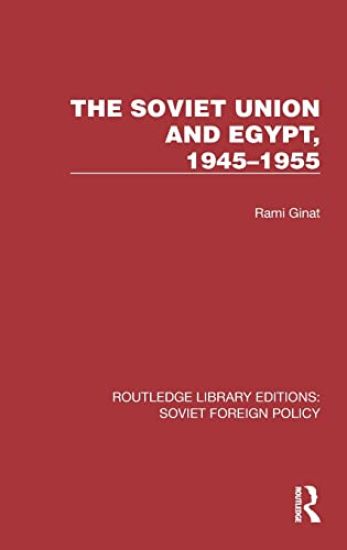
The Soviet Union and Egypt, 1945–1955

The Soviet Union and Egypt, 1945–1955

Rami Ginat

TAYLOR FRANCIS LTD
2024
nidottu
The Soviet Union and Egypt, first published in 1993, sheds new light on Soviet policy towards the Middle East after 1945. It seeks to uncover and analyse the events leading to the eventual domination of Egypt and other Arab countries by the Soviet Union. Soviet penetration into the region can only be understood by tracing the roots and motives of Soviet policy after the Second World War. The strengthening of Soviet influence resulted from a process of gradual political and ideological development in Egypt. Special attention is drawn to domestic and foreign developments in both countries, and the book makes extensive use of recently declassified documents and primary sources.
Egypt and the Struggle for Power in Sudan

Egypt and the Struggle for Power in Sudan

Rami Ginat

Cambridge University Press
2020
pokkari
For decades, the doctrine of the 'Unity of the Nile Valley' united Egyptians of a variety of political and nationalist backgrounds. Many Egyptians regarded Sudan as an integral part of their homeland, and therefore battled to rid the entire Nile Valley of British imperialism and unite its inhabitants under the Egyptian crown. Here, Rami Ginat provides a vital and important revised account of the history of Egypt's colonialist struggle and their efforts to prove categorically that the Nile Valley constituted a single territorial unit. These were clustered around several dominant theoretical layers: history, geography, economy, culture and ethnography. This book, for both Middle Eastern and African historians, uses a mixture of Arabic and English sources to critically examine the central stages in the historical development of Egypt's doctrine, concentrating on the defining decade (1943–1953) that first witnessed both the pinnacle of the doctrine's struggle and the subsequent shattering of a consensual nationalist dream.
Egypt and the Struggle for Power in Sudan

Egypt and the Struggle for Power in Sudan

Rami Ginat

Cambridge University Press
2017
sidottu
For decades, the doctrine of the 'Unity of the Nile Valley' united Egyptians of a variety of political and nationalist backgrounds. Many Egyptians regarded Sudan as an integral part of their homeland, and therefore battled to rid the entire Nile Valley of British imperialism and unite its inhabitants under the Egyptian crown. Here, Rami Ginat provides a vital and important revised account of the history of Egypt's colonialist struggle and their efforts to prove categorically that the Nile Valley constituted a single territorial unit. These were clustered around several dominant theoretical layers: history, geography, economy, culture and ethnography. This book, for both Middle Eastern and African historians, uses a mixture of Arabic and English sources to critically examine the central stages in the historical development of Egypt's doctrine, concentrating on the defining decade (1943–1953) that first witnessed both the pinnacle of the doctrine's struggle and the subsequent shattering of a consensual nationalist dream.
The Soviet Union and Egypt, 1945–1955

The Soviet Union and Egypt, 1945–1955

Rami Ginat

TAYLOR FRANCIS LTD
2022
sidottu
The Soviet Union and Egypt, first published in 1993, sheds new light on Soviet policy towards the Middle East after 1945. It seeks to uncover and analyse the events leading to the eventual domination of Egypt and other Arab countries by the Soviet Union. Soviet penetration into the region can only be understood by tracing the roots and motives of Soviet policy after the Second World War. The strengthening of Soviet influence resulted from a process of gradual political and ideological development in Egypt. Special attention is drawn to domestic and foreign developments in both countries, and the book makes extensive use of recently declassified documents and primary sources.
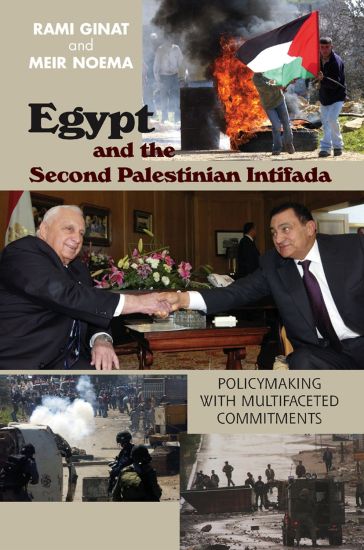
Egypt and the Second Palestinian Intifada

Egypt and the Second Palestinian Intifada

Rami Ginat; Meir Noema

Sussex Academic Press
2011
sidottu
With the outbreak of the Palestinian Intifadat al-Aqsa in September 2000 that followed the failure of the Camp David II summit, the chain of belligerent events took Egypt by surprise. Facing a dilemma in its search for an appropriate policy towards the Palestinian-Israeli escalation, this study argues that Egypt's policy towards the second Intifada may best be understood by scrutinising several circles of reference that directly affected its policymaking process throughout the long years of the bloody Israeli-Palestinian conflict. These circles of reference comprise interests and calculations derived from Egyptian internal issues; regional factors -- Egypt's role and position in the Arab world in general, and its relations with the Palestinians in particular; Egypt's relations with Israel; and its strategic ties with the United States. The growing strength and the expansion of the global Islamic terrorist network that challenges the stability of the present Arab regimes constitutes a lynchpin at every layer. Egypt's foreign policy is based on Realpolitik, that is, on pragmatic and material factors rather than on ideological or moral considerations. Safeguarding its national interests is Egypt's prime goal. In this regard, Egypt considers the peace with Israel as a strategic national asset. For Mubarak's regime, the abrogation of the peace treaty with Israel has never been an option, even during the worst days of the Intifada. Mubarak has shown exemplary restraint throughout the conflict. Despite occasional harsh anti-Israeli statements aimed mainly at easing internal and external pressures, Mubarak's regime can, on the whole, be seen as a responsible and stabilising factor vehemently striving to prevent regional escalation. This study is based primarily on Egyptian sources as well as interviews and conversations with senior members of the Al-Ahram Center for Strategic Studies. It also draws on other primary and secondary sources in Arabic, Hebrew and English. The book is essential reading for all scholars involved and engaged with the Israel-Arab conflict.
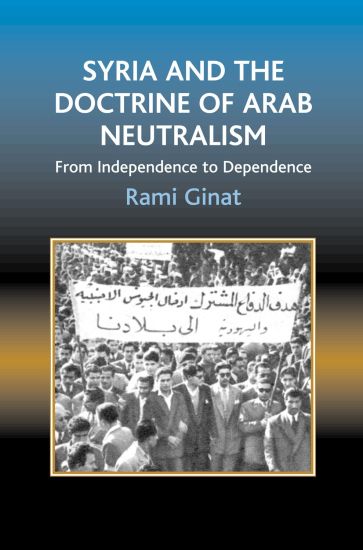
Syria and the Doctrine of Arab Neutralism

Syria and the Doctrine of Arab Neutralism

Rami Ginat

LIVERPOOL UNIVERSITY PRESS
2010
nidottu
This book examines the modern history of post-mandatory Syria. The evolution of the Syrian ideology and policy of neutralism since the early stages of the Cold War is explained, and the effects that Arab neutralism had on shaping Syria's foreign policy and the shaping of its national identity are identified. The phenomenon of Arab neutralism has never before been comprehensively investigated. The prevailing belief is that the formulation and realisation of the policy of anti-alignment began only during Nasser's first years in power in Egypt. However, the author demonstrates that the roots of neutralism were already sown in Arab soil in the early 1940s, and that successive Syrian governments carved out this policy during the final stages of World War II. A core issue in the analysis is the dynamic between ideology and policy. A conceptual framework is developed to explain the various patterns of neutralism that emerged, and the complex of relationships between features exhibited by Syria, the Arab world, and the Third World. The book makes extensive use of newly declassified material gleaned from archives in India, the former USSR, Poland, Britain, the United States and Israel; primary sources, studied and interpreted in the original Arabic, are also widely utilised.