Kirjojen hintavertailu. Mukana 12 595 353 kirjaa ja 12 kauppaa.

Kirjailija

Randall B. Lindsey

Kirjat ja teokset yhdessä paikassa: 5 kirjaa, julkaisuja vuosilta 2016-2022, suosituimpien joukossa Equity Partnerships. Vertaile teosten hintoja ja tarkista saatavuus suomalaisista kirjakaupoista.

5 kirjaa

Kirjojen julkaisuhaarukka 2016-2022.

Leading Change Through the Lens of Cultural Proficiency

Leading Change Through the Lens of Cultural Proficiency

Jaime E. Welborn; Tamika Casey; Keith T. Myatt; Randall B. Lindsey

SAGE PUBLICATIONS INC
2022
nidottu
The pathway to uncovering and dismantling inequities Educational leaders who work in the district, site, or classroom level know that opportunity gaps have long been a focus of education policy in the United States. Leadership can be a critical lever for advancing policies that oppose racism and confront systemic inequities. In meeting this challenge, educators have found that acknowledging beliefs and behaviors is critical. Still, deficit-based thinking, especially due to privilege, remains a barrier to equity. Among the most damaging blind spots is the continuation of practices that are grounded in the values of entitled groups. Leading Change Through the Lens of Cultural Proficiency tells the story of a school community in the midwest United States that contended with its approach to teaching and valuing students of diverse backgrounds. Featuring the research-based Cultural Proficiency Framework and Tools, the book provides a clear road map to advancing equity across schools and districts. Designed to support leaders and school communities in developing policies and practices that respond to the needs of all students, this book Guides school leaders in a journey of learning the theory and strategies that improved student achievement and improved the working conditions in this districtFeatures a real-life case study of a school community using the Tools of Cultural Proficiency and the FrameworkProvides vignettes and data, based on work conducted across an actual school district, that resulted in improvements in school climate, achievement, mindset, and equitable educational practicesIncludes powerful reflection, dialogic, and action activities for use in a variety of community learning modalitiesIs grounded in assets-based assumptions with respect to students, families, and the school community With a focus on engagement, leadership, implementation frameworks, and collaborative learning, the authors demonstrate how to uncover and remedy inequities. Designed for education leaders at all levels of the education system, this is the ideal foundational text for implementing Cultural Proficiency in your setting as you open doors for all students to thrive.
Culturally Proficient Coaching

Culturally Proficient Coaching

Delores B. Lindsey; Richard S. Martinez; Randall B. Lindsey; Keith T. Myatt

SAGE Publications Inc
2020
nidottu
Why a new edition of Culturally Proficient Coaching? Why now, especially? Because several polarizing years later, there’s even greater urgency for us all to critically examine our attitudes, beliefs, and practices when working with students who look or sound "different." No matter how broadly you define coach, no matter which coaching model you follow, this is the resource to help you get started. With the first edition, the authors’ big goal was to shift our thinking in service of standards-based teaching and leading, and equitable interactions that support all students achieving at highest levels. Now, with this second edition, the authors add a third goal: to encourage a more holistic mindset and expanded contextual uses. New features include: Enhanced research on the effectiveness of coaching in educational settings New data on response to implicit bias and microaggressions--subtle and unintentional, yet destructive, forms of discrimination that continue to marginalize Refinement and updating of the Tools of Cultural Proficiency, which enable you to provide equitable life-affirming experiences to all cultural groups Expanded models of Culturally Proficient Coaching Conversations A special section on crafting Breakthrough Questions to shift entrenched mindsets and barriers to Cultural Proficiency By design, Culturally Proficient Coaching is an intentional, inside-out approach that mediates a person’s thinking toward values, beliefs, and behaviors that enable effective cross-cultural interactions and equitable learning environments. Here’s your opportunity to serve as that expert and trusted mediator, boosting educators' cultural confidence and consciousness, while honing their coaching skills. "We owe it to ourselves and to our children to productively embrace and engage diversity, with all of its tensions, for the sustainability of humanity. These authors have given us the invitation, the road map, and the call to action. the embarkment is up to each one of us." --Carolyn M. McKanders, Director Emeritus Center for Adaptive Schools and Thinking Collaborative
Equity Partnerships

Equity Partnerships

Angela R. Clark-Louque; Randall B. Lindsey; Reyes L. Quezada; Cynthia L. Jew

SAGE Publications Inc
2020
nidottu
How often do you hear, "The only parents who showed were the parents who didn’t need to be here." But how often do you consider time of day, lack of child care, cost of dinner, transportation, lan­guage of the presentation, even relevance of the topic—all real-world barriers for families of our historically underserved students. Here at last is a resource that will open up access and reveal all-new ways to forge more culturally inclusive partnerships with families and communities . . . partnerships that extend well beyond parent-teacher conferences, PTA meetings, and the occasional bake sale. The two big services Equity Partnerships provides? Using the Tools of Cultural Proficiency, you’ll Discover new concepts and strategies to engage families and communities—and reduce, if not eliminate, barriers--through four essential principles: communication, connection, collaboration, and communityEngage in frequent opportunities to reflect on your own assumptions and values, then collaborate with colleagues to co-create systemic practices and policies for devising, implementing, and assessing family and community engagement actions in your schools and districts We know inherently that family and community engagement is critical to the success of our stu­dents. Let Equity Partnerships be your go-to tool for breaking down the walls that for too long have limited all of us. "Raising the next generation is a shared responsibility and privilege. These authors have been first responders for decades by pro­moting Cultural Proficiency as a means to ensure equity and access for all. In Equity Partnerships, they identify the powerful and critical link of family, school, and community engage­ment to strengthen families, build community support, and increase student success." --TRUDY ARRIAGA, Associate Dean for Equity and Outreach, California Lutheran University, and Coauthor of Opening Doors
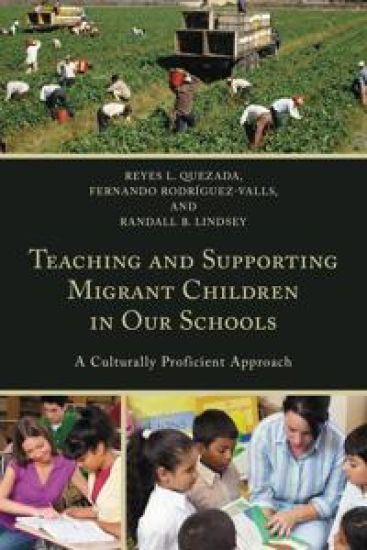
Teaching and Supporting Migrant Children in Our Schools

Teaching and Supporting Migrant Children in Our Schools

Reyes L. Quezada; Fernando Rodriguez-Valls; Randall B. Lindsey

Rowman Littlefield
2016
nidottu
General approaches to multiculturalism run the risk of overlooking an increasingly diverse student population that deserves special consideration and attention: students from immigrant backgrounds whose families toil the fields in order to provide better educational opportunities for their children. This book’s purpose is to guide educators to think deeply about their roles and responsibilities in the education of children of farmworker families in our nation’s schools. Readers will view their classrooms, schools, districts, and the migrant programs they lead in a broad and inclusive manner through the lens of cultural proficiency. The initial steps when embracing cultural proficiency entails thinking reflectively about one’s own values and behaviors and the school’s policies and practices toward children of farmworker families. Cultivating a willingness, openness and commitment to meeting the challenges and opportunities of this often-invisible aspect of diversity is an important first step for the development of effective educational practices for migrant students and their families. The cultural proficiency framework can inform staff development models for working effectively with migrant students and their families.
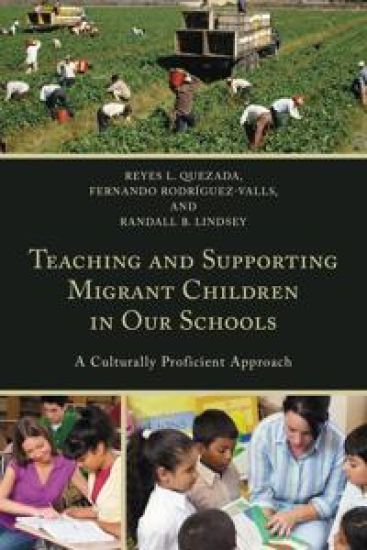
Teaching and Supporting Migrant Children in Our Schools

Teaching and Supporting Migrant Children in Our Schools

Reyes L. Quezada; Fernando Rodriguez-Valls; Randall B. Lindsey

Rowman Littlefield
2016
sidottu
General approaches to multiculturalism run the risk of overlooking an increasingly diverse student population that deserves special consideration and attention: students from immigrant backgrounds whose families toil the fields in order to provide better educational opportunities for their children. This book’s purpose is to guide educators to think deeply about their roles and responsibilities in the education of children of farmworker families in our nation’s schools. Readers will view their classrooms, schools, districts, and the migrant programs they lead in a broad and inclusive manner through the lens of cultural proficiency. The initial steps when embracing cultural proficiency entails thinking reflectively about one’s own values and behaviors and the school’s policies and practices toward children of farmworker families. Cultivating a willingness, openness and commitment to meeting the challenges and opportunities of this often-invisible aspect of diversity is an important first step for the development of effective educational practices for migrant students and their families. The cultural proficiency framework can inform staff development models for working effectively with migrant students and their families.