Kirjojen hintavertailu. Mukana 12 595 353 kirjaa ja 12 kauppaa.

Kirjailija

Randy E. Barnett

Kirjat ja teokset yhdessä paikassa: 7 kirjaa, julkaisuja vuosilta 1991-2025, suosituimpien joukossa Slavery, Equality, and the American Revolution. Vertaile teosten hintoja ja tarkista saatavuus suomalaisista kirjakaupoista.

Mukana myös kirjoitusasut: Randy E Barnett

7 kirjaa

Kirjojen julkaisuhaarukka 1991-2025.

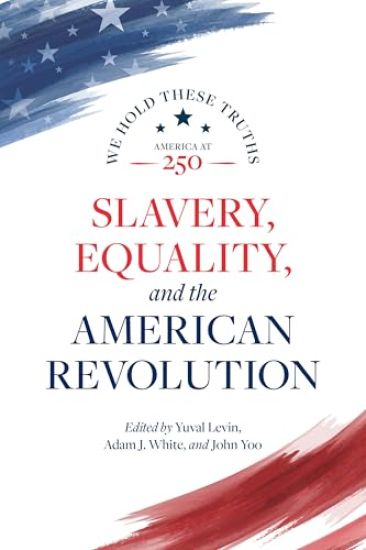
Slavery, Equality, and the American Revolution

Slavery, Equality, and the American Revolution

Randy E Barnett; Justin Driver; Kurt T Lash; Lucas E Morel; Diana Schaub

AEI PRESS
2025
pokkari
The year 2026 marks the 250th anniversary of American independence, yet the nation's founding is controversial now in ways it has not been in decades. The American Enterprise Institute offers a major intellectual and educational project to reintroduce Americans to the unique value of their national inheritance. In the fifth volume of this series, legal scholars and political scientists discuss how the American Revolution both perpetuated slavery and created the conditions for its abolition. While hundreds of thousands of African Americans remained enslaved at the end of the Revolutionary War, the Declaration of Independence's assertion of human equality galvanized slavery's opponents and laid the groundwork for increasingly egalitarian definitions of American citizenship. Considering how the Declaration shaped antislavery thinkers and politicians such as Frederick Douglass and Abraham Lincoln and informed the 14th Amendment demonstrates how the American Revolution enabled a "new birth of freedom" in the 19th century.

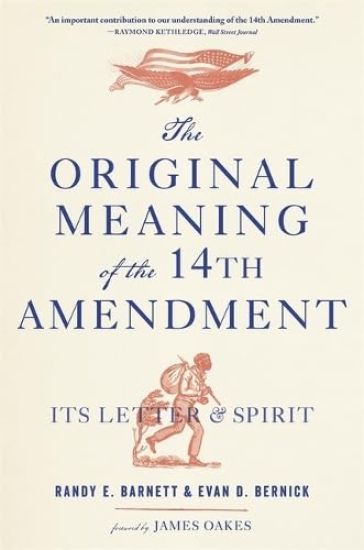
The Original Meaning of the Fourteenth Amendment

The Original Meaning of the Fourteenth Amendment

Randy E. Barnett; Evan D. Bernick; James Oakes

HARVARD UNIVERSITY PRESS
2024
nidottu
A Federalist Notable Book“An important contribution to our understanding of the 14th Amendment.”—Wall Street Journal“By any standard an important contribution…A must-read.”—National Review“The most detailed legal history to date of the constitutional amendment that changed American law more than any before or since…The corpus of legal scholarship is richer for it.”—Washington ExaminerAdopted in 1868, the Fourteenth Amendment profoundly changed the Constitution, giving the federal judiciary and Congress new powers to protect the fundamental rights of individuals from being violated by the states. Yet, the Supreme Court has long misunderstood or ignored the original meaning of its key Section I clauses.Barnett and Bernick contend that the Fourteenth Amendment must be understood as the culmination of decades of debate about the meaning of the antebellum Constitution. In the course of this debate, antislavery advocates advanced arguments informed by natural rights, the Declaration of Independence, and the common law, as well as what is today called public-meaning originalism.The authors show how these arguments and the principles of the Declaration in particular eventually came to modify the Constitution. They also propose workable doctrines for implementing the amendment’s key provisions covering the privileges and immunities of citizenship, due process, and equal protection under the law.
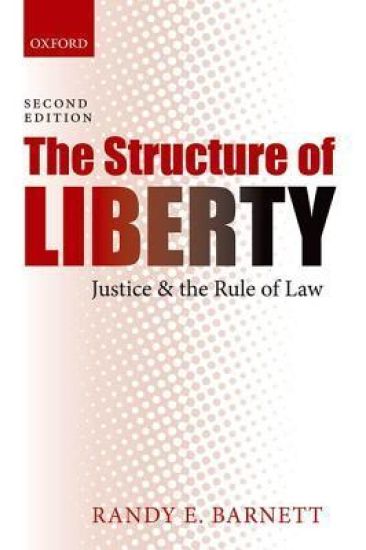
The Structure of Liberty

The Structure of Liberty

Randy E. Barnett

Oxford University Press
2014
nidottu
In this book, legal scholar Randy Barnett elaborates and defends the fundamental premise of the Declaration of Independence: that all persons have a natural right to pursue happiness so long as they respect the equal rights of others, and that governments are only justly established to secure these rights. Drawing upon insights from philosophy, economics, political theory, and law, Barnett explains why, when people pursue happiness while living in society with each other, they confront the pervasive social problems of knowledge, interest and power. These problems are best dealt with by ensuring the liberty of the people to pursue their own ends, but this liberty is distinguished from "license" by certain fundamental rights and procedures associated with the classical liberal conception of "justice" and "the rule of law." He then outlines the constitutional framework that is needed to put these principles into practice. In a new Afterword to this second edition, Barnett elaborates on this thesis by responding to several important criticisms of the original work. He then explains how this "libertarian" approach is more modest than either the "social justice" theories of the left or the "legal moralism" of the right.
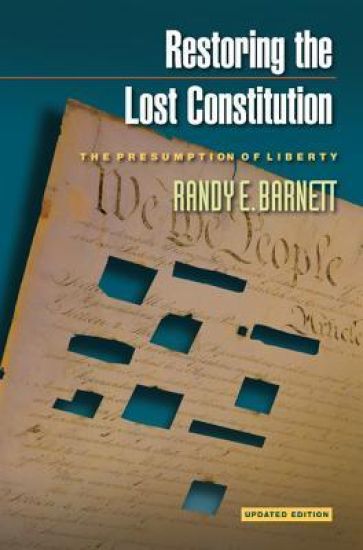
Restoring the Lost Constitution

Restoring the Lost Constitution

Randy E. Barnett

Princeton University Press
2013
pokkari
The U.S. Constitution found in school textbooks and under glass in Washington is not the one enforced today by the Supreme Court. In Restoring the Lost Constitution, Randy Barnett argues that since the nation's founding, but especially since the 1930s, the courts have been cutting holes in the original Constitution and its amendments to eliminate the parts that protect liberty from the power of government. From the Commerce Clause, to the Necessary and Proper Clause, to the Ninth and Tenth Amendments, to the Privileges or Immunities Clause of the Fourteenth Amendment, the Supreme Court has rendered each of these provisions toothless. In the process, the written Constitution has been lost. Barnett establishes the original meaning of these lost clauses and offers a practical way to restore them to their central role in constraining government: adopting a "presumption of liberty" to give the benefit of the doubt to citizens when laws restrict their rightful exercises of liberty. He also provides a new, realistic and philosophically rigorous theory of constitutional legitimacy that justifies both interpreting the Constitution according to its original meaning and, where that meaning is vague or open-ended, construing it so as to better protect the rights retained by the people. As clearly argued as it is insightful and provocative, Restoring the Lost Constitution forcefully disputes the conventional wisdom, posing a powerful challenge to which others must now respond. This updated edition features an afterword with further reflections on individual popular sovereignty, originalist interpretation, judicial engagement, and the gravitational force that original meaning has exerted on the Supreme Court in several recent cases.
The Oxford Introductions to U.S. Law

The Oxford Introductions to U.S. Law

Randy E. Barnett

Oxford University Press Inc
2010
nidottu
Written by the leading expert in the field, The Oxford Introductions to U.S. Law: Contracts provides students with ready access to the basic doctrines of contract law, the story behind their evolution, and the rationales for their continued existence. An engaging book that allows students to grasp the "big picture" of contract law, it is organized around the principle that lies at the heart of contracts: consent. Beginning with the premise of "consent," the book provides a cohesive framework in which to understand the various aspects of contract law.
The Rights Retained by the People

The Rights Retained by the People

Randy E. Barnett

George Mason University Press
1991
pokkari
This anthology of scholarship by distinguished legal academicians on the Ninth Amendment of the U.S. Constitution comes at a time when interest in the Ninth Amendment is on the rise. The Rights Retained by the People brings together in one volume the critical writings on the Ninth Amendment, from the first published article (1936) to several important articles published in the 1980s. This invaluable anthology is an essential addition to constitutional law collections. Contributors: James Madison, Edward S. Corwin, Knowlton H. Kelsey, Bennett B. Patterson, Norman Redlich, Eugene M. Van Loan, III, Randy E. Barnett, John Hart Ely, Raoul Berger, Simeon C.R. McIntosh, Russell L. Caplan, Calvin R. Massey, and Charles L. Black, Jr. Co-published with the Cato Institute.