Kirjojen hintavertailu. Mukana 12 657 676 kirjaa ja 12 kauppaa.

Kirjailija

Ravi Rikhye

Kirjat ja teokset yhdessä paikassa: 9 kirjaa, julkaisuja vuosilta 2004-2026, suosituimpien joukossa Pakistan Air Force. Vertaile teosten hintoja ja tarkista saatavuus suomalaisista kirjakaupoista.

9 kirjaa

Kirjojen julkaisuhaarukka 2004-2026.

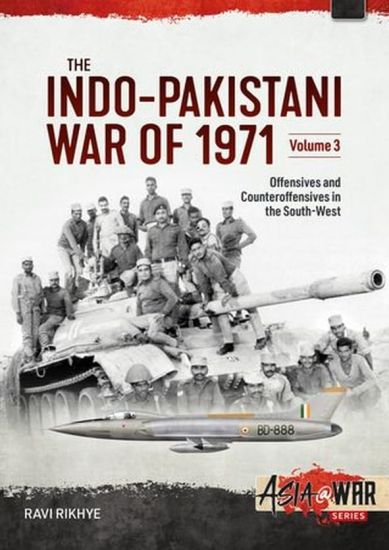
The Indo-Pakistani War of 1971 Volume 3
The Indo-Pakistani War of 1971, Volume 3 is a highly authoritative and richly illustrated account of the war during which Bangladesh was born as an independent state. This volume details the offensives and counteroffensives on the south-western section of the India-Pakistan border.In 1947, India and Pakistan were partitioned by their former colonial ruler, Great Britain, leaving unresolved the issue of Kashmir. This triggered wars between the new states in 1947-48, 1965, 1971 and a continuing insurgency/counterinsurgency.Late in the afternoon of 3 December 1971, in an attempt to distract New Delhi from developments in its eastern wing, Pakistan initiated hostilities with India by flying a series of air strikes against the forward air bases of the Indian Air force. Thus began the 'official' part of the India-Pakistan War of 1971, a bitter conventional war of the highest intensity in the history of the two countries since their independence. During the following weeks, a series of pitched battles took place as the two parties began exchanging blows almost everywhere along their 2,000-kilometre long mutual borders. By 16 December, and rather suddenly, the conflict was over: once East Pakistan had been overrun by India, Islamabad had no incentive to continue fighting a war it could not possibly win. Through the extensive use of official records and participant recollections, rare photography and authentic color profiles, Ravi Rikhye tells the captivating story of the biggest military conflict fought between India and Pakistan to date, and the war that resulted in the emergence of Bangladesh as an independent nation.The third volume of The Indo-Pakistani War of 1971 examines the events on the battlefields of the south-western border area between India and Pakistan and is extensively illustrated with photographs and includes specially commissioned color artworks.
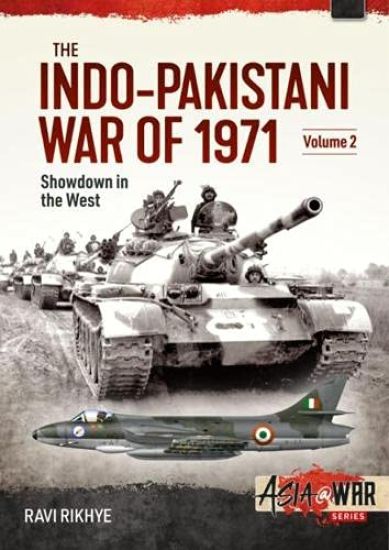
The Indo-Pakistani War of 1971, Volume 2
In 1947, India and Pakistan were partitioned by their former colonial ruler, Great Britain. A job that should have taken ten-years was done in a few months. Britain, drained by two world wars in 40-years no longer had the will or the money to guide the subcontinent to a peaceful partition by consensus. More importantly, the subcontinent was impatient for Britain’s departure. The British left in haste, leaving unresolved the issue of Kashmir. This triggered a number of wars between the new states: 1947-48, 1965, 1971 and a continuing insurgency/counterinsurgency that began in 1987. Two other potential wars were narrowly averted in 1987-88 and 2001-02, and a further limited war was fought in 1999. Since the basic issue remains unresolved, the next war may be only a matter of time. Late in the afternoon of 3 December 1971, in an attempt to distract New Delhi from developments in its eastern wing, Pakistan initiated hostilities with India by flying a series of air strikes against the forward air bases of the Indian Air force. Thus began the 'official' part of the India-Pakistan War of 1971, a bitter conventional war of the highest intensity in the history of the two countries since their independence. During the following weeks, a series of pitched battles took place as the two parties began exchanging blows almost everywhere along their 2,000-kilometre long mutual borders. By 16 December, and rather suddenly, the conflict was over: once East Pakistan had been overrun by India, Islamabad had no incentive to continue fighting a war it could not possibly win. Through the extensive use of official records and participant recollections, rare photography and authentic colour profiles, Ravi Rikhye tells the captivating story of the biggest military conflict fought between India and Pakistan to date, and the war that resulted in the emergence of Bangladesh as an independent nation.
Indo-Pakistani War of 1971

Indo-Pakistani War of 1971

Ravi Rikhye

Helion Company
2020
nidottu
In 1947, India and Pakistan were partitioned by their former colonial ruler, Great Britain. A job that should have taken ten-years was done in a few months. Britain, drained by two world wars in 40-years, no longer had the will or the money to guide the subcontinent to a peaceful partition by consensus. More importantly, the subcontinent was impatient for Britain’s departure. The British left in haste, leaving unresolved the issue of Kashmir. This triggered five wars between the new states: 1947-48, 1965, 1971, 1999 and continuing insurgency/counterinsurgency that began in 1987. Two other potential wars were narrowly averted in 1987-88 and 2001-02, and a limited one fought in 1999. Since the basic issue remains unresolved, the next war may be only a matter of time. In 1970, East Pakistan voted for independence and armed rebellion. A quick and nasty counterinsurgency suppressed the rebellion. India, seizing the chance to change the balance of power, first backed East Pakistan, then on 21 and 22 November 1971 invaded with eight divisions. India planned also to attack West Pakistan to recover Kashmir, but at the last moment the offensive was called off due to Soviet pressure. Pakistan attacked pre-emptively, and an all-out war resulted. East Pakistan was overrun by India on 16 December; the US and Soviet forced a ceasefire in the West only a day later. For the first time in 800 years, a predominantly Hindu army defeated a Muslim army. Through extensive use of official records and participant recollections, rare photography and authentic colour profiles, Ravi Rikhye tells the captivating story of the biggest military conflict fought between India and Pakistan to date, and the war that resulted in emergence of Bangladesh as an independent nation.
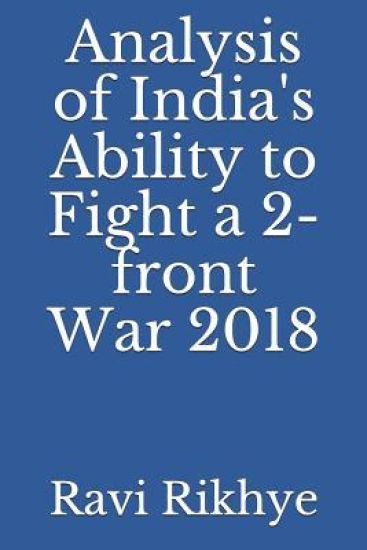
Analysis of India's Ability to Fight a 2-Front War 2018
The analysis asks one question and has one answer: Can India fight a two-front war against China and Pakistan? The answer is it cannot. Because of the China-Pakistan alliance, we cannot fight even a one-front war: engaging in a war with either adversary runs the risk of weakening the other front, leaving it open to exploitation. The solution, fortunately, is straightforward: build a 2-front war capability. The next problem is equally straightforward: The Government of India is determined not to spend money on defense. Today spending is down to 1.56% of GDP, lower even than in 1962. And we know how that ended. It takes little imagination to foresee what would have happened if 1962 had become 2-front: Pakistan would have walked over Punjab, perhaps all the way to Delhi, and we would have lost Kashmir too. If we chose to defend Punjab, we would have lost the North East Frontier Agency, now called Arunachal. If we tried to defend both fronts, we would have lost both. For a strong defensive posture, we need to spend the 3
Concise World Armies 2005

Concise World Armies 2005

Richard B Borenstein; Ravi Rikhye; Larry J Smith

General Data LLC
2004
pokkari
From Orbat.info's global intelligence network comes Orders of Battle for the world's armies, from Abkhazia to Zimbabwe. Available to the pubic for the first time. (Technology & Industrial Arts)