Kirjojen hintavertailu. Mukana 12 595 353 kirjaa ja 12 kauppaa.

Kirjailija

Raymond A. Smith

Kirjat ja teokset yhdessä paikassa: 7 kirjaa, julkaisuja vuosilta 2002-2021, suosituimpien joukossa Gay and Lesbian Americans and Political Participation. Vertaile teosten hintoja ja tarkista saatavuus suomalaisista kirjakaupoista.

7 kirjaa

Kirjojen julkaisuhaarukka 2002-2021.

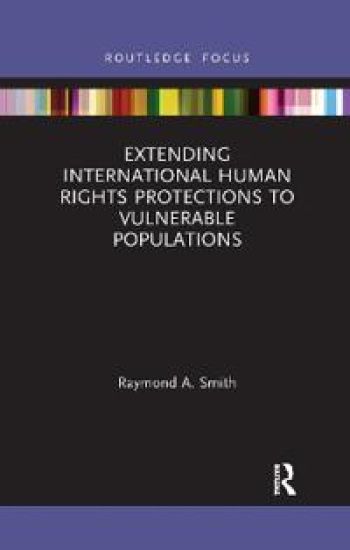
Extending International Human Rights Protections to Vulnerable Populations
This book inductively develops a new typology that identifies and evaluates three principal strategies that have been, and are being, used to extend international human rights protections to new categories of vulnerable populations. The book explicates the evolution and ongoing utility of the three strategies: categorical enlargement, conceptual expansion, and group-conscious universal application. The strategies are elucidated by case studies of nine distinct vulnerable populations: national minorities; those oppressed on the basis of caste; people with albinism; cross-cultural migrants; members of the African diaspora; Roma/Gypsies; persons affected by leprosy; older individuals; and lesbian, gay, bisexual, and transgender (LGBT) people. The book concludes by considering the utility of the three strategies for emerging vulnerable populations. It encourages discourse about the protection of vulnerable populations to move beyond a stale fixation on the texts of treaties and towards a more proactive normative framework that prioritizes the lived experiences of human beings. Extending International Human Rights Protections to Vulnerable Populations will be of key interest to students and scholars of international human rights, to social justice advocates, to human rights practitioners, and to those working with oppressed groups, human rights law, and international relations.

Extending International Human Rights Protections to Vulnerable Populations
This book inductively develops a new typology that identifies and evaluates three principal strategies that have been, and are being, used to extend international human rights protections to new categories of vulnerable populations. The book explicates the evolution and ongoing utility of the three strategies: categorical enlargement, conceptual expansion, and group-conscious universal application. The strategies are elucidated by case studies of nine distinct vulnerable populations: national minorities; those oppressed on the basis of caste; people with albinism; cross-cultural migrants; members of the African diaspora; Roma/Gypsies; persons affected by leprosy; older individuals; and lesbian, gay, bisexual, and transgender (LGBT) people. The book concludes by considering the utility of the three strategies for emerging vulnerable populations. It encourages discourse about the protection of vulnerable populations to move beyond a stale fixation on the texts of treaties and towards a more proactive normative framework that prioritizes the lived experiences of human beings. Extending International Human Rights Protections to Vulnerable Populations will be of key interest to students and scholars of international human rights, to social justice advocates, to human rights practitioners, and to those working with oppressed groups, human rights law, and international relations.

The American Anomaly

The American Anomaly

Raymond A. Smith

Routledge
2018
nidottu
The American Anomaly systematically analyzes the U.S. political system by way of comparison with other countries, especially other industrialized democracies. It is organized into four sections, respectively covering the constitutional order, governmental institutions, political participation, and public policy. Extended case studies and examples in each chapter draw on all the major regions of the world.Thoroughly revised throughout, the fourth edition includes: Updates to reflect events including the anomalous presidential election of 2016, the start of the unconventional presidency of Donald Trump, and shifting partisan dynamics within Congress. Coverage of recent political developments such as the Black Lives Matter and Antifa left-wing groups, the rise of the Alt-Right and resurgent nationalism, and youth-led movements for immigration reform and gun violence prevention. A newly developed chapter offering a comparative perspective on U.S. public opinion and mass media, including social media; includes a new case study focused on post-Communist Russia and a chart on comparative freedom of the press. The contextualizing of emerging political memes such as "fake news," "alternative facts," the "deep state," "Brexit," and "#MeToo". Updates to examples from other countries, including challenges to the European Union; the aftermath of the Arab Uprisings; recent political upheavals in Venezuela, Zimbabwe, South Korea, and Brazil; the global reassertion of Russian power and its possible manipulation of the US election; and the steady growth of China’s global military and economic role. A substantive update to the domestic policy chapter, in light of the return of unified Republican control in Washington DC, and to the foreign policy chapter, taking into account isolationist and unlateralist thinking in the Trump administration. Updated tables and charts comparing major democratic political systems; expanded further reading suggestions; and revised discussion questions and Web-based exercises throughout the book.
The American Anomaly

The American Anomaly

Raymond A. Smith

Routledge
2018
sidottu
The American Anomaly systematically analyzes the U.S. political system by way of comparison with other countries, especially other industrialized democracies. It is organized into four sections, respectively covering the constitutional order, governmental institutions, political participation, and public policy. Extended case studies and examples in each chapter draw on all the major regions of the world.Thoroughly revised throughout, the fourth edition includes: Updates to reflect events including the anomalous presidential election of 2016, the start of the unconventional presidency of Donald Trump, and shifting partisan dynamics within Congress. Coverage of recent political developments such as the Black Lives Matter and Antifa left-wing groups, the rise of the Alt-Right and resurgent nationalism, and youth-led movements for immigration reform and gun violence prevention. A newly developed chapter offering a comparative perspective on U.S. public opinion and mass media, including social media; includes a new case study focused on post-Communist Russia and a chart on comparative freedom of the press. The contextualizing of emerging political memes such as "fake news," "alternative facts," the "deep state," "Brexit," and "#MeToo". Updates to examples from other countries, including challenges to the European Union; the aftermath of the Arab Uprisings; recent political upheavals in Venezuela, Zimbabwe, South Korea, and Brazil; the global reassertion of Russian power and its possible manipulation of the US election; and the steady growth of China’s global military and economic role. A substantive update to the domestic policy chapter, in light of the return of unified Republican control in Washington DC, and to the foreign policy chapter, taking into account isolationist and unlateralist thinking in the Trump administration. Updated tables and charts comparing major democratic political systems; expanded further reading suggestions; and revised discussion questions and Web-based exercises throughout the book.
The Politics of Sexuality

The Politics of Sexuality

Raymond A. Smith

Greenwood Press
2010
sidottu
Since the landmark 1965 Supreme Court ruling Griswold v. Connecticut established a Constitutional right to privacy, the regulation of sexuality has become an extremely volatile area of American politics. From reproductive rights to sex education, pornography to gay marriage, the balance between community norms and individual autonomy has been fiercely contested. These and related subjects are often viewed in isolation, as though they were entirely separate issues. Yet as the documentary record makes clear, they are in fact closely interrelated, and their impact is cumulative. By addressing a broad array of topics at the intersection of sexuality and politics, this volume highlights the connections and makes an important contribution to a debate that touches every American.Taking as a starting point the 1965 Griswold decision—sometimes said to have launched the sexual revolution—the approximately 100 primary source documents assembled here either mark watersheds in themselves or are representative of a broad range of political developments. The documents are drawn from all quarters of U.S. political life. They include legislative texts; proposed laws and constitutional amendments; state and federal court rulings; political party platforms; and interest-group position statements.
Drugs into Bodies

Drugs into Bodies

Raymond A. Smith; Patricia D. Siplon

Praeger Publishers Inc
2006
sidottu
Drugs into Bodies recounts the emergence and development of a globally oriented AIDS treatment activist movement that refused to accept that more than 40 million people with HIV in the developing world should simply be left to die. Rooted in earlier AIDS activist efforts, this new movement has forged a global network dedicated to providing universal access to life-saving medications.More than 40 million people are living with HIV/AIDS worldwide, yet only a small fraction have access to life-saving treatments. For many years, governments, pharmaceutical companies, and even some international relief agencies have called this a tragic but unavoidable situation, given the high cost of the medications used to fight HIV. A small but growing group of activists, however, have banded together to prove that the obstacles to universal HIV treatments are mostly human-made, and thus can be overcome by human actions.Drugs into Bodies chronicles the birth and expansion of the global AIDS treatment activist movement, focusing in particular on the U.S.-based organization Health GAP. Drawing on the legacy of the protest group ACT UP and other earlier AIDS activism, Health GAP and like-minded allies have forged a global network to combat the AIDS crisis in Africa and throughout the developing world. From the White House to the United Nations, from plush corporate offices to South African shantytowns, AIDS treatment activists have defied the dictates of globalization, altered government policies, shamed multinational corporations, secured funding for treatment, and brought hope to millions of people with HIV.
Gay and Lesbian Americans and Political Participation

Gay and Lesbian Americans and Political Participation

Raymond A. Smith; Donald P. Haider-Markel

ABC-CLIO
2002
sidottu
A groundbreaking volume surveying the contributions that gay and lesbian Americans have made to the democratic process. In 1969, when lesbian, gay, bisexual, and transgender (LGBT) people first participated as a group in the political process, they faced an imposing array of obstacles. Everything from personal rejection and violence; state anti-sodomy laws; exclusion from the armed forces; and legal discrimination in employment, housing, credit, consumer service, and public accommodations. Nevertheless, by the end of the millennium, LGBT people had transformed themselves into a well-organized and begrudgingly respected political force. In the process, they dramatically changed laws and attitudes across the nation. This new volume tells the story of the rapid growth and remarkable successes of the LGBT movement—a record that makes it one of the most successful social movements in U.S. history and, ironically, the least studied.