Kirjojen hintavertailu. Mukana 12 390 323 kirjaa ja 12 kauppaa.

Kirjailija

Raymond J. DeMallie

Kirjat ja teokset yhdessä paikassa: 7 kirjaa, julkaisuja vuosilta 1984-2019, suosituimpien joukossa A Whirlwind Passed through Our Country. Vertaile teosten hintoja ja tarkista saatavuus suomalaisista kirjakaupoista.

7 kirjaa

Kirjojen julkaisuhaarukka 1984-2019.

A Whirlwind Passed through Our Country

A Whirlwind Passed through Our Country

Rani-Henrik Andersson; Raymond J. DeMallie

University of Oklahoma Press
2019
nidottu
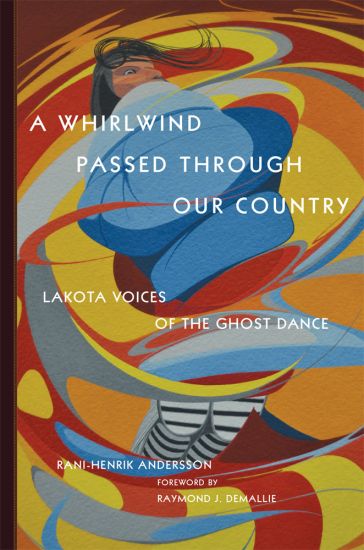
The inception of the Ghost Dance religion in 1890 marked a critical moment in Lakota history. Yet, because this movement alarmed government officials, culminating in the infamous massacre at Wounded Knee of 250 Lakota men, women, and children, historical accounts have most often described the Ghost Dance from the perspective of the white Americans who opposed it. In A Whirlwind Passed through Our Country, historian Rani-Henrik Andersson instead gives Lakotas a sounding board, imparting the multiplicity of Lakota voices on the Ghost Dance at the time. Whereas early accounts treated the Ghost Dance as a military or political movement, A Whirlwind Passed through Our Country stresses its peaceful nature and reveals the breadth of Lakota views on the subject. The more than one hundred accounts compiled here show that the movement caused friction within Lakota society even as it spurred genuine religious belief. These accounts, many of them never before translated from the original Lakota or published, demonstrate that the Ghost Dance's message resonated with Lakotas across artificial ""progressive"" and ""nonprogressive"" lines. Although the movement was often criticized as backward and disconnected from the harsh realities of Native life, Ghost Dance adherents were in fact seeking new ways to survive, albeit not those that contemporary whites envisioned for them. The Ghost Dance, Andersson suggests, might be better understood as an innovative adaptation by the Lakotas to the difficult situation in which they found themselves - and as a way of finding a path to a better life. By presenting accounts of divergent views among the Lakota people, A Whirlwind Passed through Our Country expands the narrative of the Ghost Dance, encouraging more nuanced interpretations of this significant moment in Lakota and American history.
A Cheyenne Voice

A Cheyenne Voice

John Stands In Timber; Margot Liberty; Raymond J. DeMallie

University of Oklahoma Press
2019
nidottu
Rarely does a primary source become available that provides new and significant information about the history and culture of a famous American Indian tribe. With A Cheyenne Voice, readers now have access to a vast ethnographic and historical trove about the Cheyenne people - much of it previously unavailable.A Cheyenne Voice contains the complete transcribed interviews conducted by anthropologist Margot Liberty with Northern Cheyenne elder John Stands In Timber (1882-1967). Recorded by Liberty in 1956-1959 when she was a schoolteacher on the Northern Cheyenne Indian Reservation in southeastern Montana, the interviews were the basis of the well-known 1967 book Cheyenne Memories. While that volume is a noteworthy edited version of the interviews, this volume presents them word for word, in their entirety, for the first time. Along with memorable candid photographs, it also features a unique set of maps depicting movements by soldiers and warriors at the Battle of the Little Bighorn. Drawn by Stands In Timber himself, they are reproduced here in full color. The diverse topics that Stands In Timber addresses range from traditional stories to historical events, including the battles of Sand Creek, Rosebud, and Wounded Knee. Replete with absorbing, and sometimes even humorous, details about Cheyenne tradition, warfare, ceremony, interpersonal relations, and everyday life, the interviews enliven and enrich our understanding of the Cheyenne people and their distinct history.
A Whirlwind Passed through Our Country

A Whirlwind Passed through Our Country

Rani-Henrik Andersson; Raymond J. DeMallie

University of Oklahoma Press
2018
sidottu
The inception of the Ghost Dance religion in 1890 marked a critical moment in Lakota history. Yet, because this movement alarmed government officials, culminating in the infamous massacre at Wounded Knee of 250 Lakota men, women, and children, historical accounts have most often described the Ghost Dance from the perspective of the white Americans who opposed it. In A Whirlwind Passed through Our Country, historian Rani-Henrik Andersson instead gives Lakotas a sounding board, imparting the multiplicity of Lakota voices on the Ghost Dance at the time. Whereas early accounts treated the Ghost Dance as a military or political movement, A Whirlwind Passed through Our Country stresses its peaceful nature and reveals the breadth of Lakota views on the subject. The more than one hundred accounts compiled here show that the movement caused friction within Lakota society even as it spurred genuine religious belief. These accounts, many of them never before translated from the original Lakota or published, demonstrate that the Ghost Dance's message resonated with Lakotas across artificial ""progressive"" and ""nonprogressive"" lines. Although the movement was often criticized as backward and disconnected from the harsh realities of Native life, Ghost Dance adherents were in fact seeking new ways to survive, albeit not those that contemporary whites envisioned for them. The Ghost Dance, Andersson suggests, might be better understood as an innovative adaptation by the Lakotas to the difficult situation in which they found themselves - and as a way of finding a path to a better life. By presenting accounts of divergent views among the Lakota people, A Whirlwind Passed through Our Country expands the narrative of the Ghost Dance, encouraging more nuanced interpretations of this significant moment in Lakota and American history.
Transforming Ethnohistories

Transforming Ethnohistories

Raymond J. DeMallie

University of Oklahoma Press
2013
nidottu
Anthropologists need history to understand how the past has shaped the present. Historians need anthropology to help them interpret the past. Where anthropologists' and historians' needs intersect is ethnohistory. The contributors to this volume have been inspired in large part by the teaching and writing of distinguished ethnohistorian Raymond J. DeMallie, whose exemplary combination of ethnographic and archival research demonstrates the ways anthropology and history can work together to create an understanding of the past and the present. Transforming Ethnohistories comprises ten new avenues of ethnohistorical research ranging in topic from fiddling performances to environmental disturbance and spanning places from North Carolina to the Yukon. The authors seek to understand communities by finding and interpreting their stories in a variety of different texts, some of which lie outside academic understanding and research methodology. It is exactly those stories, conventionally labeled ""myths"" or ""oral tradition,"" that ethnohistorians demand we pay attention to. Although historians cannot see or talk to their informants as anthropologists do, both anthropologists and historians can listen to oral histories and written documents for the essential stories they contain. The essays assembled here use DeMallie's approach to contribute to the history and anthropology of Native North America and address issues of literary criticism and contexts, sociolinguistics, performance theory, identity and historical change, historical and anthropological methods and theory, and the interpretation of histories, cultures, and stories. Debates over the legitimacy of ethnohistory as a specialization have led some scholars to declare its decline. This volume shows ethnohistory to be alive and well and continuing to attract young scholars.
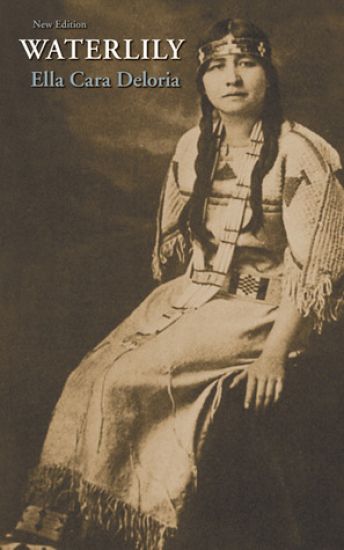
Waterlily

Waterlily

Ella Cara Deloria; Raymond J. DeMallie

Bison Books
2009
pokkari
“Exquisite evocation, in novelistic form, of the life of a female Dakota (Sioux) in the mid-nineteenth century, before whites settled the plains. . . . An unself-conscious and never precious or quaint pairing of scholarship and fiction.”-KirkusWhen Blue Bird and her grandmother leave their family’s camp to gather beans for the long, threatening winter, they inadvertently avoid the horrible fate that befalls the rest of the family. Luckily, the two women are adopted by a nearby Dakota community and are eventually integrated into their kinship circles. Ella Cara Deloria’s tale follows Blue Bird and her daughter, Waterlily, through the intricate kinship practices that created unity among her people. Waterlily, published after Deloria’s death and generally viewed as the masterpiece of her career, offers a captivating glimpse into the daily life of the nineteenth-century Sioux.This new Bison Books edition features an introduction by Susan Gardner and an index.
Documents of American Indian Diplomacy (2 volume set)

Documents of American Indian Diplomacy (2 volume set)

Vine Deloria; Raymond J. DeMallie

University of Oklahoma Press
1999
sidottu
Reproduced in this two-volume set are hundreds of treaties and agreements made by Indian nations - with, among others, the Continental Congress; England, Spain, and other foreign countries; the Republic of Texas and the Confederate States; railroad companies seeking rights-of-way across Indian land; and other Indian nations. Many were made with the United States but either remained unratified by Congress or were rejected by the Indians themselves after the Senate amended them. Many others are ""agreements"" made after U.S. treaty making with Indian tribes officially ended in 1871. These documents - augmented by chapter introductions that concisely set each type of treaty in its historical and political context - these documents effectively trace the evolution of American Indian diplomacy in the United States. This volume is the first major accessible compilation since Charles Kappler's 1904 Indian Affairs, Laws and Treaties. As a group, these documents highlight American Indians' roles as active agents in international diplomatic affairs.
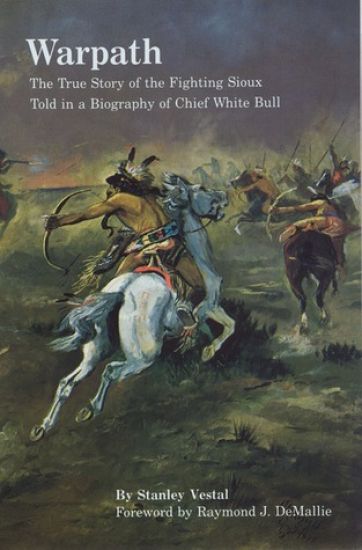
Warpath

Warpath

Stanley Vestal; Raymond J. DeMallie

University of Nebraska Press
1984
pokkari
Nephew to Sitting Bull, chief of the Sioux, Pte San Hunka (White Bull) was a famous warrior in his own right. He had been on the warpath against whites and other Indians for more than a decade when he fought the greatest battle of his life. On the afternoon of June 25, 1876, five troops of the U. S. Seventh Cavalry under the command of George Armstrong Custer rode into the valley of the Little Big Horn River, confidently expecting to rout the Indian encampments there. Instead, the cavalry met the gathered strength of Sioux and Cheyenne warriors, who did not run as expected but turned the battle toward the soldiers. White Bull charged again and again, fighting until the last soldier was dead. The battle was Custer's Last Stand, and White Bull was later referred to as the warrior who killed Custer. In 1932 White Bull related his life story to Stanley Vestal, who corroborated the details, from other sources and prepared this biography. "All that I told him is straight and true," said White Bull. His story is a matchless account of the life of an Indian warrior.