Kirjojen hintavertailu. Mukana 12 390 323 kirjaa ja 12 kauppaa.

Kirjailija

Raymond J. La Raja

Kirjat ja teokset yhdessä paikassa: 10 kirjaa, julkaisuja vuosilta 2008-2026, suosituimpien joukossa Money, Partisanship and Power in Local Politics. Vertaile teosten hintoja ja tarkista saatavuus suomalaisista kirjakaupoista.

10 kirjaa

Kirjojen julkaisuhaarukka 2008-2026.

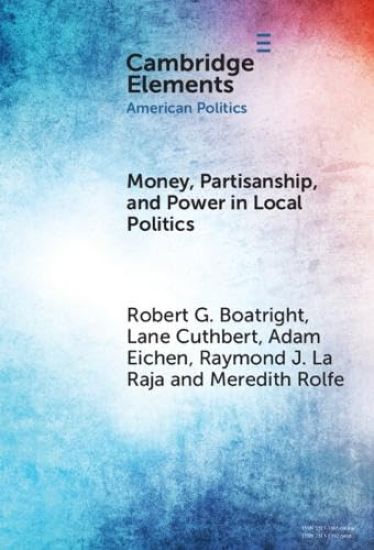
Money, Partisanship and Power in Local Politics

Money, Partisanship and Power in Local Politics

Robert G. Boatright; Lane Cuthbert; Adam Eichen; Raymond J. La Raja; Meredith Rolfe

Cambridge University Press
2025
pokkari
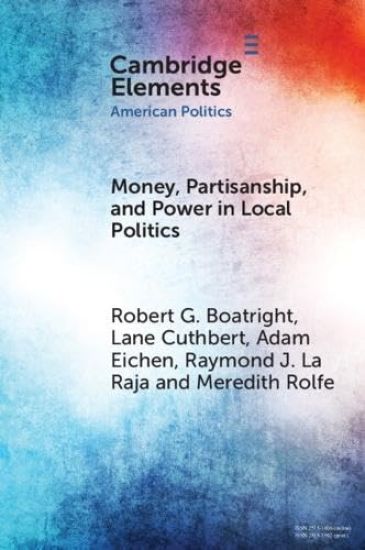
This Element presents an analysis of campaign finance in city council elections in four midsize Massachusetts cities. It shows that while money does not determine local election outcomes it plays a gatekeeping role – especially for nonincumbents. Moreover, this money comes from a very unrepresentative segment of the electorate. Although elections in these cities are nonpartisan, individual donors and interest groups are sorted into networks that function like political parties. The Element also shows that donors tend to be substantially more liberal than city residents. This can lead cities to adopt policies that are at odds with the views and needs of cities' less-wealthy inhabitants, including racial minorities. Despite low financial stakes relative to national races, campaign finance in midsize city elections reflects and reinforces broader patterns of political inequality. The result is a campaign finance system that disadvantages city residents who lack the cues that exist in other elections.

Small Donors in US Politics

Small Donors in US Politics

Zachary Albert; Raymond J. La Raja

THE UNIVERSITY OF CHICAGO PRESS
2026
sidottu
A myth-busting investigation of small donors: who they are, how they spend their money, and whose campaigns actually benefit from their donations. Many political reformers argue that more robust small donor participation in US campaigns would reduce the influence of the wealthiest Americans and improve political responsiveness to ordinary citizens. Drawing on extensive data, including surveys and campaign records, Zachary Albert and Raymond J. La Raja largely dispel this myth, offering the first comprehensive portrait to date of small donors in US elections. Although small donor contributions to high-profile, national races have increased markedly since 2018, the US campaign finance system allows for even larger sums of money from Super PACs and other independent spending groups. Moreover, small donors are mostly similar to their larger contributor counterparts: both are socioeconomically advantaged, strongly partisan, ideologically extreme, and distinct from non-donors. Small donors can also be impulsive: they tend to give mostly to high-profile candidates on the ideological extremes, empowering media celebrities and norm-breakers rather than consensus-builders, and they underinvest in competitive and down-ballot races. Importantly, the candidates who rely most heavily on small donor support are not necessarily better legislators or representatives. Yet, the story is not entirely bleak. Small donors bring energy and resources, especially for challengers and outsider candidates. The book shows how reforms could channel this energy more productively—by strengthening political parties, emphasizing local representation, and creating systems that broaden participation beyond the most ideological citizens. Timely, accessible, and grounded in data, Small Donors in US Politics reveals both the promise and the peril of small donor politics—and what it will take to make money in politics serve democracy, not undermine it.
Small Donors in Us Politics: Myth and Reality

Small Donors in Us Politics: Myth and Reality

Zachary Albert; Raymond J. La Raja

University of Chicago Press
2026
nidottu
A myth-busting investigation of small donors: who they are, how they spend their money, and whose campaigns actually benefit from their donations. Many political reformers argue that more robust small donor participation in US campaigns would reduce the influence of the wealthiest Americans and improve political responsiveness to ordinary citizens. Drawing on extensive data, including surveys and campaign records, Zachary Albert and Raymond J. La Raja largely dispel this myth, offering the first comprehensive portrait to date of small donors in US elections. Although small donor contributions to high-profile, national races have increased markedly since 2018, the US campaign finance system allows for even larger sums of money from Super PACs and other independent spending groups. Moreover, small donors are mostly similar to their larger contributor counterparts: both are socioeconomically advantaged, strongly partisan, ideologically extreme, and distinct from non-donors. Small donors can also be impulsive: they tend to give mostly to high-profile candidates on the ideological extremes, empowering media celebrities and norm-breakers rather than consensus-builders, and they underinvest in competitive and down-ballot races. Importantly, the candidates who rely most heavily on small donor support are not necessarily better legislators or representatives. Yet, the story is not entirely bleak. Small donors bring energy and resources, especially for challengers and outsider candidates. The book shows how reforms could channel this energy more productively--by strengthening political parties, emphasizing local representation, and creating systems that broaden participation beyond the most ideological citizens. Timely, accessible, and grounded in data, Small Donors in US Politics reveals both the promise and the peril of small donor politics--and what it will take to make money in politics serve democracy, not undermine it.
Money, Partisanship and Power in Local Politics

Money, Partisanship and Power in Local Politics

Robert G. Boatright; Lane Cuthbert; Adam Eichen; Raymond J. La Raja; Meredith Rolfe

Cambridge University Press
2025
sidottu
This Element presents an analysis of campaign finance in city council elections in four midsize Massachusetts cities. It shows that while money does not determine local election outcomes it plays a gatekeeping role – especially for nonincumbents. Moreover, this money comes from a very unrepresentative segment of the electorate. Although elections in these cities are nonpartisan, individual donors and interest groups are sorted into networks that function like political parties. The Element also shows that donors tend to be substantially more liberal than city residents. This can lead cities to adopt policies that are at odds with the views and needs of cities' less-wealthy inhabitants, including racial minorities. Despite low financial stakes relative to national races, campaign finance in midsize city elections reflects and reinforces broader patterns of political inequality. The result is a campaign finance system that disadvantages city residents who lack the cues that exist in other elections.

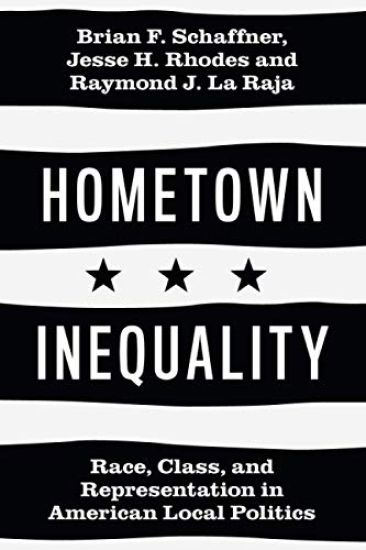
Hometown Inequality

Hometown Inequality

Brian F. Schaffner; Jesse H. Rhodes; Raymond J. La Raja

Cambridge University Press
2020
pokkari
Local governments play a central role in American democracy, providing essential services such as policing, water, and sanitation. Moreover, Americans express great confidence in their municipal governments. But is this confidence warranted? Using big data and a representative sample of American communities, this book provides the first systematic examination of racial and class inequalities in local politics. We find that non-whites and less-affluent residents are consistent losers in local democracy. Residents of color and those with lower incomes receive less representation from local elected officials than do whites and the affluent. Additionally, they are much less likely than privileged community members to have their preferences reflected in local government policy. Contrary to the popular assumption that governments that are “closest” govern best, we find that inequalities in representation are most severe in suburbs and small towns. Typical reforms do not seem to improve the situation, and we recommend new approaches.
Hometown Inequality

Hometown Inequality

Brian F. Schaffner; Jesse H. Rhodes; Raymond J. La Raja

Cambridge University Press
2020
sidottu
Local governments play a central role in American democracy, providing essential services such as policing, water, and sanitation. Moreover, Americans express great confidence in their municipal governments. But is this confidence warranted? Using big data and a representative sample of American communities, this book provides the first systematic examination of racial and class inequalities in local politics. We find that non-whites and less-affluent residents are consistent losers in local democracy. Residents of color and those with lower incomes receive less representation from local elected officials than do whites and the affluent. Additionally, they are much less likely than privileged community members to have their preferences reflected in local government policy. Contrary to the popular assumption that governments that are “closest” govern best, we find that inequalities in representation are most severe in suburbs and small towns. Typical reforms do not seem to improve the situation, and we recommend new approaches.
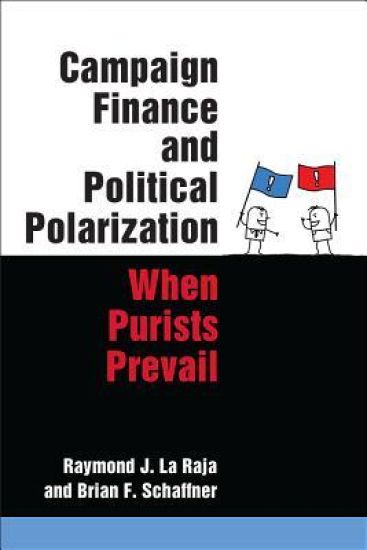
Campaign Finance and Political Polarization

Campaign Finance and Political Polarization

Raymond J. La Raja; Brian F. Schaffner

The University of Michigan Press
2015
nidottu
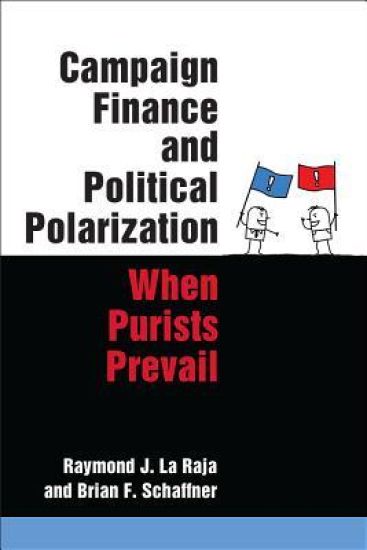
Efforts to reform the U.S. campaign finance system typically focus on the corrupting influence of large contributions. Yet, as Raymond J. La Raja and Brian F. Schaffner argue, reforms aimed at cutting the flow of money into politics have unintentionally favored candidates with extreme ideological agendas and, consequently, fostered political polarization. Drawing on data from 50 states and the U.S. Congress over 20 years, La Raja and Schaffner reveal that current rules allow wealthy ideological groups and donors to dominate the financing of political campaigns. In order to attract funding, candidates take uncompromising positions on key issues and, if elected, take their partisan views into the legislature. As a remedy, the authors propose that additional campaign money be channeled through party organizations—rather than directly to candidates—because these organizations tend to be less ideological than the activists who now provide the lion’s share of money to political candidates. Shifting campaign finance to parties would ease polarization by reducing the influence of “purist” donors with their rigid policy stances. La Raja and Schaffner conclude the book with policy recommendations for campaign finance in the United States. They are among the few non-libertarians who argue that less regulation, particularly for political parties, may in fact improve the democratic process.
Campaign Finance and Political Polarization

Campaign Finance and Political Polarization

Raymond J. La Raja; Brian F. Schaffner

The University of Michigan Press
2015
sidottu
Efforts to reform the U.S. campaign finance system typically focus on the corrupting influence of large contributions. Yet, as Raymond J. La Raja and Brian F. Schaffner argue, reforms aimed at cutting the flow of money into politics have unintentionally favored candidates with extreme ideological agendas and, consequently, fostered political polarization. Drawing on data from 50 states and the U.S. Congress over 20 years, La Raja and Schaffner reveal that current rules allow wealthy ideological groups and donors to dominate the financing of political campaigns. In order to attract funding, candidates take uncompromising positions on key issues and, if elected, take their partisan views into the legislature. As a remedy, the authors propose that additional campaign money be channeled through party organizations—rather than directly to candidates—because these organizations tend to be less ideological than the activists who now provide the lion’s share of money to political candidates. Shifting campaign finance to parties would ease polarization by reducing the influence of “purist” donors with their rigid policy stances. La Raja and Schaffner conclude the book with policy recommendations for campaign finance in the United States. They are among the few non-libertarians who argue that less regulation, particularly for political parties, may in fact improve the democratic process.
Small Change

Small Change

Raymond J. La Raja

The University of Michigan Press
2008
nidottu
Reformers lament that, with every effort to regulate the sources of campaign funding, candidates creatively circumvent the new legislation. But in fact, political fundraisers don't need to look for loopholes because, as Raymond J. La Raja proves, legislators intentionally design regulations to gain advantage over their partisan rivals. La Raja traces the history of the U.S. campaign finance system from the late nineteenth century through the passage of the Bipartisan Campaign Reform Act (BCRA) of 2002. Then, using the 2004 presidential election as a case study, he compares the ways in which Democrats and Republicans adapted their national fund-raising and campaigning strategies to satisfy BCRA regulations. Drawing upon this wealth of historical and recent evidence, he concludes with recommendations for reforming campaign finance in ways that promote fair competition among candidates and guarantee their accountability to voters.Small Change offers an engaging account of campaign finance reforms' contradictory history; it is a must-read for anyone concerned about influence of money on democratic elections.
Small Change

Small Change

Raymond J. La Raja

The University of Michigan Press
2008
sidottu
Reformers lament that, with every effort to regulate the sources of campaign funding, candidates creatively circumvent the new legislation. But in fact, political fundraisers don't need to look for loopholes because, as Raymond J. La Raja proves, legislators intentionally design regulations to gain advantage over their partisan rivals. La Raja traces the history of the U.S. campaign finance system from the late nineteenth century through the passage of the Bipartisan Campaign Reform Act (BCRA) of 2002. Then, using the 2004 presidential election as a case study, he compares the ways in which Democrats and Republicans adapted their national fund-raising and campaigning strategies to satisfy BCRA regulations. Drawing upon this wealth of historical and recent evidence, he concludes with recommendations for reforming campaign finance in ways that promote fair competition among candidates and guarantee their accountability to voters.Small Change offers an engaging account of campaign finance reforms' contradictory history; it is a must-read for anyone concerned about influence of money on democratic elections.