Kirjojen hintavertailu. Mukana 12 390 323 kirjaa ja 12 kauppaa.

Kirjailija

Raymond L. Weiss

Kirjat ja teokset yhdessä paikassa: 2 kirjaa, julkaisuja vuosilta 1991-2018, suosituimpien joukossa Maimonides' Ethics. Vertaile teosten hintoja ja tarkista saatavuus suomalaisista kirjakaupoista.

2 kirjaa

Kirjojen julkaisuhaarukka 1991-2018.

The Ethics

The Ethics

Benedict de Spinoza; Raymond L. Weiss

Dover Publications Inc.
2018
nidottu
What does it mean to live an ethical life? For seventeenth-century philosopher Benedict de Spinoza, this question led to a doctrine in which God is present in all things and the human mind is part of God's infinite intellect. Spinoza regarded ethics as a rational system corresponding to the rational nature of the universe and employed a deductive method derived from Euclidean geometry to show that the validity of ethical ideas can be demonstrated by a mathematical style argument. His conclusion: to be guided by reason is to live freely, motivated by love and goodwill rather than fear or hatred. These ideas challenged both conventional views of God and the related social and political structure. Reviled by the religious authorities of his native Amsterdam, Spinoza remained an uncompromising model of intellectual courage. His vision, published posthumously as The Ethics, has served as an inspiration to Enlightenment philosophers, Romantic poets, and generations of thinkers.
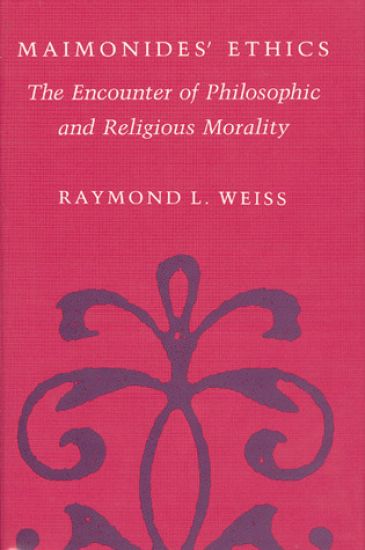
Maimonides' Ethics

Maimonides' Ethics

Raymond L. Weiss

University of Chicago Press
1991
sidottu
In this book Raymond L. Weiss examines how a seminal Jewish thinker negotiates the philosophical conflict between Athens and Jerusalem in the crucial area of ethics. Maimonides, a master of both the classical and the biblical-rabbinic traditions, reconciled their differing views of morality primarily in the context of Jewish jurisprudence. Taking into consideration the entire corpus of Maimonides' writings, Weiss focuses on the ethical sections of the Commentary on the Mishnah and the Mishneh Torah, but also discusses the Guide of the Perplexed, the letters of Maimonides, and his medical works. The gulf between classical philosophy and the Torah made the task of Maimonides extraordinarily difficult. Weiss shows that Maimonides subtly preserves the tension between those traditions while producing a practical accommodation between them. To explain how Maimonides was able to accomplish this twofold goal, Weiss takes seriously the multilevel character of Maimonides' works. Weiss interprets Maimonides as a heterodox thinker who, with utter integrity, faces the Law's encounter with philosophy and gives both the Torah and philosophy their due.