Kirjojen hintavertailu. Mukana 12 566 937 kirjaa ja 12 kauppaa.

Kirjailija

Raymond R. Tan

Kirjat ja teokset yhdessä paikassa: 5 kirjaa, julkaisuja vuosilta 2016-2021, suosituimpien joukossa Input-Output Models for Sustainable Industrial Systems. Vertaile teosten hintoja ja tarkista saatavuus suomalaisista kirjakaupoista.

5 kirjaa

Kirjojen julkaisuhaarukka 2016-2021.

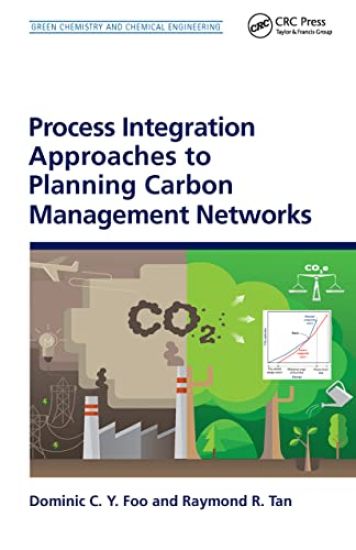
Process Integration Approaches to Planning Carbon Management Networks

Process Integration Approaches to Planning Carbon Management Networks

Dominic C. Y. Foo; Raymond R. Tan

TAYLOR FRANCIS LTD
2021
nidottu
Process Integration Approaches to Planning Carbon Management Networks provides a comprehensive treatment of carbon emissions pinch analysis (CEPA), covering the fundamentals as well as more advanced variants based on mathematical programming. A significant portion of the book is dedicated to case studies that provide a range of examples to demonstrate how CEPA can be applied to practical energy planning problems. Selected chapters also include electronic supplements (e.g., spreadsheet templates and software code) to aid the reader in applying these methods to new sets of data. This book is ideal for academic researchers and graduate students interested in carbon-constrained energy planning models and applications.This book Provides essential information on CEPA and mathematical programming Gives illustrative examples and case studies drawn from contemporary climatic issues Covers state-of-the-art methodological developments Discusses about applications in various countries Offers additional support through supplementary spreadsheet templates and software codeProfessor Dominic Foo is a professor of process design and integration at the University of Nottingham Malaysia. He is a fellow of the Institution of Chemical Engineers, a fellow of the Academy of Science Malaysia, a chartered engineer with the UK Engineering Council, and a professional engineer with the Board of Engineers Malaysia. He works on process integration for resource conservation and CO2 reduction, with more than 400 published works. Prof. Foo is the co-editor-in-chief for Process Integration and Optimization for Sustainability, subject editor for Process Safety & Environmental Protection, and an editorial board member for several other renowned journals. Raymond R. Tan is a professor of chemical engineering and university fellow at De La Salle University, Philippines. He is also a member of the National Academy of Science and Technology of the Philippines. His main areas of research are process systems engineering and process integration, where he has over 300 published works. Prof. Tan received his BS and MS degrees in chemical engineering and PhD in mechanical engineering from De La Salle University. He is also a co-editor-in-chief of Process Integration and Optimization for Sustainability, subject editor of Sustainable Production and Consumption, and an editorial board member of Clean Technologies and Environmental Policy.
Process Integration Approaches to Planning Carbon Management Networks

Process Integration Approaches to Planning Carbon Management Networks

Dominic C. Y. Foo; Raymond R. Tan

CRC Press Inc
2020
sidottu
Process Integration Approaches to Planning Carbon Management Networks provides a comprehensive treatment of carbon emissions pinch analysis (CEPA), covering the fundamentals as well as more advanced variants based on mathematical programming. A significant portion of the book is dedicated to case studies that provide a range of examples to demonstrate how CEPA can be applied to practical energy planning problems. Selected chapters also include electronic supplements (e.g., spreadsheet templates and software code) to aid the reader in applying these methods to new sets of data. This book is ideal for academic researchers and graduate students interested in carbon-constrained energy planning models and applications.This book Provides essential information on CEPA and mathematical programming Gives illustrative examples and case studies drawn from contemporary climatic issues Covers state-of-the-art methodological developments Discusses about applications in various countries Offers additional support through supplementary spreadsheet templates and software codeProfessor Dominic Foo is a professor of process design and integration at the University of Nottingham Malaysia. He is a fellow of the Institution of Chemical Engineers, a fellow of the Academy of Science Malaysia, a chartered engineer with the UK Engineering Council, and a professional engineer with the Board of Engineers Malaysia. He works on process integration for resource conservation and CO2 reduction, with more than 400 published works. Prof. Foo is the co-editor-in-chief for Process Integration and Optimization for Sustainability, subject editor for Process Safety & Environmental Protection, and an editorial board member for several other renowned journals. Raymond R. Tan is a professor of chemical engineering and university fellow at De La Salle University, Philippines. He is also a member of the National Academy of Science and Technology of the Philippines. His main areas of research are process systems engineering and process integration, where he has over 300 published works. Prof. Tan received his BS and MS degrees in chemical engineering and PhD in mechanical engineering from De La Salle University. He is also a co-editor-in-chief of Process Integration and Optimization for Sustainability, subject editor of Sustainable Production and Consumption, and an editorial board member of Clean Technologies and Environmental Policy.
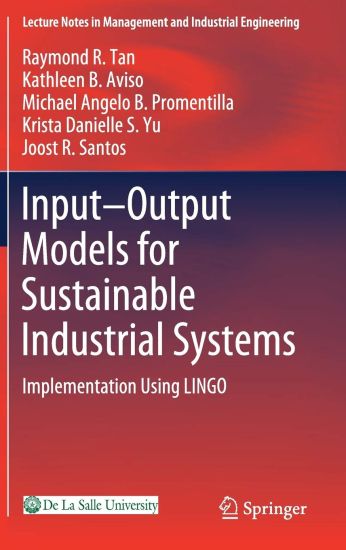
Input-Output Models for Sustainable Industrial Systems

Input-Output Models for Sustainable Industrial Systems

Raymond R. Tan; Kathleen B. Aviso; Michael Angelo B. Promentilla; Krista Danielle S. Yu; Joost R. Santos

Springer Verlag, Singapore
2018
nidottu
This book addresses the specialized topic of input–output models for sustainable industrial systems. While these models are well-established tools for economic analysis, their underlying mathematical structure is also applicable to the analysis and optimization of a wide range of systems that are characterized by linear interdependencies among their components. This means that input–output models can be used for diverse networks, such as processes within industrial plants, industrial plants in a supply chain, or departmental units within an organization. The models can also be readily extended to interactions between man-made systems and the environment, e.g. flows of natural resources and/or pollutants. Furthermore, model variants with excess degrees of freedom can be formulated to allow optimization and decision-making to be integrated within the framework. This book examines how input–output models can be applied to sustainable industrial systems. Each major variant is discussed separately in a dedicated chapter, and representative case studies and supporting LINGO code are also included.
Input-Output Models for Sustainable Industrial Systems

Input-Output Models for Sustainable Industrial Systems

Raymond R. Tan; Kathleen B. Aviso; Michael Angelo B. Promentilla; Krista Danielle S. Yu; Joost R. Santos

Springer Verlag, Singapore
2018
sidottu
This book addresses the specialized topic of input–output models for sustainable industrial systems. While these models are well-established tools for economic analysis, their underlying mathematical structure is also applicable to the analysis and optimization of a wide range of systems that are characterized by linear interdependencies among their components. This means that input–output models can be used for diverse networks, such as processes within industrial plants, industrial plants in a supply chain, or departmental units within an organization. The models can also be readily extended to interactions between man-made systems and the environment, e.g. flows of natural resources and/or pollutants. Furthermore, model variants with excess degrees of freedom can be formulated to allow optimization and decision-making to be integrated within the framework. This book examines how input–output models can be applied to sustainable industrial systems. Each major variant is discussed separately in a dedicated chapter, and representative case studies and supporting LINGO code are also included.
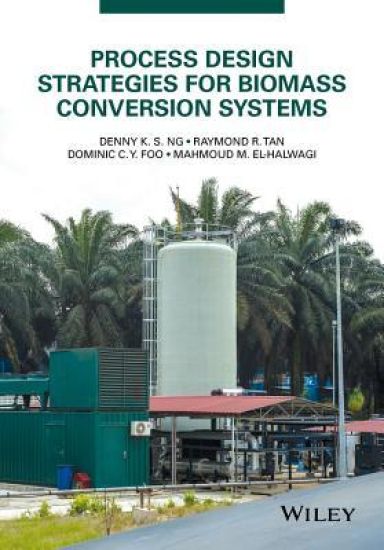
Process Design Strategies for Biomass Conversion Systems

Process Design Strategies for Biomass Conversion Systems

Denny K. S. Ng; Raymond R. Tan; Dominic C. Y. Foo; Mahmoud M. El-Halwagi

John Wiley Sons Inc
2016
sidottu
This book covers recent developments in process systems engineering (PSE) for efficient resource use in biomass conversion systems. It provides an overview of process development in biomass conversion systems with focus on biorefineries involving the production and coproduction of fuels, heating, cooling, and chemicals. The scope includes grassroots and retrofitting applications. In order to reach high levels of processing efficiency, it also covers techniques and applications of natural-resource (mass and energy) conservation. Technical, economic, environmental, and social aspects of biorefineries are discussed and reconciled. The assessment scales vary from unit- to process- and life-cycle or supply chain levels. The chapters are written by leading experts from around the world, and present an integrated set of contributions. Providing a comprehensive, multi-dimensional analysis of various aspects of bioenergy systems, the book is suitable for both academic researchers and energy professionals in industry.