Kirjojen hintavertailu. Mukana 12 595 353 kirjaa ja 12 kauppaa.

Kirjailija

Razvan Gelca

Kirjat ja teokset yhdessä paikassa: 5 kirjaa, julkaisuja vuosilta 2008-2023, suosituimpien joukossa Geometric Transformations. Vertaile teosten hintoja ja tarkista saatavuus suomalaisista kirjakaupoista.

5 kirjaa

Kirjojen julkaisuhaarukka 2008-2023.

Geometric Transformations

Geometric Transformations

Razvan Gelca; Ionut Onisor; Carlos Yuzo Shine

Springer Nature Switzerland AG
2023
nidottu
This textbook teaches the transformations of plane Euclidean geometry through problems, offering a transformation-based perspective on problems that have appeared in recent years at mathematics competitions around the globe, as well as on some classical examples and theorems. It is based on the combined teaching experience of the authors (coaches of several Mathematical Olympiad teams in Brazil, Romania and the USA) and presents comprehensive theoretical discussions of isometries, homotheties and spiral similarities, and inversions, all illustrated by examples and followed by myriad problems left for the reader to solve. These problems were carefully selected and arranged to introduce students to the topics by gradually moving from basic to expert level. Most of them have appeared in competitions such as Mathematical Olympiads or in mathematical journals aimed at an audience interested in mathematics competitions, while some are fundamental facts of mathematics discussed in the framework of geometric transformations. The book offers a global view of the geometric content of today's mathematics competitions, bringing many new methods and ideas to the attention of the public.Talented high school and middle school students seeking to improve their problem-solving skills can benefit from this book, as well as high school and college instructors who want to add nonstandard questions to their courses. People who enjoy solving elementary math problems as a hobby will also enjoy this work.
Geometric Transformations

Geometric Transformations

Razvan Gelca; Ionut Onisor; Carlos Yuzo Shine

Springer Nature Switzerland AG
2022
sidottu
This textbook teaches the transformations of plane Euclidean geometry through problems, offering a transformation-based perspective on problems that have appeared in recent years at mathematics competitions around the globe, as well as on some classical examples and theorems. It is based on the combined teaching experience of the authors (coaches of several Mathematical Olympiad teams in Brazil, Romania and the USA) and presents comprehensive theoretical discussions of isometries, homotheties and spiral similarities, and inversions, all illustrated by examples and followed by myriad problems left for the reader to solve. These problems were carefully selected and arranged to introduce students to the topics by gradually moving from basic to expert level. Most of them have appeared in competitions such as Mathematical Olympiads or in mathematical journals aimed at an audience interested in mathematics competitions, while some are fundamental facts of mathematics discussed in the framework of geometric transformations. The book offers a global view of the geometric content of today's mathematics competitions, bringing many new methods and ideas to the attention of the public.Talented high school and middle school students seeking to improve their problem-solving skills can benefit from this book, as well as high school and college instructors who want to add nonstandard questions to their courses. People who enjoy solving elementary math problems as a hobby will also enjoy this work.
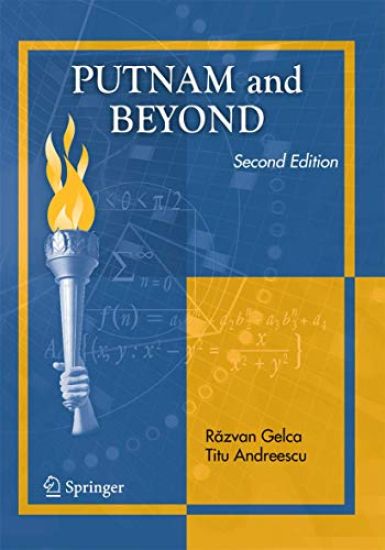
Putnam and Beyond

Putnam and Beyond

Razvan Gelca; Titu Andreescu

Springer International Publishing AG
2017
nidottu
This book takes the reader on a journey through the world of college mathematics, focusing on some of the most important concepts and results in the theories of polynomials, linear algebra, real analysis, differential equations, coordinate geometry, trigonometry, elementary number theory, combinatorics, and probability. Preliminary material provides an overview of common methods of proof: argument by contradiction, mathematical induction, pigeonhole principle, ordered sets, and invariants. Each chapter systematically presents a single subject within which problems are clustered in each section according to the specific topic. The exposition is driven by nearly 1300 problems and examples chosen from numerous sources from around the world; many original contributions come from the authors. The source, author, and historical background are cited whenever possible. Complete solutions to all problems are given at the end of the book. This second edition includes new sections on quadratic polynomials, curves in the plane, quadratic fields, combinatorics of numbers, and graph theory, and added problems or theoretical expansion of sections on polynomials, matrices, abstract algebra, limits of sequences and functions, derivatives and their applications, Stokes' theorem, analytical geometry, combinatorial geometry, and counting strategies. Using the W.L. Putnam Mathematical Competition for undergraduates as an inspiring symbol to build an appropriate math background for graduate studies in pure or applied mathematics, the reader is eased into transitioning from problem-solving at the high school level to the university and beyond, that is, to mathematical research. This work may be used as a study guide for the Putnam exam, as a text for many different problem-solving courses, and as a source of problems for standard courses in undergraduate mathematics. Putnam and Beyond is organized for independent study by undergraduate and graduate students, as well as teachers and researchers in the physical sciences who wish to expand their mathematical horizons.
Theta Functions And Knots

Theta Functions And Knots

Razvan Gelca

World Scientific Publishing Co Pte Ltd
2014
sidottu
This book presents the relationship between classical theta functions and knots. It is based on a novel idea of Razvan Gelca and Alejandro Uribe, which converts Weil's representation of the Heisenberg group on theta functions to a knot theoretical framework, by giving a topological interpretation to a certain induced representation. It also explains how the discrete Fourier transform can be related to 3- and 4-dimensional topology.Theta Functions and Knots can be read in two perspectives. Readers with an interest in theta functions or knot theory can learn how the two are related. Those interested in Chern-Simons theory will find here an introduction using the simplest case, that of abelian Chern-Simons theory. Moreover, the construction of abelian Chern-Simons theory is based entirely on quantum mechanics and not on quantum field theory as it is usually done.Both the theory of theta functions and low dimensional topology are presented in detail, in order to underline how deep the connection between these two fundamental mathematical subjects is. Hence the book is self-contained with a unified presentation. It is suitable for an advanced graduate course, as well as for self-study.
Mathematical Olympiad Challenges

Mathematical Olympiad Challenges

Titu Andreescu; Razvan Gelca

Birkhauser Boston Inc
2008
nidottu
Why Olympiads? Working mathematiciansoftentell us that results in the ?eld are achievedafter long experience and a deep familiarity with mathematical objects, that progress is made slowly and collectively, and that ?ashes of inspiration are mere punctuation in periods of sustained effort. TheOlympiadenvironment,incontrast,demandsarelativelybriefperiodofintense concentration,asksforquickinsightsonspeci?coccasions,andrequiresaconcentrated but isolated effort. Yet we have foundthat participantsin mathematicsOlympiadshave oftengoneontobecome?rst-classmathematiciansorscientistsandhaveattachedgreat signi?cance to their early Olympiad experiences. For many of these people, the Olympiad problem is an introduction, a glimpse into the world of mathematics not afforded by the usual classroom situation. A good Olympiad problem will capture in miniature the process of creating mathematics. It’s all there: the period of immersion in the situation, the quiet examination of possible approaches, the pursuit of various paths to solution. There is the fruitless dead end, as well as the path that ends abruptly but offers new perspectives, leading eventually to the discoveryof a better route. Perhapsmost obviously,grapplingwith a goodproblem provides practice in dealing with the frustration of working at material that refuses to yield. If the solver is lucky, there will be the moment of insight that heralds the start of a successful solution. Like a well-crafted work of ?ction, a good Olympiad problem tells a story of mathematical creativity that captures a good part of the real experience and leaves the participant wanting still more. And this book gives us more.