Kirjojen hintavertailu. Mukana 12 337 235 kirjaa ja 12 kauppaa.

Kirjailija

Reiner Schürmann

Kirjat ja teokset yhdessä paikassa: 17 kirjaa, julkaisuja vuosilta 1987-2024, suosituimpien joukossa Diskordanz der Zeiten. Vertaile teosten hintoja ja tarkista saatavuus suomalaisista kirjakaupoista.

Mukana myös kirjoitusasut: Reiner Schurmann

17 kirjaa

Kirjojen julkaisuhaarukka 1987-2024.

Ways of Releasement

Ways of Releasement

Reiner Schürmann

Diaphanes AG
2024
nidottu
Never-before-published writing from a key twentieth-century philosopher. In 1962, Reiner Schürmann began studying at the Dominican school of theology Le Saulchoir, outside Paris. That experience radically shaped his life and work, enabling him to begin to develop many of the ideas for which he would later be known: letting be, life without why, ontological anarchy, and the tragic double bind. Ways of Releasement contains never-before-published material from Schürmann’s early period as well as a report Schürmann wrote about his encounter with Heidegger; a précis of his autobiographical novel, Origins; and translations and new editions of later groundbreaking essays. Ways of Releasement concludes with an extensive afterword setting Schürmann’s writings in the context of his thinking and life.
The Place of the Symbolic – Essays on Art and Politics

The Place of the Symbolic – Essays on Art and Politics

Reiner Schürmann; Malte Fabian Rauch; Nicolas Schneider

Diaphanes AG
2023
nidottu
This book weaves together Reiner Schürmann’s work on art and politics, drawing on a range of the most important thinkers and poets of the twentieth century and beyond.The Place of the Symbolic gathers Reiner Schürmann’s essays on the nexus of art and politics. In keeping with his translation of the destruction of metaphysics into an an-archic philosophy of practice, Schürmann develops a radical theory of the place of symbols, irreducible either to idealist theories of symbols or structuralist accounts of the symbolic. Symbols, Schürmann argues, may provide a bridge between ontological difference and politics. They resist being grasped metaphysically, in terms of representation. Instead, their understanding requires a specific way of existence: attending to the coming-to-presence of phenomena. As such, the understanding of symbols discloses a form of praxis that abandons ultimate grounds and opens onto the manifold. Alongside Schürmann’s theory of symbols, the collection includes essays on the relation between metaphysics, tragedy, and technology; on the “there is” in poetry; as well as on judgment. Throughout these characteristically lucid interventions, Schürmann’s most urgent concern remains a consideration of singular and finite practices that enact a release from universal principles. Art and politics appear here as the unworking of ultimate grounds; that is, as practices attuned to a truly groundless form of life.
Heidegger`s De(con)struction of Metaphysics

Heidegger`s De(con)struction of Metaphysics

Reiner Schürmann; Francesco Guercio; Marcia Sá Cavalcante Schu

Diaphanes AG
2023
nidottu
In Being and Time, Heidegger announced the “Task of Destroying the History of Ontology” in order to free what had remained “unthought” in Western metaphysics. The unpublished part of that work was to be titled “Basic Features of a Phenomenological Destruction of the History of Ontology. According to the Guiding Thread of the Problem of Temporality.” This latest work in the Reiner Schürmann Selected Writings and Lecture Notes series aims to carry out Heidegger’s plan. The destruction, or, as it is later called, the deconstruction of metaphysics, has a negative side—the peeling off, or the archeology, of metaphysical history by means of the guiding thread of the question of Being—and a positive side—“retrieval” of the original experience of Being in ancient Greek philosophy. “The destruction has no other intent than to win back the original experience of metaphysics through a deconstruction of those conceptions which have become current and empty.” The purpose of taking to pieces the fabric of Western metaphysics is to show how at each important stage “the question of the meaning of Being has not only remained unattended to or inadequately raised, but that it has become quite forgotten in spite of all our interest in 'metaphysics'.”
Luther. The Origin of Modern Self–Consciousness – Lectures, Vol. 12
If we are to understand the specifically modern function of self-consciousness, we must first look to the origins of the concept. Among the key thinkers who elaborated on self-consciousness was the German monk and theologian Martin Luther. Reiner Schuermann's writings and lectures on Luther therefore offer an innovative reading of the systematic role of self-consciousness in both premodern and modern cultures. The twelfth volume in a planned twenty-nine-part series, Reiner Schuermann: Luther. The Origin of Modern Self-Consciousness sees Schuermann tracing Luther's conception of the rise of self-consciousness as the subjective reference point. Schuermann then explores this conception in conversation with both the Cartesian cogito and Kantian apperception.
Modern Philosophies of the Will

Modern Philosophies of the Will

Reiner Schürmann; Francesco Guercio; Kieran Aarons

Diaphanes AG
2022
nidottu
Through the lenses of Kant, Nietzsche, and Heidegger, this edited volume traces the development of the relation between the will and the law as self-given. Modern Philosophies of the Will explores a variety of topics including: the ontological turn in philosophy of the will; the will’s playful character and the problem of teleology; the will as principle of morality as discussed by Kant, of life­forms as discussed by Nietzsche, and of technology as discussed by Heidegger; the formal identity of legislation; and transgression of the law. This volume traces three strategies in the development of the philosophy of will from Kant to Heidegger, through rationality and irrationality of the will, the ontological turn, and law.
Se constituer soi-même comme sujet anarchique
Le pr sent livre constitue le recueil de trois articles-charni res de Rainer Sch rmann. Deux d'entre eux, Que faire la fin de la m taphysique ? et Des doubles contraintes normatives sont des chos, respectivement r capitulatif et prospectif, des deux opus magnum de Sch rmann, Le principe d'anarchie et Les h g monies bris es. L'autre texte, Se constituer soi-m me comme sujet anarchique, jette un clairage tout fait in dit sur ce qu'on pouvait d j savoir partir des deux autres textes, abondamment repris dans les deux ouvrages-phares de leurs auteurs. Ils les font lire diff remment. C'est cet clairage enti rement neuf, quant la port e praxique que rev t la vaste m ditation post-m taphysique de Sch rmann, qui fait du pr sent recueil un in dit, au sens le plus plein du terme.
Reading Marx – On Transcendental Materialism

Reading Marx – On Transcendental Materialism

Reiner Schürmann; Malte Fabian Rauch; Nicolas Schneider

Diaphanes AG
2021
nidottu
In this book, Reiner Schürmann argues that what is most original about Marx is his philosophical axis. Extending his highly original engagement with the history of philosophy, Schürmann draws out this axis, which determines and localizes his theories of history, social relations, and economy. Whereas Marxist readings of Marx conceive history, classes, and social relations as primary realities, Schürmann brings out a radically immanent understanding of praxis that introduces multiplicity. This edition is complemented by a reprinting of Schürmann’s Anti-Humanism essay, in which he reads Marx alongside Nietzsche and Heidegger as spelling out the dissociation of being and action. Reading Marx showcases underappreciated facets of Schürmann’s work and offers an interpretation of Marx that resonates with the readings of Jacques Derrida, Michel Henry, Antonio Negri, and François Laruelle.
Neo–Aristotelianism and the Medieval Renaissance – On Aquinas, Ockham, and Eckhart
In this lecture course, Reiner Schürmann develops the idea that, in between the spiritual Carolingian Renaissance and the secular humanist Renaissance, there was a distinctive medieval Renaissance connected with the rediscovery of Aristotle. Focusing on Thomas Aquinas’s ontology and epistemology, William of Ockham’s conceptualism, and Meister Eckhart’s speculative mysticism, Schürmann shows how thought began to break free from religion and the hierarchies of the feudal, neo-Platonic order and devote its attention to otherness and singularity. A crucial supplement to Schürmann’s magnum opus Broken Hegemonies, Neo-Aristotelianism and the Medieval Renaissance will be essential reading for anyone interested in the rise and fall of Western principles, and thus in how to think and act today.
Tomorrow the Manifold – Essays on Foucault, Anarchy, and the Singularization to Come

Tomorrow the Manifold – Essays on Foucault, Anarchy, and the Singularization to Come

Reiner Schürmann; Malte Fabian Rauch; Nicolas Schneider

Diaphanes AG
2019
nidottu
This volume tracks the crucial role of Reiner Schürmann’s engagement with the work of Michel Foucault between 1983 and 1991. Drawing on Foucault’s highly original reading of the philosophical tradition, Schürmann traces the status of identity and difference in Foucault’s conception of history to develop a radical phenomenological understanding of anarchy. He examines the fate of philosophy after the critique of the subject and the collapse of the divide between theory and praxis, philosophy and politics. Taken together, these pivotal essays introduce the reader to Schürmann’s most urgent concerns and assemble the conceptual tools that go on to lay the groundwork for his final work, Broken Hegemonies, which offers a subversive re-reading of the history of Western metaphysics outside of Foucault’s genealogical approach. To the reader unfamiliar with Schürmann’s work, these texts establish him as one of the most radical thinkers of the late 20th century, whose work might eventually become legible in our present.
The Philosophy of Nietzsche - Lectures, Vol. 18

The Philosophy of Nietzsche - Lectures, Vol. 18

Reiner Schurmann; Michael Heitz

Diaphanes AG
2018
nidottu
Nietzsche praised Kant for having "annihilated Socratism," for exhibiting all ideals as essentially unattainable, and for having exposed himself to the despair of truth--all essential traits Nietzsche claimed for his own thinking. At the same time, the existentialist philosopher remained highly critical of Kant. This volume of Reiner Schurmann's lectures unpacks Nietzsche's ambivalence towards Kant, in particular positioning Nietzsche's claim to have brought an end to German idealism against the backdrop of the Kantian transcendental-critical tradition. Rather than simply compare the two philosophers, Schurmann's lectures help us to understand the consequences Nietzsche derived from Kantian concepts, as well as the wider horizon within which Nietzsche's ideas arose and can best be shown to apply. According to Schurmann's trenchant reading: if Nietzsche was indeed "fatal" to Western philosophy, as he claimed, he was so in large part because of the Kantian transcendental thinking from which he inherited the very elements and tools of his criticism.
Origins

Origins

Reiner Schurmann

Diaphanes AG
2016
nidottu
"Born too late to see the war and too early to forget it." So writes Reiner Schurmann in Origins, a startlingly personal account of life as a young man from postwar Germany in the 1960s. Schurmann's semi-autobiographical protagonist is incapable of escaping a past he never consciously experienced. All around him are barely concealed reminders of Nazi-inflicted death and destruction. His own experiences of displacement and rootlessness, too, are the burden of a cruel collective past. His story presents itself as a continuous quest for--and struggle to free himself from--his origins. The hero is haunted relentlessly by his fractured identity--in his childhood at his father's factory, where he learns of the Nazi past through a horrible discovery; in an Israeli kibbutz, where, after a few months of happiness, he is thrown out for being a German; in postwar Freiburg, where he reencounters a friend who escaped the Nazi concentration camps; and finally, in the United States, where his attempts at a fresh start almost fail to exorcise the ghosts of the past. Originally published in French in 1976, Origins was the winner of the coveted Prix Broquette-Gonin of the Academie Francaise. In close collaboration with the author, this meticulously crafted translation was created in the early 1990s, but Schurmann's premature death in 1993 prevented its publication process and, as a result, one of the most important literary accounts of the conflicted process of coming to terms with the Holocaust and Germany's Nazi past has been unavailable to English readers until now. Candid and frank, filled with fury and caustic sarcasm, Origins offers insight into a generation caught between disappointment and rage, alignment and rebellion, guilt and obsession with the past.
On Heidegger's Being and Time

On Heidegger's Being and Time

Simon Critchley; Reiner Schürmann

Routledge
2008
sidottu
On Heidegger's Being and Time is an outstanding exploration of Heidegger's most important work by two major philosophers. Simon Critchley argues that we must see Being and Time as a radicalization of Husserl's phenomenology, particularly his theories of intentionality, categorial intuition, and the phenomenological concept of the a priori. This leads to a reappraisal and defense of Heidegger's conception of phenomenology. In contrast, Reiner Schürmann urges us to read Heidegger 'backward', arguing that his later work is the key to unravelling Being and Time. Through a close reading of Being and Time Schürmann demonstrates that this work is ultimately aporetic because the notion of Being elaborated in his later work is already at play within it. This is the first time that Schürmann's renowned lectures on Heidegger have been published.The book concludes with Critchley's reinterpretation of the importance of authenticity in Being and Time. Arguing for what he calls an 'originary inauthenticity', Critchley proposes a relational understanding of the key concepts of the second part of Being and Time: death, conscience and temporality.
On Heidegger's Being and Time

On Heidegger's Being and Time

Simon Critchley; Reiner Schürmann

Routledge
2008
nidottu
On Heidegger's Being and Time is an outstanding exploration of Heidegger's most important work by two major philosophers. Simon Critchley argues that we must see Being and Time as a radicalization of Husserl's phenomenology, particularly his theories of intentionality, categorial intuition, and the phenomenological concept of the a priori. This leads to a reappraisal and defense of Heidegger's conception of phenomenology. In contrast, Reiner Schürmann urges us to read Heidegger 'backward', arguing that his later work is the key to unravelling Being and Time. Through a close reading of Being and Time Schürmann demonstrates that this work is ultimately aporetic because the notion of Being elaborated in his later work is already at play within it. This is the first time that Schürmann's renowned lectures on Heidegger have been published.The book concludes with Critchley's reinterpretation of the importance of authenticity in Being and Time. Arguing for what he calls an 'originary inauthenticity', Critchley proposes a relational understanding of the key concepts of the second part of Being and Time: death, conscience and temporality.
Broken Hegemonies

Broken Hegemonies

Reiner Schürmann

Indiana University Press
2003
pokkari
". . . a book of striking originality and depth, a brilliant and quite new interpretation of the nature and history of philosophy." —John Sallis In Broken Hegemonies, the late distinguished philosopher Reiner Schürmann offers a radical rethinking of the history of Western philosophy from the Greeks through Heidegger. Schürmann interprets the history of Western thought and action as a series of eras governed by the rise and fall of certain dominating philosophical ideas that contained the seeds of their own destruction. These eras coincided with their dominant languages: Greek, Latin, and vernacular tongues. Analyzing philosophical texts from Parmenides, Plotinus, and Cicero, through Augustine, Meister Eckhardt, and Kant, to Heidegger, Schürmann traces the arguments by which these ideas gained hegemony and by which their credibility was ultimately demolished. Recognizing the failure of ultimate norms, Broken Hegemonies questions how humanity today is to think and act in the absence of principles.
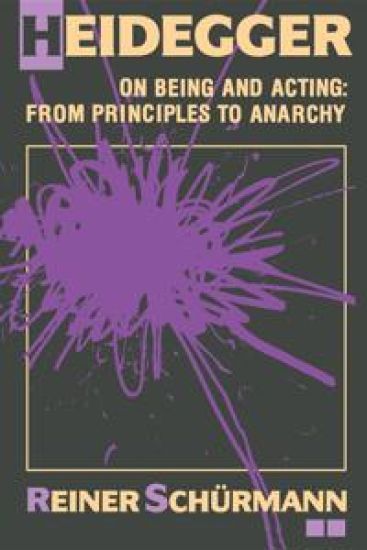
Heidegger on Being and Acting

Heidegger on Being and Acting

Reiner Schürmann

Indiana University Press
1987
pokkari
" . . . elegant and provocative . . . Exhibit[s] a subtle mastery of Heidegger's works." —Review of Metaphysics " . . . splendidly precise study of Heidegger . . . to be recommended not only to Heidegger scholars but also to those interested in the question of what philosophical thinking has as its task in the modern technological world." —Religious Studies Review " . . . indispensable to understanding the later Heidegger." —Choice