Kirjojen hintavertailu. Mukana 12 432 314 kirjaa ja 12 kauppaa.

Kirjailija

Rem Koolhaas

Kirjat ja teokset yhdessä paikassa: 17 kirjaa, julkaisuja vuosilta 1997-2026, suosituimpien joukossa Braun/Hogenberg. Villes du monde. Vertaile teosten hintoja ja tarkista saatavuus suomalaisista kirjakaupoista.

17 kirjaa

Kirjojen julkaisuhaarukka 1997-2026.

Braun/Hogenberg. Villes du monde

Braun/Hogenberg. Villes du monde

Rem Koolhaas; Stephan Füssel

TASCHEN GMBH
2026
sidottu
More than four centuries on from its first publication, discover one of the jewels of urban cartography and civic studies. This reprint includes the most enchanting color plates from the Civitates orbis terrarum, a magnificent collection of town map engravings, produced between 1572 and 1617. Featuring plans, bird’s-eye views, and maps for all major cities in Europe, plus important urban centers in Asia, Africa, and Latin America, this masterwork in urban mapping gives us a comprehensive view of city life at the turn of the 17th century. It was edited and annotated by theologian and publisher Georg Braun and largely engraved by Franz Hogenberg, but also involved over a hundred different artists and cartographers who contributed not only town views, but additional elements, such as figures in local dress, courtroom scenes, and topographical details, to help convey the situation, commercial power, and political influence of each city. TASCHEN's reprint contextualizes the plates with selected extracts from Braun’s original texts on the history and significance of each urban center as well as detailed commentaries to place each city map in its cartographical and cultural context.
Rem Before Koolhaas: Journalism by an Architect
A compact primer on Koolhaas' early, lesser-known journalistic career Before the Dutch architect Rem Koolhass (born 1944) cofounded the architectural firm OMA in 1975, published seminal works of postmodern theory, such as Delirious New York (1978), gained a professorship at Harvard University and cofounded Volume Magazine (2005), he was a journalist. Between 1963 and 1968, Koolhaas regularly contributed to the Dutch weekly, Haagse Post. His specialty was the interview. Through his deft powers of observation and analysis, the young Koolhaas employed the form to make visible power dynamics and cultural shifts. This pocket-size volume is the first to compile Koolhaas' interviews for the Haagse Post, reproducing their original layouts. Rather than treating this period as a mere precursor to his architectural career, Rem Before Koolhaas presents it as culminating in a valuable body of critical work that lent itself to his later endeavors.
Braun/Hogenberg. Cities of the World

Braun/Hogenberg. Cities of the World

Rem Koolhaas; Stephan Füssel

TASCHEN GMBH
2025
sidottu
More than four centuries on from its first publication, discover one of the jewels of urban cartography and civic studies. This reprint includes the most enchanting color plates from the Civitates orbis terrarum, a magnificent collection of town map engravings, produced between 1572 and 1617.Featuring plans, bird’s-eye views, and maps for all major cities in Europe, plus important urban centers in Asia, Africa, and Latin America, this masterwork in urban mapping gives us a comprehensive view of city life at the turn of the 17th century. It was edited and annotated by theologian and publisher Georg Braun and largely engraved by Franz Hogenberg, but also involved over a hundred different artists and cartographers who contributed not only town views, but additional elements, such as figures in local dress, courtroom scenes, and topographical details, to help convey the situation, commercial power, and political influence of each city.TASCHEN's reprint contextualizes the plates with selected extracts from Braun’s original texts on the history and significance of each urban center as well as detailed commentaries to place each city map in its cartographical and cultural context.
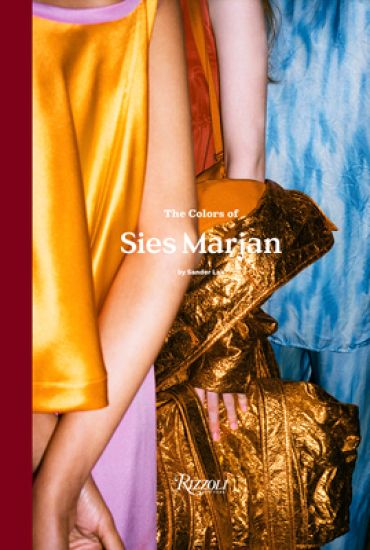
The Colors of Sies Marjan

The Colors of Sies Marjan

Sander Lak; Rem Koolhaas

RIZZOLI INTERNATIONAL PUBLICATIONS
2022
sidottu
Known for its evocative use of colour, proportion, and subversive fabrication, the New York based fashion house Sies Marjan, founded in 2016 by Dutch creative director Sander Lak, had a brief but influential life. Sies Marjan s pieces were marked by luxurious construction, the signature use of shining, jewel-toned hues, and effortlessly cool appeal the house s pastel coats, thrown over T-shirts, are still regularly seen in downtown New York and Brooklyn. Since its founding Sies Marjan has garnered a devoted fan base and praise from notable critics, celebrities, and fans alike in a city known for its endless affection for a darker palette. Rejecting the chronologies and seasonality of the typical fashion compendium, this exhaustive, richly illustrated volume is organized purely by colour. The trajectory through the colour spectrum traces the journey through the blazing life of the brand. Images featured within range from previously unpublished drawings, looks from iconic runway shows and ad campaigns, as well as found objects that reveal the inspiration behind the creation of these luxurious, chromatic garments. The flow of colour is punctuated by a number of interviews and reflections from Donna Tartt, Isabella Rossellini, Rem Koolhaas, Nia Dacosta, Hanya Yanagihara, and others.
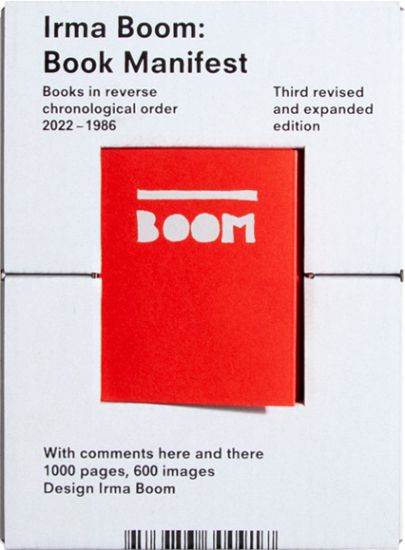
Irma Boom. Book Manifest

Irma Boom. Book Manifest

Irma Boom; Rem Koolhaas; Michael Rock; Mathieu Lommen; Louwrien Wijers; Nina Stritzler-Levine; Johan Pijnappel

VERLAG DER BUCHHANDLUNG WALTHER KONIG
2022
nidottu
A miniature manifesto for the endless possibilities of the book form, from the world's most famous living book designerIn Book Manifest, world-renowned Dutch designer Irma Boom presents her vision on the essence, meaning and relevance of the book. Based on the in-depth research that Boom conducted into the development of the book in the library of the Vatican, Book Manifest is at once a survey of the history of the book and a miniature Irma Boom retrospective, reproducing a selection of more than 350 books she has designed over the course of her eminent career. Alongside reproductions, Boom extensively discusses the relationship between her work and older book forms.With this tiny (two and a half by three inches), slipcased, 1,000-page, richly illustrated volume, itself an exceptional feat of bookmaking, Boom aims to inspire and encourage a new generation of designers to experiment and develop new ways of conceiving this simplest and most enduringly effective of forms.Described by Eye Magazine as "the Queen of Books," Irma Boom (born 1960) has created more than 300 books, always challenging the conventions of both design and printed content. She is the youngest recipient of the Gutenberg Prize, recognizing outstanding services to the advancement of the book arts. A selection of Boom's books are held in the permanent collection of the Museum of Modern Art, New York, and an Irma Boom Archive has been instituted at the University of Amsterdam, Netherlands, to showcase her work.
Source Books in Architecture No. 14

Source Books in Architecture No. 14

Benjamin Wilke; Rem Koolhaas

Goff Books
2021
nidottu
Source Books in Architecture No.14: Rem Koolhaas / OMA + AMO Spaces for Prada is the most recent volume in the Source Books in Architecture series. Among the topics discussed in the book are the longstanding relationship with Prada and how the early objectives in that relationship have both maintained and shifted. An underlying theme to the conversations held with students and faculty of the Knowlton School community is the topic of architect client relationships, their history, their problems, and how they have contributed to the discipline over time. Explicitly, a focus of the conversation is on a number of projects that OMA has developed or completed with Prada, a large number of which are installation scale environments that manifest in the form of runway shows and exhibitions. The challenge of such projects is to retain a commitment to the political and cultural agenda that OMA embeds in the larger and permanent buildings. Given the ephemerality and role of these environments as literal backgrounds to highlighted events, the projects are ideal scenarios in which to develop an architecture that lacks the permanence of buildings while still carrying potency and contributing to larger cultural discussions involving, for example, event, place, concept, product, staging, the crowd, lighting, and materiality. Source Books in Architecture No.14 contains project documentation from the OMA and Prada archives, transcripts from Koolhaas’ conversations with students at the Knowlton School at The Ohio State University, and commentary and critique from architects, critics, and theorists.
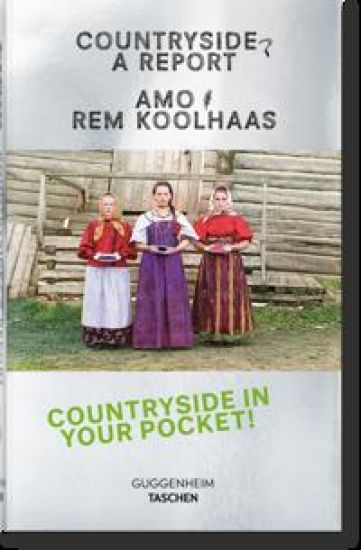
Koolhaas. Countryside, A Report

Koolhaas. Countryside, A Report

AMO; Rem Koolhaas

Taschen GmbH
2020
nidottu
The rural, remote, and wild territories we call “countryside”, or the 98% of the earth’s surface not occupied by cities, make up the front line where today’s most powerful forces—climate and ecological devastation, migration, tech, demographic lurches—are playing out. Increasingly under a ‘Cartesian’ regime—gridded, mechanized, and optimized for maximal production—these sites are changing beyond recognition. In his latest publication, Rem Koolhaas explores the rapid and often hidden transformations underway across the Earth’s vast non-urban areas.Countryside, A Report gathers travelogue essays exploring territories marked by global forces and experimentation at the edge of our consciousness: a test site near Fukushima, where the robots that will maintain Japan’s infrastructure and agriculture are tested; a greenhouse city in the Netherlands that may be the origin for the cosmology of today’s countryside; the rapidly thawing permafrost of Central Siberia, a region wrestling with the possibility of relocation; refugees populating dying villages in the German countryside and intersecting with climate change activists; habituated mountain gorillas confronting humans on ‘their’ territory in Uganda; the American Midwest, where industrial-scale farming operations are coming to grips with regenerative agriculture; and Chinese villages transformed into all-in-one factory, e-commerce stores, and fulfillment centers. This book is the official companion to the Guggenheim Museum exhibition Countryside, The Future. The exhibition and book mark a new area of investigation for architect and urbanist Rem Koolhaas, who launched his career with two city-centric entities: The Office for Metropolitan Architecture (1975) and Delirious New York (1978). It’s designed by Irma Boom, who drew inspiration for the book’s pocket-sized concept, as well as its innovative typography and layout, from her research in the Vatican library. The book brings together collaborative research by AMO, Koolhaas, and students at the Harvard Graduate School of Design; the Central Academy of Fine Arts, Beijing; Wageningen University in the Netherlands; and the University of Nairobi. Contributors also include Samir Bantal, Janna Bystrykh, Troy Conrad Therrien, Lenora Ditzler, Clemens Driessen, Alexandra Kharitonova, Keigo Kobayashi, Niklas Maak, Etta Madete, Federico Martelli, Ingo Niermann, Dr. Linda Nkatha Gichuyia, Kayoko Ota, Stephan Petermann, and Anne M. Schneider.
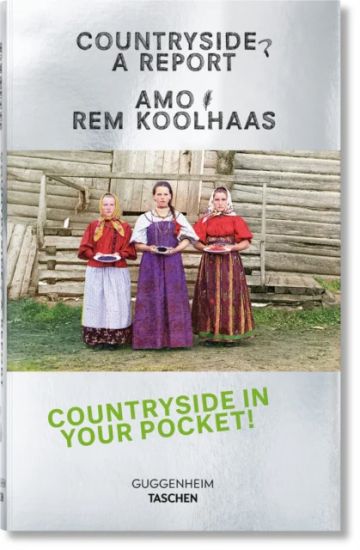
Koolhaas. Countryside, A Report

Koolhaas. Countryside, A Report

AMO; Rem Koolhaas

TASCHEN GMBH
2020
pokkari
From animals to robotization, climate change to migration, Rem Koolhaas presents a new collaborative project exploring how countryside everywhere is transforming beyond recognition. The official companion to the highly anticipated exhibition at New York's Guggenheim Museum, this pocketbook gathers in-depth essays spanning from Fukushima to the...
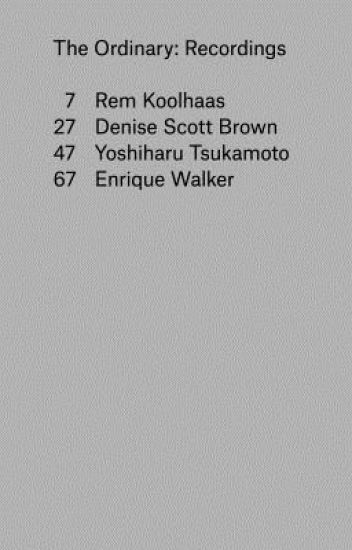
The Ordinary – Recordings

The Ordinary – Recordings

Rem Koolhaas; Denise Scott Brown; Yoshiharu Tsukamoto; Enrique Walker

Columbia Books on Architecture and the City
2018
nidottu
Since the beginning of the century, the field of architecture has fervently turned its attention to documenting the contemporary urban condition. Every city been has been examined as a repository of architectural concepts, scrutinized as an urban manifesto, and recorded as a series of found objects. The Ordinary articulates a potential genealogy for this practice and for the genre of books derived from it. Organized around conversations with the authors of three seminal texts that document the city-Denise Scott Brown's Learning from Las Vegas (1972), Rem Koolhaas's Delirious New York (1978), and Yoshiharu Tsukamoto's Made in Tokyo (2001)-this volume traces the history of these "books on cities" by examining the material they recorded, the findings they established, the arguments they advanced, and the projects they promoted. These conversations also question the assumptions underlying this practice and whether in its ubiquity it still remains a space of opportunity.
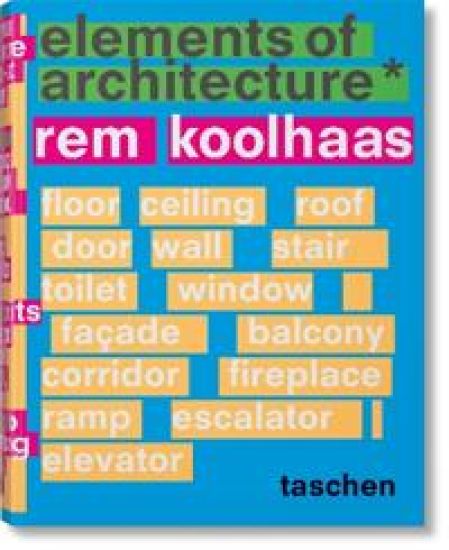
Koolhaas. Elements of Architecture

Koolhaas. Elements of Architecture

Rem Koolhaas

Taschen GmbH
2018
sidottu
Elements of Architecture focuses on the fragments of the rich and complex architectural collage. Window, façade, balcony, corridor, fireplace, stair, escalator, elevator and toilet: the book seeks to excavate the micro-narratives of building detail. The result is no single history, but rather the web of origins, contaminations, similarities, and differences in architectural evolution, including the influence of technological advances, climatic adaptation, political calculation, economic contexts, regulatory requirements, and new digital opportunities. It’s a guide that is long overdue—in Koolhaas’s own words, “Never was a book more relevant—at a moment where architecture as we know it is changing beyond recognition.” Derived, updated, and expanded from Koolhaas’s exhaustive and much-lauded exhibition at the 2014 Venice Architecture Biennale, this is an essential toolkit to understanding the fundamentals that comprise structure around the globe. Designed by Irma Boom and based on research from the Harvard Graduate School of Design, the 2,600-page monograph contains essays from Rem Koolhaas, Stephan Trueby, James Westcott and Stephan Petermann; interviews with Werner Sobek and Tony Fadell (of Nest); and an exclusive photo essay by Wolfgang Tillmans. In addition to comprehensively updated texts and new images, this edition is designed and produced to visually (and physically) embody the immense scope of its subject matter: Custom split-spine binding: our printer modified their industrial binding machine to allow for the flexible, eight-centimeter thick spine Contains a new introductory chapter with forewords, table of contents, and an index, located in the middle of the book (where it naturally opens due to its unique spine) Printed on 50g Opakal paper, allowing for the ideal level of opacity needed to realize Boom’s palimpsest-like design Translucent overlays and personal annotations by Koolhaas and Boom are woven in each chapter to create an alternative, faster route through the book Printed at the originally intended 100% size for full readability
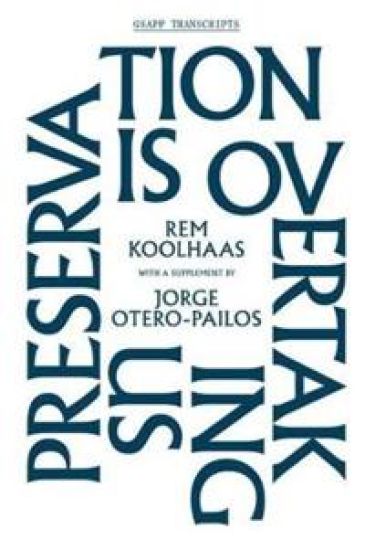
Preservation is Overtaking Us

Preservation is Overtaking Us

Rem Koolhaas; Jorge Otero–pailos; Jordan Carver; Mark Wigley

Columbia Books on Architecture and the City
2014
nidottu
Preservation is Overtaking Us brings together two lectures given by Rem Koolhaas at Columbia University's Graduate School of Architecture, Planning and Preservation, along with a response (framed as a supplement to the original lectures) by Jorge Otero-Pailos. In the first essay Koolhaas describes alternative strategies for preserving Beijing, China. The second talk marks the inaugural Paul Spencer Byard lecture, named in celebration of the longtime professor of Historic Preservation at GSAPP. These two lectures trace key moments of Koolhaas' thinking on preservation, including his practice's entry into China and the commission to redevelop the State Hermitage Museum in St. Petersburg, Russia. In a format well known to Koolhaas' readers, Otero-Pailos reworks the lectures into a working manifesto, using it to interrogate OMA's work from within the discipline of preservation.
Junkspace with Running Room

Junkspace with Running Room

Rem Koolhaas; Hal Foster

Notting Hill Editions
2013
sidottu
In Junkspace (2001), architect Rem Koolhaas itemises in delirious detail how our cities are being overwhelmed. His celebrated jeremiad is here updated and twinned with Running Room, a fresh response from architectural critic Hal Foster. 'The manifesto is a modernist mode, one that looks to the future… Junkspace makes no such claim: “Architecture disappeared in the twentieth century,” states Koolhaas matter-of-factly. Junkspace does a harder thing: it “foretells” the present, which is to say that it calls on us to recognize what is already everywhere around us.’ Hal Foster
London Dialogues

London Dialogues

Hans Ulrich Obrist; Rem Koolhaas

Skira
2012
nidottu
This volume inaugurates a new series of publications edited by three leading authors on the world's architectural and artistic scene: H.U.Obrist, Rem Koolhaas and Stefano Boeri. This series of dialogues conducted by Hans Ulrich Obrist and Rem Koolhaas is dedicated to the most topical subjects on the international scene. Protagonists of the British architectural, political, and artistic scene, including Brian Eno, Zaha Hadid, Doris Lessing, Damien Hirst, and Gilbert and George, amongst others, have been invited to speak about the near future.
Koolhaas/Obrist. Project Japan. Metabolism Talks

Koolhaas/Obrist. Project Japan. Metabolism Talks

Hans Ulrich Obrist; Rem Koolhaas

Taschen GmbH
2011
nidottu
“Once there was a nation that went to war, but after they conquered a continent their own country was destroyed by atom bombs... then the victors imposed democracy on the vanquished. For a group of apprentice architects, artists, and designers, led by a visionary, the dire situation of their country was not an obstacle but an inspiration to plan and think... although they were very different characters, the architects worked closely together to realize their dreams, staunchly supported by a super-creative bureaucracy and an activist state... after 15 years of incubation, they surprised the world with a new architecture—Metabolism—that proposed a radical makeover of the entire land... Then newspapers, magazines, and TV turned the architects into heroes: thinkers and doers, thoroughly modern men… Through sheer hard work, discipline, and the integration of all forms of creativity, their country, Japan, became a shining example... when the oil crisis initiated the end of the West, the architects of Japan spread out over the world to define the contours of a post-Western aesthetic....” —Rem Koolhaas / Hans Ulrich Obrist Between 2005 and 2011, architect Rem Koolhaas and curator Hans Ulrich Obrist interviewed the surviving members of Metabolism—the first non-Western avant-garde, launched in Tokyo in 1960, in the midst of Japan’s postwar miracle. Project Japan features hundreds of never-before-seen images—master plans from Manchuria to Tokyo, intimate snapshots of the Metabolists at work and play, architectural models, magazine excerpts, and astonishing sci-fi urban visions—telling the 20th-century history of Japan through its architecture. From the tabula rasa of a colonized Manchuria in the 1930s, a devastated Japan after the war, and the establishment of Metabolism at the 1960 World Design Conference in Tokyo to the rise of Kisho Kurokawa as the first celebrity architect, the apotheosis of Metabolism at Expo ’70 in Osaka, and its expansion into the Middle East and Africa in the 1970s: The result is a vivid documentary of the last moment when architecture was a public rather than a private affair. Oral history by Rem Koolhaas and Hans Ulrich Obrist Extensive interviews with Arata Isozaki, Toshiko Kato, Kiyonori Kikutake, Noboru Kawazoe, Fumihiko Maki, Kisho Kurokawa, Kenji Ekuan, Atsushi Shimokobe, and Takako and Noritaka Tange Hundreds of never-before-seen images, architectural models, and magazine excerpts Layout by award-winning Dutch designer Irma Boom Further reading
Delirious New York

Delirious New York

Rem Koolhaas

Monacelli Press
1997
pokkari
Since its original publication in 1978, Delirious New York has attained mythic status. Back in print in a newly designed edition, this influential cultural, architectural, and social history of New York is even more popular, selling out its first printing on publication. Rem Koolhaas's celebration and analysis of New York depicts the city as a metaphor for the incredible variety of human behavior. At the end of the nineteenth century, population, information, and technology explosions made Manhattan a laboratory for the invention and testing of a metropolitan lifestyle -- "the culture of congestion" -- and its architecture. "Manhattan," he writes, "is the 20th century's Rosetta Stone . . . occupied by architectural mutations (Central Park, the Skyscraper), utopian fragments (Rockefeller Center, the U.N. Building), and irrational phenomena (Radio City Music Hall)." Koolhaas interprets and reinterprets the dynamic relationship between architecture and culture in a number of telling episodes of New York's history, including the imposition of the Manhattan grid, the creation of Coney Island, and the development of the skyscraper. Delirious New York is also packed with intriguing and fun facts and illustrated with witty watercolors and quirky archival drawings, photographs, postcards, and maps. The spirit of this visionary investigation of Manhattan equals the energy of the city itself.
S, M, L, XL

S, M, L, XL

Rem Koolhaas; Bruce Mau

Monacelli Press
1997
sidottu
S,M,L,XL presents a selection of the remarkable visionary design work produced by the Dutch firm Office for Metropolitan Architecture (O.M.A.) and its acclaimed founder, Rem Koolhaas, in its first twenty years, along with a variety of insightful, often poetic writings. The inventive collaboration between Koolhaas and designer Bruce Mau is a graphic overture that weaves together architectural projects, photos and sketches, diary excerpts, personal travelogues, fairy tales, and fables, as well as critical essays on contemporary architecture and society.The book's title is also its framework: projects and essays are arranged according to scale. While Small and Medium address issues ranging from the domestic to the public, Large focuses on what Koolhaas calls "the architecture of Bigness." Extra-Large features projects at the urban scale, along with the important essay "What Ever Happened to Urbanism?" and other studies of the contemporary city. Running throughout the book is a "dictionary" of an adventurous new Koolhaasian language -- definitions, commentaries, and quotes from hundreds of literary, cultural, artistic, and architectural sources.