Kirjojen hintavertailu. Mukana 12 152 606 kirjaa ja 12 kauppaa.

Kirjailija

Remei Capdevila-Werning

Kirjat ja teokset yhdessä paikassa: 3 kirjaa, julkaisuja vuosilta 2013-2018, suosituimpien joukossa Goodman for Architects. Vertaile teosten hintoja ja tarkista saatavuus suomalaisista kirjakaupoista.

3 kirjaa

Kirjojen julkaisuhaarukka 2013-2018.

Mies Van Der Rohe: Barcelona-1929

Mies Van Der Rohe: Barcelona-1929

Remei Capdevila-Werning; Beatriz Colomina; Juan Jose Lahuerta; Laura Martinez de Guerenu; Dietrich Neumann; Fritz Neumeyer; Spyros Papapetros; Lutz Robbers; Carmen Rodriguez Pedret

Editorial Tenov S.L.
2018
sidottu
The expert contributors to this lavishly illustrated volume, devoted entirely to Mies van der Rohe's Barcelona Pavilion of 1929, address here for the first time the forgotten contexts of the Pavilion's genesis. Habitually thought of as an abstract, unpolluted, and splendidly isolated building--a precursor of Mies's American period--the Pavilion is revealed here as a thoroughly European work, perhaps less pristine but more authentic. Mies and Lilly Reich were commissioned to design not only the Pavilion but also more than one hundred thousand square feet of German stands spread throughout the Exposition. By examining that work in addition to the Pavilion itself, the contributors present a farreaching reinterpretation of the whole. They also explore connections with the mass media, highlight the work's antecedents and meaning in the history of architecture, and analyze the current pavilion, a reconstruction of the original built in 1986. No other critical study offers a comparable overview of Mies's work in Barcelona.
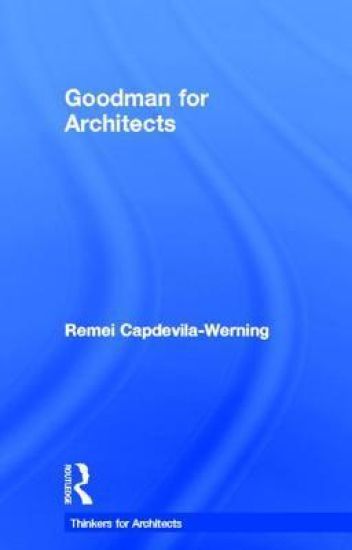
Goodman for Architects

Goodman for Architects

Remei Capdevila-Werning

Routledge
2013
sidottu
American philosopher Nelson Goodman (1906-1998) was one of the foremost analytical thinkers of the twentieth century, with groundbreaking contributions in the fields of logic, philosophy of science, epistemology, and aesthetics. This book is an introduction to the aspects of Goodman’s philosophy which have been the most influential among architects and architectural theorists.Goodman specifically discussed architecture in his major work on aesthetics, The Languages of Art: An Approach to a Theory of Symbols (1968), and in two essays "How Buildings Mean" (1985), and "On Capturing Cities" (1991). His main philosophical notions in Ways of Worldmaking (1978) also apply well to architecture. Goodman’s thought is particularly attractive because of its constructive aspect: there is not a given and immutable world, but both knowledge and reality are constantly built and rebuilt. Whereas other theories, such as deconstruction, implicitly entail an undoing of modern precepts, Goodman’s conception of world-making offers a positive, constructive way to understand how a plural reality is made and remade.Goodman’s approach to architecture is not only relevant thinking in providing new insights to understanding the built environment, but serves also as an illustration of analytical thinking in architecture. This book shows that the methods, concepts, and ways of arguing characteristic of analytical philosophy are helpful tools to examine buildings in a novel and fruitful way and they will certainly enhance the architect’s critical skills when designing and thinking about architecture.
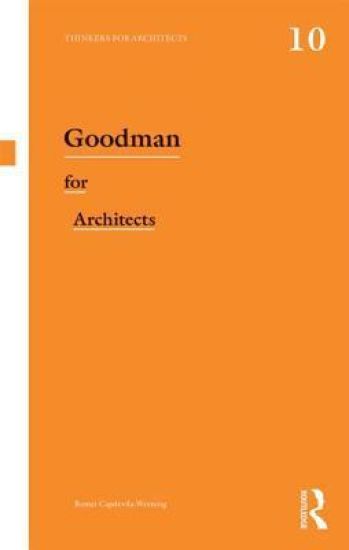
Goodman for Architects

Goodman for Architects

Remei Capdevila-Werning

Routledge
2013
nidottu
American philosopher Nelson Goodman (1906-1998) was one of the foremost analytical thinkers of the twentieth century, with groundbreaking contributions in the fields of logic, philosophy of science, epistemology, and aesthetics. This book is an introduction to the aspects of Goodman’s philosophy which have been the most influential among architects and architectural theorists.Goodman specifically discussed architecture in his major work on aesthetics, The Languages of Art: An Approach to a Theory of Symbols (1968), and in two essays "How Buildings Mean" (1985), and "On Capturing Cities" (1991). His main philosophical notions in Ways of Worldmaking (1978) also apply well to architecture. Goodman’s thought is particularly attractive because of its constructive aspect: there is not a given and immutable world, but both knowledge and reality are constantly built and rebuilt. Whereas other theories, such as deconstruction, implicitly entail an undoing of modern precepts, Goodman’s conception of world-making offers a positive, constructive way to understand how a plural reality is made and remade.Goodman’s approach to architecture is not only relevant thinking in providing new insights to understanding the built environment, but serves also as an illustration of analytical thinking in architecture. This book shows that the methods, concepts, and ways of arguing characteristic of analytical philosophy are helpful tools to examine buildings in a novel and fruitful way and they will certainly enhance the architect’s critical skills when designing and thinking about architecture.