Kirjojen hintavertailu. Mukana 12 595 353 kirjaa ja 12 kauppaa.

Kirjailija

René Chartrand

Kirjat ja teokset yhdessä paikassa: 62 kirjaa, julkaisuja vuosilta 1988-2024, suosituimpien joukossa Napoleon's Guns 1792–1815 (1). Vertaile teosten hintoja ja tarkista saatavuus suomalaisista kirjakaupoista.

Mukana myös kirjoitusasut: Rene Chartrand

62 kirjaa

Kirjojen julkaisuhaarukka 1988-2024.

Frontier Soldiers of New France Volume 1

Frontier Soldiers of New France Volume 1

Rene Chartrand; Kevin Gelinas

HELION COMPANY
2024
nidottu
Frontier Soldiers of New France examines the official and regulation dress, weapons and equipment of the regular colonial troops maintained by the French government in North America from 1683 to 1760, including unpublished information with a focus on new illustrations, line drawings, and photos of rare portraits and surviving artefacts from public and private collections.This volume is the first of a series of three that will present all the regular forces that served in New France from 1683, when the first permanent garrisons of royal troops arrived, to September 1760. Many North American military campaigns of that era have been, and continue to be, covered in countless history books. The purpose of this work is, however, to be the first to present in detail the organisation and especially the material culture of all military participants, be they generals or private soldiers. There have been some sections of books, usually brief, and articles devoted to organisation, armament, dress, and equipment previously published. The aim of this work is to present a complete record of these aspects.To achieve this goal, three veteran researchers have consulted primary documents preserved in archives and collections on both sides of the Atlantic during the last half century and have united their efforts to produce a wide-ranging and as accurate as possible record. The result is often intriguing and attractive, both in the regulation uniforms worn by officers and soldiers that might be seen by onlookers at frontier forts as far as the known world (to Europeans) or at fortresses such as Qu bec and Louisbourg. The weapons and equipment were usually somewhat distinctive. They had weapons, clothing and equipment that became specially adapted to North America's wilderness, thanks to their First Nations allies, be it in the primaeval forests crisscrossed by great rivers and lakes or at the great central plains, which will be covered in volume 2. Volume 3 will be devoted to the battalions detached from the French regular metropolitan army commanded, from 1756, by Montcalm who led an arguably heroic resistance against overwhelming British and American forces. They, too, had surprising aspects of material culture; for instance, the battalions that came in 1755 had different uniforms in Canada than their regulation dress in France.The work is illustrated with period paintings and prints, as well as museum-quality artwork by internationally acclaimed military artists lauded for accuracy combined with fine art. Indeed, some works have already graced academic publications and displays in museums and historic sites.
Armies and Wars of the French East India Companies 1664-1770
From the early seventeenth century a multitude of French East or West India companies holding overseas trade monopolies and privileges were active in various parts of the world, especially in Africa and Asia. From 1719, they were united into a single vast Compagnie des Indes (Company of the Indies) known to the anglophone world as the French East India Company, It was far more than that, for its trade privileges also covered Africa, other places in Asia from Arabia to China, and North America.Besides a multitude of usually modestly fortified trade lodges and factories, these companies were the actual government representing the Kingdom of France over substantial parts of Africa, India and the Indian Ocean islands as well as Louisiana in America from 1716 to 1731. The profits were expected to cover government operations. The companies had the power 'to make war' where they operated and thus private-sector military conflicts often occurred. They therefore maintained their own private armies and navies that were totally independent from those of the King of France.These private troops were usually very modest until the formation of the Compagnie des Indes in 1719. Thereafter, as the French company expanded and became involved in the politics of the crumbling Mughal Empire in India, especially during the rule of the imperial visionary Dupleix, the fairly modest number of European soldiers was greatly expanded by enlisting many thousands of Indian soldiers who were given European training, weapons and sometimes uniforms. It was at the 1746 Battle of Aydar that Compagnie des Indes French soldiers and sepoys utterly defeated a far larger Indian princely army so that dominance of a European nation in India was assured. After a hard fight, though, that nation would be Great Britain thanks to good and effective support of its government compared to the French disinterest in overseas matters by the late 1750s. Pondicherry fell in 1761 as Senegal in Africa had three years earlier. The Compagnie des Indes, however, went on for another decade until it closed its books in 1770.The monopoly companies had quite a variety of troops posted in many places. The port of Lorient in France was, from the later seventeenth century, the European troops' depot and training center. Some served as marines on the company ships, others in a multitude of forts and loges on three continents. Their recruitment, and command are described. In India, their tactical role multiplied and led to having units of gunners, horse grenadiers, dragoons, hussars, grenadiers, all with very distinct uniforms. There were sepoy, topas and caffre units as well as auxiliary allied princely armies in India, and trained auxiliary soldiers in Africa. The few royal army soldiers sent to India in the late 1750s are also considered. All Indian, African and metropolitan army troops are covered and described in this fully illustrated study.
Victoria's Militia

Victoria's Militia

Rene Chartrand

Winged Hussar Publishing, LLC
2023
sidottu
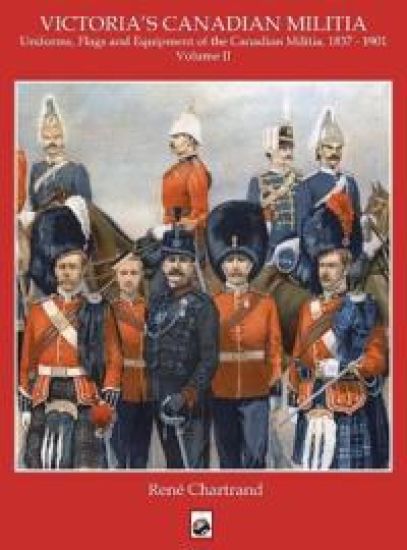
A military history of Canadian militia prior to World War I Volume II of the history of the Canadian Armed forces prior to World War I with complete units histories, uniforms, flags and equipment in color.
The Armies and Wars of the Sun King 1643-1715  Volume 4
This fourth and final part of our study concentrates on the early 18th century War of Spanish Succession. It was the largest and most difficult conflict in Europe since the Thirty Years War and unsurpassed until the Napoleonic Wars. It started because of Bourbon France and Habsburg Austria’s conflicting candidates to the Spanish that soon involved other nations such as Great Britain and the Netherlands. It was mostly fought on three fronts: Flanders, northern Italy and Spain. Due to various factors, it proved to be a very difficult period for the Sun King. During the first decade, there were repeated and massive defeats in Flanders and Germany where French princes and marshals proved to be unequal to the genial Duke of Marlborough and the competent Prince Eugene. The hard-pressed French forces in the northern Italian front eventually collapsed in 1706. The Spanish front, although it started badly for Felipe V, the French pretender, things improved and the allied troops supporting the Austrian Carlos III were decisively defeated in 1707, again in 1710 and finally at Barcelona in 1714. Meanwhile, following the hard fought battle at Malplaquet, the main French armies, that were amazingly resilient reflecting the nation’s tenacity from the Sun King to the humblest folks, now had some success under Marshal Villars culminating in the strategic 1712 victory at Denain. This led to many previous allied gains now being lost. This was happening when Great Britain basically withdrew its support for the war. The treaties signed from 1713 basically gave the Sun King and France what it most wanted: Felipe V as King of Spain and its empire. It was a hard fought conflict but, in the end, France won. The study then discusses the economic and the serious climactic effects notably brought about by the awful winter of 1708-1709 in France that was also severe in other countries. The economic pressure was enormous on the Sun King’s government, but it finally managed to go through it thanks to the amazing resilience of the French economy. French histories often state it was catastrophic, yet Britain’s economy had a national debt rising up to four times faster than France’s and this was obviously a factor in Britain’s withdrawal from the alliance. The French army’s technical and support services, many of which were the first to be organised as corps befitting a modern army, are next presented. The artillery that was totally militarised and its materiel modernised to standards copied by all other nations. Engineering under the guidance of Marshal Vauban became peerless and imitated in all nations. Up to the Sun King’s time, old and crippled veteran soldiers were left to a pauper’s miserable survival; he first introduced a pension system and, in the 1670s, had the splendid Invalides hospital built in Paris to care for these soldiers. We will also glance at what religious personnel was attached to army units and hospitals to care for soldiers broken bodies and souls. Since Medieval times in France, troops that were considered part of the army were specifically concerned with controlling bandits and applying the law under the command of a Marshal. Their original name of archers remained long after they adopted firearms and they could be found in all parts of France. They still are today, but under the name of gendarme in most countries. They were often veteran soldiers and this section will also feature what punishments a soldier could expect when condemned of some wrongdoing. Many towns and cities had their own regular local troops on duty as garrisons and security corps and we describe a number of these well appointed and effective soldiers, some of whom saw action. A fairly large section is devoted to the reserve forces. France had three types of militias. The best-known is the 1688 Royal Militia, which was the first integrated system leading to what became national conscription for military service in the regular armies. Next to unknown are the Coast Guard Militia organisation that might might muster 150,000 men and, most of all, the Bourgeois Militia in all the cities and towns of the realm that probably amounted to some half a million men, many of them well armed and uniformed. This section includes a number of notices describing the Bourgeois Militias and their Privileged companies showing an almost totally unknown sedentary “territorial” army that performed well in the few times when some were called upon. The last section will be a look at the social life of soldiers, their “families”, camp followers and and sutlers. There were many women and children in the wake of regiments, as prints show and some documents elude, but they were not officially recognised in the army yet should not be forgotten.
The Armies and Wars of the Sun King 1643-1715
The volume starts in an age of intolerance: the Protestant tragedy in France and the Irish tragedy. Tens of thousands of Protestants fled France. Various military and political events of the later 1680s, notably the “Glorious Revolution” of 1688 that chased out King James II and installed William of Orange as King William III of Great Britain led to hostilities in 1689-1691 with Ireland being secured by William. Both had considerable impact on the armies of western Europe. Tens of thousands of officers and soldiers fled France for other nations and also left Ireland for France and later Spain. Much has been said about the loss of Protestant soldiers to the French army, but less known is that the Irish Catholic military refugees certainly compensated losses in the French army and later also boosted the Spanish army. William’s accession to the British throne also meant that Great Britain resolutely now joined the Holy Roman Empire, the Netherlands, Brandenburg-Prussia and other nations opposed to Louis XIV’s France that formed the League of Augsburg. In effect, Britain joined Europe in a large military alliance and all-out war broke out in 1689. This was not good news for Louis XIV; although the British army was not formidable, it was an efficient force and a large part of it would, for the first time, join its allies on the continent. The other main European armies had also learned a lot from the French army and had adopted many of its features; the Blitzkrieg campaigns were over. In the successive battles and sieges of the war, the allied armies could equal the French in combat, but the Sun King’s commanders, on the whole, were still the finest. Cohesion in command plagued the allies, but good commanders were rising there too, notably Prince Eugene of the imperial army. Several chapters will go through the campaigns on the two main fronts: Flanders and western Germany, and Catalonia in Spain. On the whole, the early battles such as Fleurus, Leuze, Steenkirk and Neerwinden were hard-won successes for the French armies; there were many sieges and the two of Namur (1692 captured by the French, retaken by the allies in 1695) stand out. By 1697, all belligerents were nearly exhausted, but the French army prevailed in Catalonia and took Barcelona. Peace was concluded shortly thereafter and it was a draw as to who really won the war. An important topic, sometime noted in histories, but rarely faced is the brutality and cruelty by soldiers on largely defenceless civilians as well as the devastation, sacking and burning of homes, villages and towns attained new dimensions during this period. Encouraged by government authority, the persecution of Protestants within France and of Catholics in Ireland showed that such behaviour by French and British troops on their own populations could even be rewarded with approval by the righteous church and state. With instructions from Minister of War Louvois, troops were specifically encouraged to devastate the Palatinate including the outrageous destruction of the university town of Heidelberg. However, after the passing of Louvois in 1691 and the exile and subjection of Ireland, there was certainly disgust and a realisation that hatred had its limits. Some civility reappeared by the mid-1690s and would eventually evolve into the 18th century mannerism of the so-called “Lace Wars”. The French army in the west still relied on the Ottoman Turks to keep a good part of the Austrian and German state armies watching their eastern borders. The failure of the 1683 siege of Vienna had certainly not ended the Ottoman menace and much more fighting went on in the 1680s and 1690s. The end of the 17th century saw the beginnings of the rise of Russia under its extraordinary Tzar Peter I and also of Prussia at the expense of Poland and Sweden in a complex situation that went into the early 18th century. The Dutch War had given rise to very numerous armies and the War of the League of Augsburg attained new heights with French armies in the field nearing half a million men. Clearly, recruiting volunteers had reached its limits and, in late 1688, the Sun King created the Royal Militia that heralded large-scale obligatory military service in modern Europe. From then on, the Sun King could enlist tens of thousands of, usually, peasants to fill the ranks of the numerous armies he maintained. Maintaining such forces required considerable funds that taxes simply could not meet. Various extra taxes were introduced in France, with very limited success so that borrowing ended up being the main option. The fiscal pressure was also tremendous on the opposing allied armies either directly through their own taxes and also with subsidies from the more capitalised trading countries, England and the Netherlands, whose almost untenable credit situation led to the creation of Bank of England - the first modern government bank - to manage credit and debt. France and Austria did not create such banks yet but managed these aspects well so that there were enough funds to field huge armies on both sides, but not indefinitely. Part 2 The Cavalry. This section describes what was by very far Europe’s largest cavalry force. It included the Gendarmerie de France, which was a privileged division between the guards and the line cavalry. The line cavalry evolved from a fairly standard heavy cavalry force in the 1640s to a more complex arm of the service that first added numerous dragoon regiments in the 1670s, a division of rifled-armed elite carabiniers in the 1690s and also the advent of Hussars as light cavalry at that time. The peculiar organisation of the cavalry with its Mestre de Camp Général, Colonel Général is also described and some of its personalities had rather colourful careers. Arms, accoutrements and dress of the cavalry are discussed and also, the horses and the never-attained challenge of furnishing enough for some 60,000 troopers in the 1690s. By comparison, British cavalry hovered at about 7,000. This included efforts to develop better breeding and the advent of “dressage” as we know it today from France’s Louis XIVs era. The Wild Geese This expatriate force of Irish officers and men formed quite a different type of force. They were not mercenaries as other foreign regiments. They either belonged to the army that came with James II to France and, in the 1690s, formed his distinct army or served in the Irish regiments that formed a division within the French army. The Sun King subsided everything and it was a very good investment. One benefit was that he gained Berwick, a leading future marshal of France. The Irish were fine soldiers and, in time, also integrated into French society with success in government and business besides the army. As in previous volumes, the last part of Vol. 3 features a large appendice listing all the regiments of the French cavalry from 1643 to 1715. Other appendices concern uniforms as described in the main contemporary sources. There will further be at least one appendice on opponent armies, certainly the Austrian army in this volume. Another topic is a list of French Protestant regiments in the British army.
The Armies and Wars of the Sun King 1643-1715. Volume 2
The reign of Louis XIV of France had a great impact on the course of European and world military history. The years 1643 to 1715 were a defining epoch for western military, diplomatic, and economic matters. Most of those years were marked by conflict between major European powers and the Sun King’s forces. This four-volume series is the first that present an extensive account of the many facets of the French army and the wars it fought. It was an era during which the Sun King’s and eventually all armies saw extraordinarily significant changes such as: the advent of very large professional armies, increasingly centralized command systems, professional training for officers and men, introduction of obligatory military service, improvements in discipline and control, technical advances regarding armament thus affecting battlefield tactics, marked progress regarding fortifications, introduction of uniforms, logistics capable of supplying large armies, financial practices that permitted the upkeep and pay large military forces. The above and even more factors produced many influences that weighted heavily in European geo-political and geo-strategic maters. In these, the Sun King largely dominated Europe’s agenda from the time he took effective autocratic power in 1661 to his last moments in 1715. Since his army was, initially, the largest, most modern and effective in Europe, he had success to the point that neighbouring countries formed coalitions to stop him. However, the Sun King was a master at geo-strategy, notably regarding the balance that he managed to maintain with the Ottoman Empire whose forces always threatened the eastern frontiers of France’s opponents. Thus, France’s forces were always sufficient to keep enemies mostly on the defensive; it was unthinkable that they would ever reach Paris. These and many more topics are presented in this four volume work. Each volume is basically in two parts. The first part is the era of the wars and their context, the second part consist of a detailed look at a part of the French army. The appendices present certain aspects such as uniform lists of the period and evaluations of opponent and allied armies of the Sun King’s forces.
Raiders from New France

Raiders from New France

René Chartrand

Osprey Publishing
2019
nidottu
Though the French and British colonies in North America began on a 'level playing field', French political conservatism and limited investment allowed the British colonies to forge ahead, pushing into territories that the French had explored deeply but failed to exploit. The subsequent survival of 'New France' can largely be attributed to an intelligent doctrine of raiding warfare developed by imaginative French officers through close contact with Indian tribes and Canadian settlers. The ground-breaking new research explored in this study indicates that, far from the ad hoc opportunism these raids seemed to represent, they were in fact the result of a deliberate plan to overcome numerical weakness by exploiting the potential of mixed parties of French soldiers, Canadian backwoodsmen and allied Indian warriors.Supported by contemporary accounts from period documents and newly explored historical records, this study explores the 'hit-and-run' raids which kept New Englanders tied to a defensive position and ensured the continued existence of the French colonies until their eventual cession in 1763.
The Armies and Wars of the Sun King 1643-1715
The reign of Louis XIV of France had a great impact on the course of European and world military history. The years 1643 to 1715 were a defining epoch for western military, diplomatic and economic matters. Most of those years were marked by conflict between major European powers and the Sun King’s forces. This four volume series is the first that present an extensive account of the many facets of the French army and the wars it fought. It was an era during which the Sun King’s and eventually all armies saw extraordinarily significant changes such as: the advent of very large professional armies; increasingly centralized command systems; professional training for officers and men; introduction of obligatory military service, improvements in discipline and control; technical advances regarding armament thus affecting battlefield tactics; marked progress regarding fortifications; introduction of uniforms; logistics capable of supplying large armies; financial practices that permitted the upkeep and pay large military forces. The above and even more factors produced many influences that weighted heavily in European geo-political and geo-strategic maters. In these, the Sun King largely dominated Europe’s agenda from the time he took effective autocratic power in 1661 to his last moments in 1715. Since his army was, initially, the largest, most modern and effective in Europe, he had success to the point that neighbouring countries formed coalitions to stop him. However, the Sun King was a master at geo-strategy, notably regarding the balance that he managed to maintain with the Ottoman Empire whose forces always threatened the eastern frontiers of France’s opponents. Thus, France’s forces were always sufficient to keep enemies mostly on the defensive; it was unthinkable that they would ever reach Paris. These and many more topics are presented in this four volume work. Each volume is basically in two parts. The first part is the era of the wars and their context, the second part consist of a detailed look at a part of the French army. The appendices present certain aspects such as uniform lists of the period and evaluations of opponent and allied armies of the Sun King’s forces. Volume 1 deals with the Sun King’s early years, from his birth in 1638, the resounding victory of Rocroi when he was five and a child king, the unstable years of the Fronde civil wars, his seizure of absolute power in 1661, the initial foreign military adventures culminating with the French army’s blitzkriegs of 1667-1668. This is followed by a look at the command systems, short biographies of the senior officers, their own guards, their lifestyles and orders of chivalry. Closing with several chapters on the Royal Guard including their more mundane or obscure duties with their battle record, uniforms and material culture. Of the appendices, the largest is devoted to the opponent Spanish army of the 17th century. This volume, like the three others, has about 200 illustrations, most in colour, taken from contemporary sources joined by many works by now nearly forgotten 19th century eminent military illustrators such as Marbot, Titeu, Philippoteaux and JOB. As a bonus, each volume has five especially commissioned colour plates of three figures each showing usually never before seen uniforms reconstructed from descriptions and three especially commissioned colour plates showing colours and standards.
French Naval & Colonial Troops 1872–1914

French Naval & Colonial Troops 1872–1914

René Chartrand

Osprey Publishing
2018
nidottu
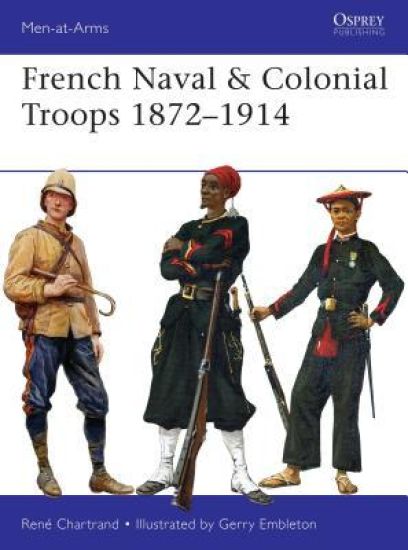
A fully illustrated study of the colourful regiments raised for France's late 19th-century colonial wars in Africa and Vietnam.France's colonial wars in sub-Saharan Africa and South-East Asia were very largely fought by an organization completely separate from both the home-defence Metropolitan Army and the Armée d'Afrique in Algeria. The Naval Troops (Troupes de la Marine) were volunteers, and earned a reputation for greater toughness and hardiness than the conscripted Metropolitan Army. Spread throughout the French Empire, Naval Troops in this period were characterized by very large infantry and artillery regiments based in France, mixed race regiments (Régiments Mixtes), and entire native regiments raised in West Africa, Madagascar and Indochina. The latter, the so-called 'Tirailleurs’ were organized and led by officers and cadres from the Naval Troops, and wore very varied and colourful uniforms based on formalized versions of traditional local costumes.French Naval & Colonial Troops 1872–1914 uses rich and detailed full colour plates as well as thorough analysis to detail the story of these tough colonial units which bore the brunt of French colonial campaigns in Africa and Vietnam.
The Vikings

The Vikings

René Chartrand; Keith Durham; Mark Harrison; Ian Heath

Osprey Publishing
2016
sidottu
The history of the Vikings is bloody and eventful, and Viking warriors capture the popular imagination to this day. They made history, establishing the dukedom of Normandy, providing the Byzantine Emperors’ bodyguard and landing on the shores of America 500 years before Columbus. Beautifully illustrated with colour photographs and original Osprey artwork, this book presents a new window into their way of life including detailed studies of the Hersir, the raiding warrior of the Viking world, and the legendary Viking longship.
Forts of the American Revolution 1775-83

Forts of the American Revolution 1775-83

René Chartrand

Osprey Publishing
2016
nidottu
Though primarily fought in the field, the American Revolution saw fortifications play an important part in some of the key campaigns of the war.Field fortifications were developed around major towns including Boston, New York and Savannah, while the frontier forts at Stanwix, Niagara and Cumberland were to all be touched by the war. This book details all the types of fortification used throughout the conflict, the engineers on all sides who constructed and maintained them, and the actions fought around and over them.
Montcalm’s Crushing Blow

Montcalm’s Crushing Blow

René Chartrand

Osprey Publishing
2014
nidottu
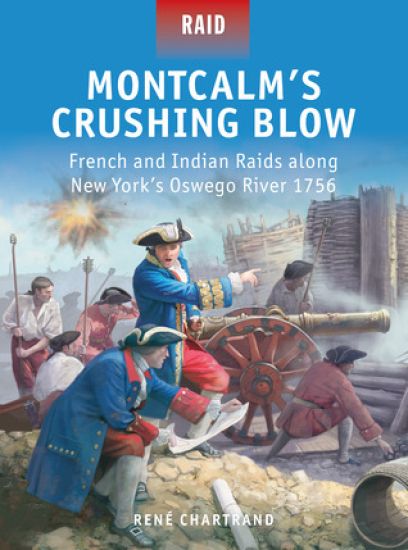
The year 1755 saw the rivalry between Britain and France in North America escalate into open warfare as both sides sought to overcome the other’s forts and trading posts. Lord Loudoun and the Marquis de Montcalm were sent out to lead their forces and Montcalm was soon tasked with capturing the formidable Anglo-American post at Oswego. Montcalm’s 3,000-strong force surrounded the forts at Oswego and soon forced the defenders to surrender – an outstanding French success. Featuring specially commissioned full colour artwork, expert analysis, and lively narrative, this engaging study casts light on a daring feat of arms at the height of the French and Indian War.
French Musketeer 1622–1775

French Musketeer 1622–1775

René Chartrand

Osprey Publishing
2013
nidottu
The works of French novelist Alexandre Dumas have been reproduced time and again on stage and screen. Based on a genuine memoir by an officer named D’Artagnan, Dumas published The Three Musketeers. The King’s Musketeers were formed in 1622 and were populated by young men of noble birth, but often of poorer means. The Musketeers served as a form of military academy, which enabled these men to qualify for commission into the regular army, but the academy was not just a schoolroom - the Musketeers served in all major battles and campaigns of the period; their reputation for bravery was well deserved. This title explores the history behind the legends created by Dumas. Drawing on historical and fascinating accounts the truth of this most colourful and flamboyant of units is revealed.
Talavera 1809

Talavera 1809

René Chartrand

Osprey Publishing
2013
nidottu
A highly illustrated account of the battle of Talavera in 1809, one of the major battles of the Peninsular War.The battle of Talavera in 1809 was one of the major battles of the Peninsular War and Arthur Wellesley’s first victory in Spain itself, following which he was created Viscount Wellington of Talavera and Wellington. Although Wellesely’s forces were outnumbered, and a sizeable contingent of the Spanish ran away, he had chosen a superb defensive position and was able to beat off successive French attacks, though at a heavy cost in terms of casualties.Although the French had withdrawn leaving Wellesley the master of the field, his high casualties and approaching French reinforcements led to Wellesley withdrawing to Portugal. His foray into Spain had an enormous effect on Spanish morale as they realized they were not alone in the struggle. British redcoats had had got to within 70km of Madrid, and they would return in future years.With full-colour maps, as well as contemporary prints and illustrations, this detailed yet concise volume examines the battle in detail.
Oldest Allies

Oldest Allies

René Chartrand

Osprey Publishing
2012
nidottu
Although somewhat overshadowed by Wellington's main campaign in the north, the Alcantara raid was an outstanding success. The primary objective of alarming and distracting the French forces in Spain was achieved. Furthermore, the raiders also succeeded in preventing a French incursion into Portugal and tied down one of Napoleon's best marshals. There were further raids to come, but the 1809 Alcantara raid delivered a strong, permanent message: that the Anglo–Portuguese were willing and able to strike back against the French, and that they would support their Spanish allies as much as they were able.
Forts of the War of 1812

Forts of the War of 1812

René Chartrand

Osprey Publishing
2012
nidottu
When war broke out between the United States and Great Britain in 1812, neither side was prepared for the conflict, as evidenced by their respective fortifications.The most sophisticated and modern fortifications were those built by the US Corps of Engineers to protect some of the main port cities. These included Fort Mifflin in Philadelphia, Fort McHenry in Baltimore and Castle William in New York. The British also heavily fortified their main harbor at Halifax and their main center of power at Quebec. However, elsewhere, especially in the interior, fortifications were old, neglected or only hastily erected. The forts at Detroit and Mackinac were much as the British had left them in 1796.This book covers all of the main fortifications of the conflict, those that faced the crashing of guns and those whose intimidation played a part in the grand strategy of the war.
Tomahawk and Musket

Tomahawk and Musket

René Chartrand

Osprey Publishing
2012
nidottu
In 1758, at the height of the French and Indian War, British Brigadier General John Forbes led his army on a methodical advance against Fort Duquesene, French headquarters in the Ohio valley. As his army closed in upon the fort, he sent Major Grant of the 77th Highlanders and 850 men on a reconnaissance in force against the fort. The French, alerted to this move, launched their own counter-raid. 500 French and Canadians, backed by 500 Indian allies, ambushed the highlanders and sent them fleeing back to the main army. With the success of that operation, the French planed their own raid against the English encampment at Fort Ligonier under less than fifty miles away. With only 600 men, against an enemy strength of 4,000, he ordered a daring night attack on the heart of the enemy encampment. This book tells the complete story of these ambitious raids and counter-raids, giving in-depth detail on the forces, terrain, and tactics.
Japanese War Art and Uniforms 1853-1930

Japanese War Art and Uniforms 1853-1930

Rene Chartrand

Schiffer Publishing Ltd
2011
sidottu
This beautifully illustrated book reviews the extraordinary evolution of Japan’s military institutions at a period of enormous transformation. Conversely, as this book shows with many fine color plates, Japanese art deeply influenced emergent impressionist Western artists. The uniforms, equipment and ships are shown with much realism while keeping the tradition of great art. For the first time in art history as well as military history, this book documents what the prints show thanks to extremely rare early military regulations and related documents whose illustrations are also exquisite if totally unknown.
The Spanish Army in North America 1700–1793

The Spanish Army in North America 1700–1793

René Chartrand

Osprey Publishing
2011
nidottu
Long before England established a serious presence in the New World, Spain had already established an overseas Empire.In North America, this included vast tracts of territory including most of what today comprises the states of Florida, Arizona, Nevada, New Mexico, Texas, Alabama, Illinois and California. In later years, as the British and the French came to expand their claims, they often came into conflict with the Spanish. The Spanish also played a significant part during the American Revolution, fighting against the British and drawing off forces needed to fight the Americans.This book covers all of the North American Spanish forces that fought in the campaigns of the 18th century.