Kirjojen hintavertailu. Mukana 12 595 353 kirjaa ja 12 kauppaa.

Kirjailija

René de Borst

Kirjat ja teokset yhdessä paikassa: 3 kirjaa, julkaisuja vuosilta 2012-2017, suosituimpien joukossa Nonlinear Finite Element Analysis of Solids and Structures. Vertaile teosten hintoja ja tarkista saatavuus suomalaisista kirjakaupoista.

3 kirjaa

Kirjojen julkaisuhaarukka 2012-2017.

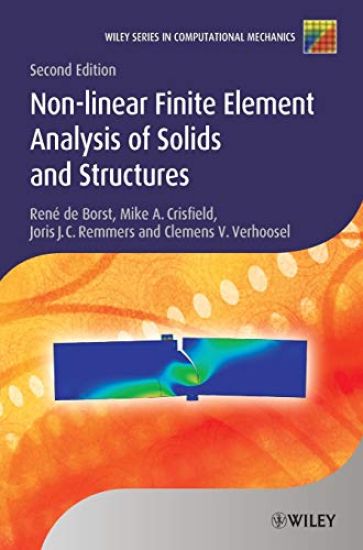
Nonlinear Finite Element Analysis of Solids and Structures

Nonlinear Finite Element Analysis of Solids and Structures

René de Borst; Mike A. Crisfield; Joris J. C. Remmers; Clemens V. Verhoosel

John Wiley Sons Inc
2012
sidottu
Built upon the two original books by Mike Crisfield and their own lecture notes, renowned scientist René de Borst and his team offer a thoroughly updated yet condensed edition that retains and builds upon the excellent reputation and appeal amongst students and engineers alike for which Crisfield's first edition is acclaimed. Together with numerous additions and updates, the new authors have retained the core content of the original publication, while bringing an improved focus on new developments and ideas. This edition offers the latest insights in non-linear finite element technology, including non-linear solution strategies, computational plasticity, damage mechanics, time-dependent effects, hyperelasticity and large-strain elasto-plasticity. The authors' integrated and consistent style and unrivalled engineering approach assures this book's unique position within the computational mechanics literature. Key features: Combines the two previous volumes into one heavily revised text with obsolete material removed, an improved layout and updated references and notationsExtensive new material on more recent developments in computational mechanicsEasily readable, engineering oriented, with no more details in the main text than necessary to understand the concepts.Pseudo-code throughout makes the link between theory and algorithms, and the actual implementation.Accompanied by a website (www.wiley.com/go/deborst) with a Python code, based on the pseudo-code within the book and suitable for solving small-size problems. Non-linear Finite Element Analysis of Solids and Structures, 2nd Edition is an essential reference for practising engineers and researchers that can also be used as a text for undergraduate and graduate students within computational mechanics.
Encyclopedia of Computational Mechanics, 6 Volume Set

Encyclopedia of Computational Mechanics, 6 Volume Set

Erwin Stein; René de Borst; Thomas J. R. Hughes

Wiley-Blackwell
2017
sidottu
An extensively expanded and revised edition of the leading major reference work in computational engineering The completely updated and extended second edition of Encyclopedia of Computational Mechanics, Second Edition has, once again, been prepared under the guidance of three of the world's foremost experts in the field. It follows the same structure as the first edition, yet has been expanded from three to six full volumes to give readers a more in-depth and complete understanding of the topic. Volumes 1 & 2 (Fundamentals) contain contributions related to mathematics, mechanics, and computer science, and are structured as discretization methods, treating approximations with finite differences, discrete variational forms, boundary integral equations and further problem-oriented techniques, mesh-based and meshfree discretizations and the generation and visualization of geometry; Isogeometric analysis as well as various direct and iterative solvers; time-dependent parabolic problems and FEMs for the Maxwell equation; further, new chapters on uncertainty quantification and related stochastic solution methods are included. Volumes 3 & 4 (Solids and Structures) are organized into five different parts, namely, structural behavior; constitutive theories and their implementation; materials and processing; interaction problems; and identification, stochastics, and optimization. Volumes 5 & 6 (Fluids) build on the fundamentals of the first volumes, and offer four main groups that describe additional basic methodologies used in computational fluid dynamics; cover the various aspects of incompressible viscous flows; focus on compressible fluid dynamics; and address problems involving moving domains and free surfaces, and application areas. The single most comprehensive reference on computational mechanics18 new chapters added representing a more than 20% increase over current editionExtensive revision plan with major updates to the majority of existing articlesCovers solid and fluid mechanics, with extensive treatment of FEA and CFD techniques With contributions from leading experts around the globe, this is an essential and comprehensive reference for any university engineering department or corporation, and contains invaluable, up-to-date content for researchers, students, and practitioners alike.
Computational Methods for Fracture in Porous Media

Computational Methods for Fracture in Porous Media

René de Borst

Elsevier / The Lancet
2017
nidottu
Computational Methods for Fracture in Porous Media: Isogeometric and Extended Finite Element Methods provides a self-contained presentation of new modeling techniques for simulating crack propagation in fluid-saturated porous materials. This book reviews the basic equations that govern fluid-saturated porous media. A multi-scale approach to modeling fluid transport in joins, cracks, and faults is described in such a way that the resulting formulation allows for a sub-grid representation of the crack and fluid flow in the crack. Interface elements are also analyzed with their extension to the hydromechanical case. The flexibility of Extended Finite Element Method for non-stationary cracks is also explored and their formulation for fracture in porous media described. This book introduces Isogeometric finite element methods and its basic features and properties. The rapidly evolving phase-field approach to fracture is also discussed. The applications of this book’s content cover various fields of engineering, making it a valuable resource for researchers in soil, rock and biomechanics.