

Kirjailija
René Girard
Kirjat ja teokset yhdessä paikassa: 51 kirjaa, julkaisuja vuosilta 1976-2025, suosituimpien joukossa Violent Origins. Vertaile teosten hintoja ja tarkista saatavuus suomalaisista kirjakaupoista.
Mukana myös kirjoitusasut: Rene Girard
51 kirjaa
Kirjojen julkaisuhaarukka 1976-2025.

The One by Whom Scandal Comes
Rene Girard; M. B. (TRN) Debevoise
Michigan State University Press
2014
pokkari
"Why is there so much violence in our midst?" Rene Girard asks. "No question is more debated today. And none produces more disappointing answers." In Girard's mimetic theory it is the imitation of someone else's desire that gives rise to conflict whenever the desired object cannot be shared. This mimetic rivalry, Girard argues, is responsible for the frequency and escalating intensity of human conflict. For Girard, human conflict comes not from the loss of reciprocity between humans but from the transition, imperceptible at first but then ever more rapid, from good to bad reciprocity. In this landmark text, Girard continues his study of violence in light of geopolitical competition, focusing on the roots and outcomes of violence across societies latent in the process of globalisation. The volume concludes in a wide-ranging interview with the Sicilian cultural theorist Maria Stella Barberi, where Girard's twenty-first century emphases on the continuity of all religions, global conflict, and the necessity of apocalyptic thinking emerge.

When These Things Begin
Rene Girard; Trevor Cribben (TRN) Merrill
Michigan State University Press
2014
pokkari
In this lively series of conversations with writer Michel Treguer, Rene Girard revisits the major concepts of mimetic theory and explores science, democracy, and the nature of God and freedom. Girard affirms that "our unprecedented present is incomprehensible without Christianity." Globalisation has unified the world, yet civil war and terrorism persist despite free trade and economic growth. Because of mimetic desire and the rivalry it generates, asserts Girard, "whether we're talking about marriage, friendship, professional relationships, issues with neighbours or matters of national unity, human relations are always under threat." Literary masters including Marivaux, Dostoevsky, and Joyce understood this, as did archaic religion, which warded off violence with blood sacrifice. Christianity brought a new understanding of sacrifice, giving rise not only to modern rationality and science but also to a fragile system that is, in Girard's words, "always teetering between a new golden age and a destructive apocalypse." Treguer, a sceptic of mimetic theory, wonders: "Is what he's telling me true...or is it just a nice story, a way of looking at things?"In response, Girard makes a compelling case for his theory.
Violence and the Sacred is René Girard's landmark study of human evil. Here Girard explores violence as it is represented and occurs throughout history, literature and myth. Girard's forceful and thought-provoking analyses of Biblical narrative, Greek tragedy and the lynchings and pogroms propagated by contemporary states illustrate his central argument that violence belongs to everyone and is at the heart of the sacred.

Anorexia and Mimetic Desire
Rene Girard; Mark R. (TRN) Anspach
Michigan State University Press
2013
pokkari
Rene Girard shows that all desires are contagious--and the desire to be thin is no exception. In this compelling new book, Girard ties the anorexia epidemic to what he calls mimetic desire: a desire imitated from a model. Girard has long argued that, far from being spontaneous, our most intimate desires are copied from what we see around us. In a culture obsessed with thinness, the rise of eating disorders should be no surprise. When everyone is trying to slim down, Girard asks, how can we convince anorexic patients to have a healthy outlook on eating? Mixing theoretical sophistication with irreverent common sense, Girard denounces a "culture of anorexia" and takes apart the competitive impulse that fuels the game of conspicuous non-consumption. He shows that showing off a slim physique is not enough--the real aim is to be skinnier than one's rivals. In the race to lose the most weight, the winners are bound to be thinner and thinner. Taken to extremes, this tendency to escalation can only lead to tragic results. Featuring a foreword by neuropsychiatrist Jean-Michel Oughourlian and an introductory essay by anthropologist Mark R.Anspach, the volume concludes with an illuminating conversation between Rene Girard, Mark R. Anspach, and Laurence Tacou.


Mimesis and Theory brings together twenty of René Girard's uncollected essays on literature and literary theory, which, along with his classic, Deceit, Desire, and the Novel, have left an indelible mark on the field of literary and cultural studies. Spanning over fifty years of critical production, this anthology offers unique insights into the origin, development, and expansion of Girard's "mimetic theory"—a groundbreaking account of human interaction and of the genesis of cultural forms. The essays run the gamut of Western literary culture, from Racine and Shakespeare to the existentialist writings of Simone de Beauvoir and Jean-Paul Sartre. The authors who have most influenced Girard—Stendhal, Proust, and Dostoevsky—receive extended treatment, and Girard's observations on the changing landscape of literary studies are chronicled in several essays devoted to psychoanalysis, formalism, structuralism, and post-structuralism. Though at times overshadowed by his work in religious and cultural anthropology, Girard's work in the area of literary studies has been the wellspring of his thought. All of the essays in this volume develop the idea that the greatest authors are also the greatest students of human nature, for their artistic intuitions are generally more penetrating than the analyses of the philosophers or the social scientists. Girard does not offer us a theory of literature but literature as theory.

Sacrifice
Rene Girard; Matthew (TRN) Pattillo; David (TRN) Dawson
Michigan State University Press
2011
pokkari
Rene Girard interrogates the Brahmanas of Vedic India, exploring coincidences with mimetic theory that are too numerous and striking to be accidental. Recognizing that the Vedic tradition also converges on a revelation that discredits sacrifice, mimetic theory locates within sacrifice itself a paradoxical power of quiet reflection that leads, in the long run, to the eclipse of this institution which is violent but nevertheless fundamental to the development of human culture. Far from unduly privileging the Western tradition and awarding it a monopoly on the knowledge and repudiation of blood sacrifice, mimetic analysis recognizes comparable, but never truly identical, traits in the Vedic tradition."

"Girard har betonat upptagenheten vid offret som utmärkande för den moderna kulturen, men det är särskilt hans idé om det mimetiska begäret, tillämpat på dagens konsumtionsmönster och skönhetsideal, som ger ett nytt, socialt och historiskt perspektiv på ätstörningarnas allt akutare problem. Den springande punkten i hans resonemang är imitationens betydelse i överföringen av idealiserade kroppsbilder, i media, reklam och träningshallar." Ur Anders Olssons Inledning


Christianity, Truth, and Weakening Faith
Gianni Vattimo; Rene Girard
Columbia University Press
2010
sidottu
The debate over the place of religion in secular, democratic societies dominates philosophical and intellectual discourse. These arguments often polarize around simplistic reductions, making efforts at reconciliation impossible. Yet more rational stances do exist, positions that broker a peace between relativism and religion in people's public, private, and ethical lives. Christianity, Truth, and Weakening Faith advances just such a dialogue, featuring the collaboration of two major philosophers known for their progressive approach to this issue. Seeking unity over difference, Gianni Vattimo and Rene Girard turn to Max Weber, Eric Auerbach, and Marcel Gauchet, among others, in their exploration of truth and liberty, relativism and faith, and the tensions of a world filled with new forms of religiously inspired violence. Vattimo and Girard ultimately conclude that secularism and the involvement (or lack thereof) of religion in governance are, in essence, produced by Christianity. In other words, Christianity is "the religion of the exit from religion," and democracy, civil rights, the free market, and individual freedoms are all facilitated by Christian culture. Through an exchange that is both intimate and enlightening, Vattimo and Girard share their unparalleled insight into the relationships among religion, modernity, and the role of Christianity, especially as it exists in our multicultural world.

In this title, Rene Girard shows us a Clausewitz who is a fascinated witness of history's acceleration. In "Battling to the End", Rene Girard engages Carl von Clausewitz (1780-1831), the Prussian military theoretician who wrote "On War". Clausewitz, who has been critiqued by military strategists, political scientists, and philosophers, famously postulated that 'War is the continuation of politics by other means'. He also seemed to believe that governments could constrain war. Clausewitz, a firsthand witness to the Napoleonic Wars, understood the nature of modern warfare. Far from controlling violence, politics follows in war's wake: the means of war have become its ends. Rene Girard shows us a Clausewitz who is a fascinated witness of history's acceleration. Haunted by the French-German conflict, Clausewitz clarifies more than anyone else the development that would ravage Europe. "Battling to the End" pushes aside the taboo that prevents us from seeing that the apocalypse has begun. Human violence is escaping our control; today it threatens the entire planet.

Mimesis and Theory brings together twenty of René Girard's uncollected essays on literature and literary theory, which, along with his classic, Deceit, Desire, and the Novel, have left an indelible mark on the field of literary and cultural studies. Spanning over fifty years of critical production, this anthology offers unique insights into the origin, development, and expansion of Girard's "mimetic theory"—a groundbreaking account of human interaction and of the genesis of cultural forms. The essays run the gamut of Western literary culture, from Racine and Shakespeare to the existentialist writings of Simone de Beauvoir and Jean-Paul Sartre. The authors who have most influenced Girard—Stendhal, Proust, and Dostoevsky—receive extended treatment, and Girard's observations on the changing landscape of literary studies are chronicled in several essays devoted to psychoanalysis, formalism, structuralism, and post-structuralism. Though at times overshadowed by his work in religious and cultural anthropology, Girard's work in the area of literary studies has been the wellspring of his thought. All of the essays in this volume develop the idea that the greatest authors are also the greatest students of human nature, for their artistic intuitions are generally more penetrating than the analyses of the philosophers or the social scientists. Girard does not offer us a theory of literature but literature as theory.
Presented as a series of conversations, Evolution and Conversion is a thorough discussion of the major tenets of Girard's thought. René Girard is one of the most brilliant and striking intellectuals of the 20th century. His theory on the imitative nature of desire and on the violent origin of culture has been at the centre of the philosophical and theoretical debate since the publication in 1971 of his seminal book: Violence and the Sacred. His reflection on the relationship between violence and religion is one of the most original and persuasive and, given the urgency of this issue in our contemporary world, demands a reappraisal. Girard, who has been hailed by Michel Serres as "the Charles Darwin" of human sciences, is in fact one of the few thinkers in the humanities and social sciences that takes into full consideration an evolutionary perspective to explain the emergence of culture and institutions. The authors draw out this aspect of his thought by foregrounding ethological, anthropological and evolutionary theories. Methodological and epistemological systematization has also been lacking in Girard's previous books, and by questioning him on the issue of evidence and truth, the authors provide a convincing framework for further inquiries. In the last chapters, Girard proposes a provocative re-reading of the Biblical texts, seen as the culmination of an enduring process of historical awareness of the presence and function of collective violence in our world. In fact, Girard's long argument is a historical spiral in which the origin of culture and archaic religion is reunited with the contemporary world by means of a reinterpretation of Christianity and its revelation of the intrinsic violent nature of the human being.
René Girard är en av vår tids mest storslagna och kontroversiella tänkare. Sedan början av 60-talet har han utvecklat en teori, med grund i skönlitteratur, myter och antropologi, som försöker förklara kulturens uppkomst i människans rivalitet och begär. Utstötningoch offer är ett sätt att stabilisera samhället, där våldet avleds genom heliga riter. Det kristna evangeliet och den stora litteraturen - som hos Shakespeare, Dostojevskij och Proust - kan avslöja det våld som den offentliga kulturen täcker över.

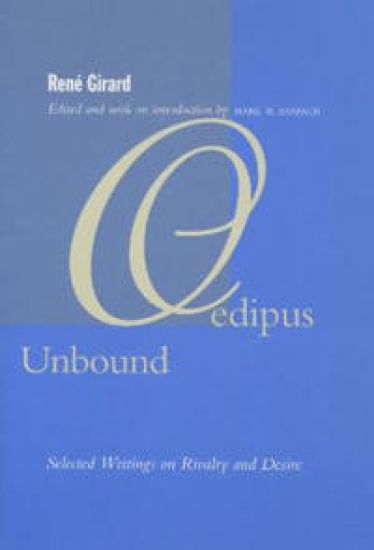
Did Oedipus really kill his father and marry his mother? Or is he nothing but a scapegoat, set up to take the blame for a crisis afflicting Thebes? For René Girard, the mythic accusations of patricide and incest are symptomatic of a plague-stricken community's hunt for a culprit to punish, and Girard succeeds in making us see an age-old myth in a wholly new light. The hard-to-find writings assembled here include three major early essays, never before available in English, which afford a behind-the-scenes glimpse at the emergence of Girard's scapegoat theory from his pioneering analysis of rivalry and desire. Girard unbinds the Oedipal triangle from its Freudian moorings, replacing desire for the mother with desire for anyone—or anything—a rival desires. In a wide-ranging and provocative introduction, Mark R. Anspach presents fresh evidence for Girard's hypotheses from classical studies, literature, anthropology, and the life of Freud himself.
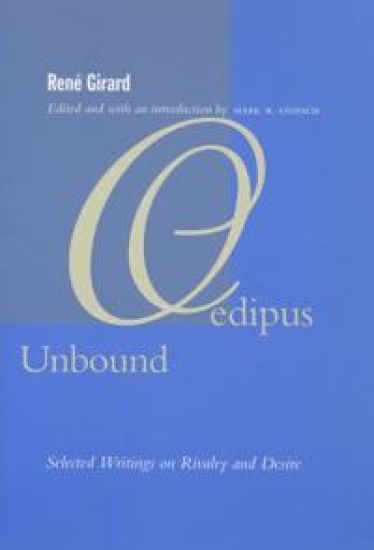
Did Oedipus really kill his father and marry his mother? Or is he nothing but a scapegoat, set up to take the blame for a crisis afflicting Thebes? For René Girard, the mythic accusations of patricide and incest are symptomatic of a plague-stricken community's hunt for a culprit to punish, and Girard succeeds in making us see an age-old myth in a wholly new light. The hard-to-find writings assembled here include three major early essays, never before available in English, which afford a behind-the-scenes glimpse at the emergence of Girard's scapegoat theory from his pioneering analysis of rivalry and desire. Girard unbinds the Oedipal triangle from its Freudian moorings, replacing desire for the mother with desire for anyone—or anything—a rival desires. In a wide-ranging and provocative introduction, Mark R. Anspach presents fresh evidence for Girard's hypotheses from classical studies, literature, anthropology, and the life of Freud himself.

Things Hidden Since the Foundation of the World
René Girard
Continuum International Publishing Group Ltd.
2003
nidottu
Develops a global theory of culture through the paradox of violence and exclusion serving a social function.