Kirjojen hintavertailu. Mukana 12 595 353 kirjaa ja 12 kauppaa.

Kirjailija

Reviel Netz

Kirjat ja teokset yhdessä paikassa: 10 kirjaa, julkaisuja vuosilta 1999-2025, suosituimpien joukossa The Transformation of Mathematics in the Early Mediterranean World. Vertaile teosten hintoja ja tarkista saatavuus suomalaisista kirjakaupoista.

10 kirjaa

Kirjojen julkaisuhaarukka 1999-2025.

Why the Ancient Greeks Matter

Why the Ancient Greeks Matter

Reviel Netz

Cambridge University Press
2025
sidottu
The ancient Greeks were exceptional and they were consequential. This innovative, engrossingly written book addresses head-on the problematic question of the Greek Miracle. It will appeal to anyone interested in the ancient world and its modern meaning. Reviel Netz boldly argues that the traditional understanding of the Greek legacy as a store of timeless values is false to the Greek literary canon itself. The latter is in fact made up of contradictory texts, sharing no common core of beliefs. This is precisely, for the author, the canon's significance: by presenting a system of works-in-polemic, it created a template for a culture of open debate, leading all the way down to modern civil society. The most lasting result of this practice of open discourse was in science, where Greek disputations paved the way for an autonomous scientific culture and opened the door both to the scientific revolution and the modern world.
A New History of Greek Mathematics

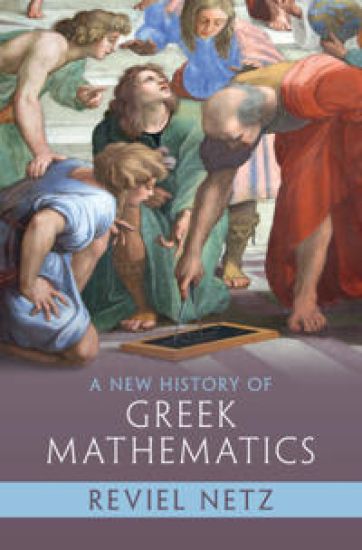
A New History of Greek Mathematics

Reviel Netz

Cambridge University Press
2022
sidottu
The ancient Greeks played a fundamental role in the history of mathematics and their ideas were reused and developed in subsequent periods all the way down to the scientific revolution and beyond. In this, the first complete history for a century. Reviel Netz offers a panoramic view of the rise and influence of Greek mathematics and its significance in world history. He explores the Near Eastern antecedents and the social and intellectual developments underlying the subject's beginnings in Greece in the fifth century BCE. He leads the reader through the proofs and arguments of key figures like Archytas, Euclid and Archimedes, and considers the totality of the Greek mathematical achievement which also includes, in addition to pure mathematics, such applied fields as optics, music, mechanics and, above all, astronomy. This is the story not only of a major historical development, but of some of the finest mathematics ever created.
Ludic Proof

Ludic Proof

Reviel Netz

Cambridge University Press
2021
pokkari
This book represents a new departure in science studies: an analysis of a scientific style of writing, situating it within the context of the contemporary style of literature. Its philosophical significance is that it provides a novel way of making sense of the notion of a scientific style. For the first time, the Hellenistic mathematical corpus - one of the most substantial extant for the period - is placed centre-stage in the discussion of Hellenistic culture as a whole. Professor Netz argues that Hellenistic mathematical writings adopt a narrative strategy based on surprise, a compositional form based on a mosaic of apparently unrelated elements, and a carnivalesque profusion of detail. He further investigates how such stylistic preferences derive from, and throw light on, the style of Hellenistic poetry. This important book will be welcomed by all scholars of Hellenistic civilization as well as historians of ancient science and Western mathematics.
Scale, Space and Canon in Ancient Literary Culture

Scale, Space and Canon in Ancient Literary Culture

Reviel Netz

Cambridge University Press
2020
sidottu
Greek culture matters because its unique pluralistic debate shaped modern discourses. This ground-breaking book explains this feature by retelling the history of ancient literary culture through the lenses of canon, space and scale. It proceeds from the invention of the performative 'author' in the archaic symposium through the 'polis of letters' enabled by Athenian democracy and into the Hellenistic era, where one's space mattered and culture became bifurcated between Athens and Alexandria. This duality was reconfigured into an eclectic variety consumed by Roman patrons and predicated on scale, with about a thousand authors active at any given moment. As patronage dried up in the third century CE, scale collapsed and literary culture was reduced to the teaching of a narrower field of authors, paving the way for the Middle Ages. The result is a new history of ancient culture which is sociological, quantitative, and all-encompassing, cutting through eras and genres.
Barbed Wire

Barbed Wire

Reviel Netz

Wesleyan University Press
2009
nidottu
In this original and controversial book, historian and philosopher Reviel Netz explores the development of a controlling and pain-inducing technology-barbed wire. Surveying its development from 1874 to 1954, Netz describes its use to control cattle during the colonization of the American West and to control people in Nazi concentration camps and the Russian Gulag. Physical control over space was no longer symbolic after 1874. This is a history told from the perspective of its victims. With vivid examples of the interconnectedness of humans, animals, and the environment, this dramatic account of barbed wire presents modern history through the lens of motion being prevented. Drawing together the history of humans and animals, Netz delivers a compelling new perspective on the issues of colonialism, capitalism, warfare, globalization, violence, and suffering. Theoretically sophisticated but written with a broad readership in mind, Barbed Wire calls for nothing less than a reconsideration of modernity.
Ludic Proof

Ludic Proof

Reviel Netz

Cambridge University Press
2009
sidottu
This book represents a new departure in science studies: an analysis of a scientific style of writing, situating it within the context of the contemporary style of literature. Its philosophical significance is that it provides a novel way of making sense of the notion of a scientific style. For the first time, the Hellenistic mathematical corpus - one of the most substantial extant for the period - is placed centre-stage in the discussion of Hellenistic culture as a whole. Professor Netz argues that Hellenistic mathematical writings adopt a narrative strategy based on surprise, a compositional form based on a mosaic of apparently unrelated elements, and a carnivalesque profusion of detail. He further investigates how such stylistic preferences derive from, and throw light on, the style of Hellenistic poetry. This important book will be welcomed by all scholars of Hellenistic civilization as well as historians of ancient science and Western mathematics.
The Transformation of Mathematics in the Early Mediterranean World
The transformation of mathematics from ancient Greece to the medieval Arab-speaking world is here approached by focusing on a single problem proposed by Archimedes and the many solutions offered. In this trajectory Reviel Netz follows the change in the task from solving a geometrical problem to its expression as an equation, still formulated geometrically, and then on to an algebraic problem, now handled by procedures that are more like rules of manipulation. From a practice of mathematics based on the localized solution (and grounded in the polemical practices of early Greek science) we see a transition to a practice of mathematics based on the systematic approach (and grounded in the deuteronomic practices of Late Antiquity and the Middle Ages). With three chapters ranging chronologically from Hellenistic mathematics, through late Antiquity, to the medieval world, Reviel Netz offers an alternate interpretation of the historical journey of pre-modern mathematics.
The Transformation of Mathematics in the Early Mediterranean World
The transformation of mathematics from ancient Greece to the medieval Arab-speaking world is here approached by focusing on a single problem proposed by Archimedes and the many solutions offered. In this trajectory Reviel Netz follows the change in the task from solving a geometrical problem to its expression as an equation, still formulated geometrically, and then on to an algebraic problem, now handled by procedures that are more like rules of manipulation. From a practice of mathematics based on the localized solution (and grounded in the polemical practices of early Greek science) we see a transition to a practice of mathematics based on the systematic approach (and grounded in the deuteronomic practices of Late Antiquity and the Middle Ages). With three chapters ranging chronologically from Hellenistic mathematics, through late Antiquity, to the medieval world, Reviel Netz offers a radically new interpretation of the historical journey of pre-modern mathematics.
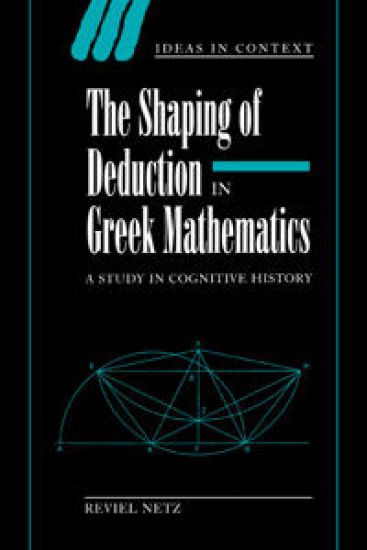
The Shaping of Deduction in Greek Mathematics

The Shaping of Deduction in Greek Mathematics

Reviel Netz

Cambridge University Press
1999
sidottu
The aim of this book is to explain the shape of Greek mathematical thinking. It can be read on three levels: as a description of the practices of Greek mathematics; as a theory of the emergence of the deductive method; and as a case-study for a general view on the history of science. The starting point for the enquiry is geometry and the lettered diagram. Reviel Netz exploits the mathematicians’ practices in the construction and lettering of their diagrams, and the continuing interaction between text and diagram in their proofs, to illuminate the underlying cognitive processes. A close examination of the mathematical use of language follows, especially mathematicians’ use of repeated formulae. Two crucial chapters set out to show how mathematical proofs are structured and explain why Greek mathematical practice manages to be so satisfactory. A final chapter looks into the broader historical setting of Greek mathematical practice.