Kirjojen hintavertailu. Mukana 12 595 353 kirjaa ja 12 kauppaa.

Kirjailija

Ricardo Caferra

Kirjat ja teokset yhdessä paikassa: 3 kirjaa, julkaisuja vuosilta 2004-2011, suosituimpien joukossa Logic for Computer Science and Artificial Intelligence. Vertaile teosten hintoja ja tarkista saatavuus suomalaisista kirjakaupoista.

3 kirjaa

Kirjojen julkaisuhaarukka 2004-2011.

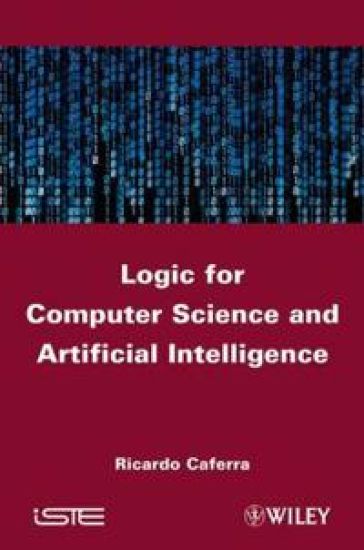
Logic for Computer Science and Artificial Intelligence

Logic for Computer Science and Artificial Intelligence

Ricardo Caferra

ISTE Ltd and John Wiley Sons Inc
2011
sidottu
Logic and its components (propositional, first-order, non-classical) play a key role in Computer Science and Artificial Intelligence. While a large amount of information exists scattered throughout various media (books, journal articles, webpages, etc.), the diffuse nature of these sources is problematic and logic as a topic benefits from a unified approach. Logic for Computer Science and Artificial Intelligence utilizes this format, surveying the tableaux, resolution, Davis and Putnam methods, logic programming, as well as for example unification and subsumption. For non-classical logics, the translation method is detailed. Logic for Computer Science and Artificial Intelligence is the classroom-tested result of several years of teaching at Grenoble INP (Ensimag). It is conceived to allow self-instruction for a beginner with basic knowledge in Mathematics and Computer Science, but is also highly suitable for use in traditional courses. The reader is guided by clearly motivated concepts, introductions, historical remarks, side notes concerning connections with other disciplines, and numerous exercises, complete with detailed solutions, The title provides the reader with the tools needed to arrive naturally at practical implementations of the concepts and techniques discussed, allowing for the design of algorithms to solve problems.
Automated Model Building

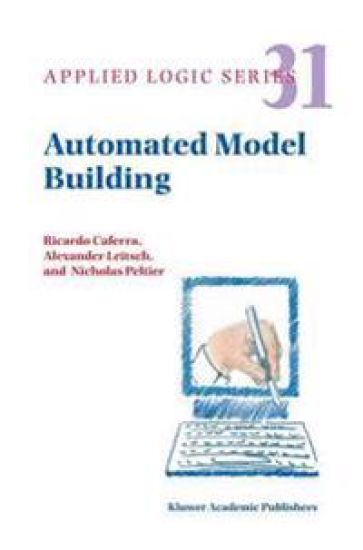
Automated Model Building

Ricardo Caferra; Alexander Leitsch; Nicolas Peltier

Springer
2010
nidottu
On the history of the book: In the early 1990s several new methods and perspectives in au- mated deduction emerged. We just mention the superposition calculus, meta-term inference and schematization, deductive decision procedures, and automated model building. It was this last ?eld which brought the authors of this book together. In 1994 they met at the Conference on Automated Deduction (CADE-12) in Nancy and agreed upon the general point of view, that semantics and, in particular, construction of models should play a central role in the ?eld of automated deduction. In the following years the deduction groups of the laboratory LEIBNIZ at IMAG Grenoble and the University of Technology in Vienna organized several bilateral projects promoting this topic. This book emerged as a main result of this cooperation. The authors are aware of the fact, that the book does not cover all relevant methods of automated model building (also called model construction or model generation); instead the book focuses on deduction-based symbolic methods for the construction of Herbrand models developed in the last 12 years. Other methods of automated model building, in particular also ?nite model building, are mainly treated in the ?nal chapter; this chapter is less formal and detailed but gives a broader view on the topic and a comparison of di?erent approaches. Howtoreadthisbook: In the introduction we give an overview of automated deduction in a historical context, taking into account its relationship with the human views on formal and informal proofs.
Automated Model Building

Automated Model Building

Ricardo Caferra; Alexander Leitsch; Nicolas Peltier

Springer-Verlag New York Inc.
2004
sidottu
On the history of the book: In the early 1990s several new methods and perspectives in au- mated deduction emerged. We just mention the superposition calculus, meta-term inference and schematization, deductive decision procedures, and automated model building. It was this last ?eld which brought the authors of this book together. In 1994 they met at the Conference on Automated Deduction (CADE-12) in Nancy and agreed upon the general point of view, that semantics and, in particular, construction of models should play a central role in the ?eld of automated deduction. In the following years the deduction groups of the laboratory LEIBNIZ at IMAG Grenoble and the University of Technology in Vienna organized several bilateral projects promoting this topic. This book emerged as a main result of this cooperation. The authors are aware of the fact, that the book does not cover all relevant methods of automated model building (also called model construction or model generation); instead the book focuses on deduction-based symbolic methods for the construction of Herbrand models developed in the last 12 years. Other methods of automated model building, in particular also ?nite model building, are mainly treated in the ?nal chapter; this chapter is less formal and detailed but gives a broader view on the topic and a comparison of di?erent approaches. Howtoreadthisbook: In the introduction we give an overview of automated deduction in a historical context, taking into account its relationship with the human views on formal and informal proofs.