Kirjojen hintavertailu. Mukana 12 219 162 kirjaa ja 12 kauppaa.

Kirjailija

Ricardo Reis

Kirjat ja teokset yhdessä paikassa: 15 kirjaa, julkaisuja vuosilta 2005-2025, suosituimpien joukossa Soft Error Reliability Using Virtual Platforms. Vertaile teosten hintoja ja tarkista saatavuus suomalaisista kirjakaupoista.

15 kirjaa

Kirjojen julkaisuhaarukka 2005-2025.

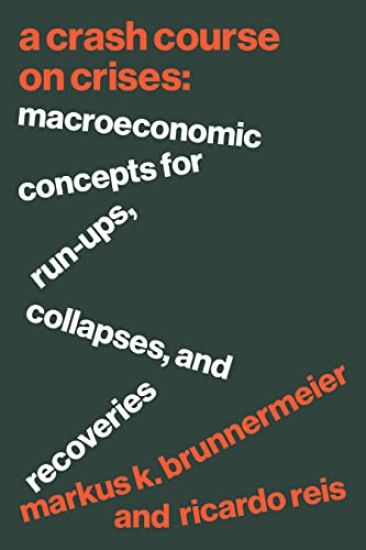
A Crash Course on Crises

A Crash Course on Crises

Markus K. Brunnermeier; Ricardo Reis

PRINCETON UNIVERSITY PRESS
2025
pokkari
An incisive overview of the macroeconomics of financial crises—essential reading for students and policy experts alikeWith alarming frequency, modern economies go through macro-financial crashes that arise from the financial sector and spread to the broader economy, inflicting deep and prolonged recessions. A Crash Course on Crises brings together the latest cutting-edge economic research to identify the seeds of these crashes, reveal their triggers and consequences, and explain what policymakers can do about them.Each of the book’s ten self-contained chapters introduces readers to a key economic force and provides case studies that illustrate how that force was dominant. Markus Brunnermeier and Ricardo Reis show how the run-up phase of a crisis often occurs in ways that are preventable but that may go unnoticed and discuss how debt contracts, banks, and a search for safety can act as triggers and amplifiers that drive the economy to crash. Brunnermeier and Reis then explain how monetary, fiscal, and exchange-rate policies can respond to crises and prevent them from becoming persistent.With case studies ranging from Chile in the 1970s to the COVID-19 pandemic, A Crash Course on Crises synthesizes a vast literature into ten simple, accessible ideas and illuminates these concepts using novel diagrams and a clear analytical framework.
Early Soft Error Reliability Assessment of Convolutional Neural Networks Executing on Resource-Constrained IoT Edge Devices
This book describes an extensive and consistent soft error assessment of convolutional neural network (CNN) models from different domains through more than 14.8 million fault injections, considering different precision bit-width configurations, optimization parameters, and processor models. The authors also evaluate the relative performance, memory utilization, and soft error reliability trade-offs analysis of different CNN models considering a compiler-based technique w.r.t. traditional redundancy approaches.
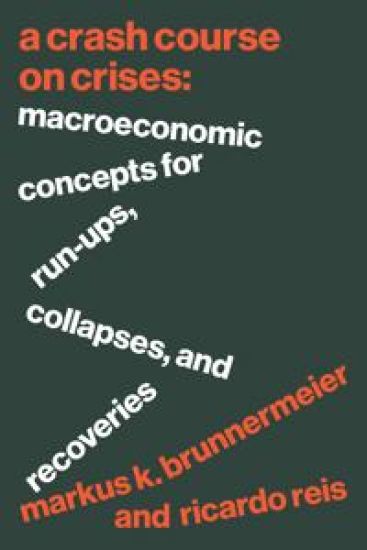
A Crash Course on Crises

A Crash Course on Crises

Markus K. Brunnermeier; Ricardo Reis

PRINCETON UNIVERSITY PRESS
2023
sidottu
An incisive overview of the macroeconomics of financial crises—essential reading for students and policy experts alikeWith alarming frequency, modern economies go through macro-financial crashes that arise from the financial sector and spread to the broader economy, inflicting deep and prolonged recessions. A Crash Course on Crises brings together the latest cutting-edge economic research to identify the seeds of these crashes, reveal their triggers and consequences, and explain what policymakers can do about them.Each of the book’s ten self-contained chapters introduces readers to a key economic force and provides case studies that illustrate how that force was dominant. Markus Brunnermeier and Ricardo Reis show how the run-up phase of a crisis often occurs in ways that are preventable but that may go unnoticed and discuss how debt contracts, banks, and a search for safety can act as triggers and amplifiers that drive the economy to crash. Brunnermeier and Reis then explain how monetary, fiscal, and exchange-rate policies can respond to crises and prevent them from becoming persistent.With case studies ranging from Chile in the 1970s to the COVID-19 pandemic, A Crash Course on Crises synthesizes a vast literature into ten simple, accessible ideas and illuminates these concepts using novel diagrams and a clear analytical framework.
Early Soft Error Reliability Assessment of Convolutional Neural Networks Executing on Resource-Constrained IoT Edge Devices
This book describes an extensive and consistent soft error assessment of convolutional neural network (CNN) models from different domains through more than 14.8 million fault injections, considering different precision bit-width configurations, optimization parameters, and processor models. The authors also evaluate the relative performance, memory utilization, and soft error reliability trade-offs analysis of different CNN models considering a compiler-based technique w.r.t. traditional redundancy approaches.
Mitigating Process Variability and Soft Errors at Circuit-Level for FinFETs

Mitigating Process Variability and Soft Errors at Circuit-Level for FinFETs

Alexandra Zimpeck; Cristina Meinhardt; Laurent Artola; Ricardo Reis

Springer Nature Switzerland AG
2022
nidottu
This book evaluates the influence of process variations (e.g. work-function fluctuations) and radiation-induced soft errors in a set of logic cells using FinFET technology, considering the 7nm technological node as a case study. Moreover, for accurate soft error estimation, the authors adopt a radiation event generator tool (MUSCA SEP3), which deals both with layout features and electrical properties of devices. The authors also explore four circuit-level techniques (e.g. transistor reordering, decoupling cells, Schmitt Trigger, and sleep transistor) as alternatives to attenuate the unwanted effects on FinFET logic cells. This book also evaluates the mitigation tendency when different levels of process variation, transistor sizing, and radiation particle characteristics are applied in the design. An overall comparison of all methods addressed by this work is provided allowing to trace a trade-off between the reliability gains and the design penalties of each approach regardingthe area, performance, power consumption, single event transient (SET) pulse width, and SET cross-section.
Soft Error Reliability Using Virtual Platforms

Soft Error Reliability Using Virtual Platforms

Felipe Rocha da Rosa; Luciano Ost; Ricardo Reis

Springer Nature Switzerland AG
2021
nidottu
This book describes the benefits and drawbacks inherent in the use of virtual platforms (VPs) to perform fast and early soft error assessment of multicore systems. The authors show that VPs provide engineers with appropriate means to investigate new and more efficient fault injection and mitigation techniques. Coverage also includes the use of machine learning techniques (e.g., linear regression) to speed-up the soft error evaluation process by pinpointing parameters (e.g., architectural) with the most substantial impact on the software stack dependability. This book provides valuable information and insight through more than 3 million individual scenarios and 2 million simulation-hours. Further, this book explores machine learning techniques usage to navigate large fault injection datasets.
Mitigating Process Variability and Soft Errors at Circuit-Level for FinFETs

Mitigating Process Variability and Soft Errors at Circuit-Level for FinFETs

Alexandra Zimpeck; Cristina Meinhardt; Laurent Artola; Ricardo Reis

Springer Nature Switzerland AG
2021
sidottu
This book evaluates the influence of process variations (e.g. work-function fluctuations) and radiation-induced soft errors in a set of logic cells using FinFET technology, considering the 7nm technological node as a case study. Moreover, for accurate soft error estimation, the authors adopt a radiation event generator tool (MUSCA SEP3), which deals both with layout features and electrical properties of devices. The authors also explore four circuit-level techniques (e.g. transistor reordering, decoupling cells, Schmitt Trigger, and sleep transistor) as alternatives to attenuate the unwanted effects on FinFET logic cells. This book also evaluates the mitigation tendency when different levels of process variation, transistor sizing, and radiation particle characteristics are applied in the design. An overall comparison of all methods addressed by this work is provided allowing to trace a trade-off between the reliability gains and the design penalties of each approach regardingthe area, performance, power consumption, single event transient (SET) pulse width, and SET cross-section.
Soft Error Reliability Using Virtual Platforms

Soft Error Reliability Using Virtual Platforms

Felipe Rocha da Rosa; Luciano Ost; Ricardo Reis

Springer Nature Switzerland AG
2020
sidottu
This book describes the benefits and drawbacks inherent in the use of virtual platforms (VPs) to perform fast and early soft error assessment of multicore systems. The authors show that VPs provide engineers with appropriate means to investigate new and more efficient fault injection and mitigation techniques. Coverage also includes the use of machine learning techniques (e.g., linear regression) to speed-up the soft error evaluation process by pinpointing parameters (e.g., architectural) with the most substantial impact on the software stack dependability. This book provides valuable information and insight through more than 3 million individual scenarios and 2 million simulation-hours. Further, this book explores machine learning techniques usage to navigate large fault injection datasets.
Electromigration Inside Logic Cells

Electromigration Inside Logic Cells

Gracieli Posser; Sachin S. Sapatnekar; Ricardo Reis

Springer International Publishing AG
2018
nidottu
This book describes new and effective methodologies for modeling, analyzing and mitigating cell-internal signal electromigration in nanoCMOS, with significant circuit lifetime improvements and no impact on performance, area and power. The authors are the first to analyze and propose a solution for the electromigration effects inside logic cells of a circuit. They show in this book that an interconnect inside a cell can fail reducing considerably the circuit lifetime and they demonstrate a methodology to optimize the lifetime of circuits, by placing the output, Vdd and Vss pin of the cells in the less critical regions, where the electromigration effects are reduced. Readers will be enabled to apply this methodology only for the critical cells in the circuit, avoiding impact in the circuit delay, area and performance, thus increasing the lifetime of the circuit without loss in other characteristics.
Electromigration Inside Logic Cells

Electromigration Inside Logic Cells

Gracieli Posser; Sachin S. Sapatnekar; Ricardo Reis

Springer International Publishing AG
2016
sidottu
This book describes new and effective methodologies for modeling, analyzing and mitigating cell-internal signal electromigration in nanoCMOS, with significant circuit lifetime improvements and no impact on performance, area and power. The authors are the first to analyze and propose a solution for the electromigration effects inside logic cells of a circuit. They show in this book that an interconnect inside a cell can fail reducing considerably the circuit lifetime and they demonstrate a methodology to optimize the lifetime of circuits, by placing the output, Vdd and Vss pin of the cells in the less critical regions, where the electromigration effects are reduced. Readers will be enabled to apply this methodology only for the critical cells in the circuit, avoiding impact in the circuit delay, area and performance, thus increasing the lifetime of the circuit without loss in other characteristics.
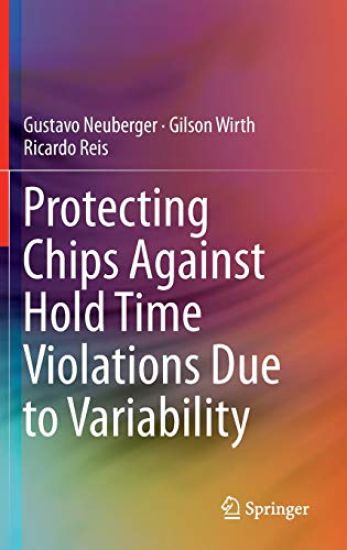
Protecting Chips Against Hold Time Violations Due to Variability

Protecting Chips Against Hold Time Violations Due to Variability

Gustavo Neuberger; Gilson Wirth; Ricardo Reis

Springer
2016
nidottu
With the development of Very-Deep Sub-Micron technologies, process variability is becoming increasingly important and is a very important issue in the design of complex circuits. Process variability is the statistical variation of process parameters, meaning that these parameters do not have always the same value, but become a random variable, with a given mean value and standard deviation. This effect can lead to several issues in digital circuit design.The logical consequence of this parameter variation is that circuit characteristics, as delay and power, also become random variables. Because of the delay variability, not all circuits will now have the same performance, but some will be faster and some slower. However, the slowest circuits may be so slow that they will not be appropriate for sale. On the other hand, the fastest circuits that could be sold for a higher price can be very leaky, and also not very appropriate for sale. A main consequence of power variability is that the power consumption of some circuits will be different than expected, reducing reliability, average life expectancy and warranty of products. Sometimes the circuits will not work at all, due to reasons associated with process variations. At the end, these effects result in lower yield and lower profitability.To understand these effects, it is necessary to study the consequences of variability in several aspects of circuit design, like logic gates, storage elements, clock distribution, and any other that can be affected by process variations. The main focus of this book will be storage elements.
Protecting Chips Against Hold Time Violations Due to Variability

Protecting Chips Against Hold Time Violations Due to Variability

Gustavo Neuberger; Gilson Wirth; Ricardo Reis

Springer
2013
sidottu
With the development of Very-Deep Sub-Micron technologies, process variability is becoming increasingly important and is a very important issue in the design of complex circuits. Process variability is the statistical variation of process parameters, meaning that these parameters do not have always the same value, but become a random variable, with a given mean value and standard deviation. This effect can lead to several issues in digital circuit design.The logical consequence of this parameter variation is that circuit characteristics, as delay and power, also become random variables. Because of the delay variability, not all circuits will now have the same performance, but some will be faster and some slower. However, the slowest circuits may be so slow that they will not be appropriate for sale. On the other hand, the fastest circuits that could be sold for a higher price can be very leaky, and also not very appropriate for sale. A main consequence of power variability is that the power consumption of some circuits will be different than expected, reducing reliability, average life expectancy and warranty of products. Sometimes the circuits will not work at all, due to reasons associated with process variations. At the end, these effects result in lower yield and lower profitability.To understand these effects, it is necessary to study the consequences of variability in several aspects of circuit design, like logic gates, storage elements, clock distribution, and any other that can be affected by process variations. The main focus of this book will be storage elements.
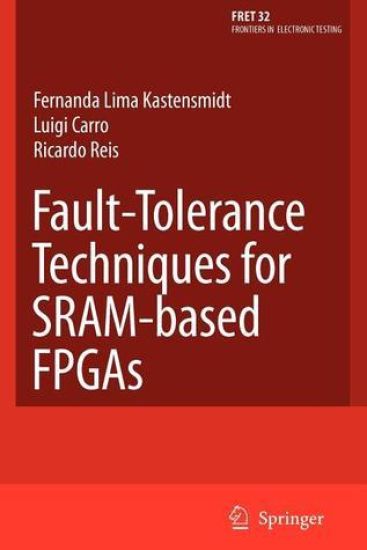
Fault-Tolerance Techniques for SRAM-Based FPGAs

Fault-Tolerance Techniques for SRAM-Based FPGAs

Fernanda Lima Kastensmidt; Ricardo Reis

Springer-Verlag New York Inc.
2010
nidottu
Fault-tolerance in integrated circuits is not an exclusive concern regarding space designers or highly-reliable application engineers. Rather, designers of next generation products must cope with reduced margin noises due to technological advances. The continuous evolution of the fabrication technology process of semiconductor components, in terms of transistor geometry shrinking, power supply, speed, and logic density, has significantly reduced the reliability of very deep submicron integrated circuits, in face of the various internal and external sources of noise. The very popular Field Programmable Gate Arrays, customizable by SRAM cells, are a consequence of the integrated circuit evolution with millions of memory cells to implement the logic, embedded memories, routing, and more recently with embedded microprocessors cores. These re-programmable systems-on-chip platforms must be fault-tolerant to cope with present days requirements. This book discusses fault-tolerance techniques for SRAM-based Field Programmable Gate Arrays (FPGAs). It starts by showing the model of the problem and the upset effects in the programmable architecture. In the sequence, it shows the main fault tolerance techniques used nowadays to protect integrated circuits against errors. A large set of methods for designing fault tolerance systems in SRAM-based FPGAs is described. Some presented techniques are based on developing a new fault-tolerant architecture with new robustness FPGA elements. Other techniques are based on protecting the high-level hardware description before the synthesis in the FPGA. The reader has the flexibility of choosing the most suitable fault-tolerance technique for its project and to compare a set of fault tolerant techniques for programmable logic applications.
Fault-Tolerance Techniques for SRAM-Based FPGAs

Fault-Tolerance Techniques for SRAM-Based FPGAs

Fernanda Lima Kastensmidt; Ricardo Reis

Springer-Verlag New York Inc.
2006
sidottu
Fault-tolerance in integrated circuits is not an exclusive concern regarding space designers or highly-reliable application engineers. Rather, designers of next generation products must cope with reduced margin noises due to technological advances. The continuous evolution of the fabrication technology process of semiconductor components, in terms of transistor geometry shrinking, power supply, speed, and logic density, has significantly reduced the reliability of very deep submicron integrated circuits, in face of the various internal and external sources of noise. The very popular Field Programmable Gate Arrays, customizable by SRAM cells, are a consequence of the integrated circuit evolution with millions of memory cells to implement the logic, embedded memories, routing, and more recently with embedded microprocessors cores. These re-programmable systems-on-chip platforms must be fault-tolerant to cope with present days requirements. This book discusses fault-tolerance techniques for SRAM-based Field Programmable Gate Arrays (FPGAs). It starts by showing the model of the problem and the upset effects in the programmable architecture. In the sequence, it shows the main fault tolerance techniques used nowadays to protect integrated circuits against errors. A large set of methods for designing fault tolerance systems in SRAM-based FPGAs is described. Some presented techniques are based on developing a new fault-tolerant architecture with new robustness FPGA elements. Other techniques are based on protecting the high-level hardware description before the synthesis in the FPGA. The reader has the flexibility of choosing the most suitable fault-tolerance technique for its project and to compare a set of fault tolerant techniques for programmable logic applications.