Kirjojen hintavertailu. Mukana 12 636 850 kirjaa ja 12 kauppaa.
Kirjailija
Richard A. Easterlin
Kirjat ja teokset yhdessä paikassa: 13 kirjaa, julkaisuja vuosilta 1980-2021, suosituimpien joukossa Happiness, Growth, and the Life Cycle. Vertaile teosten hintoja ja tarkista saatavuus suomalaisista kirjakaupoista.
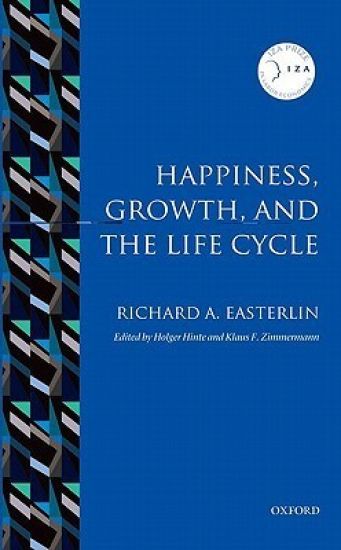
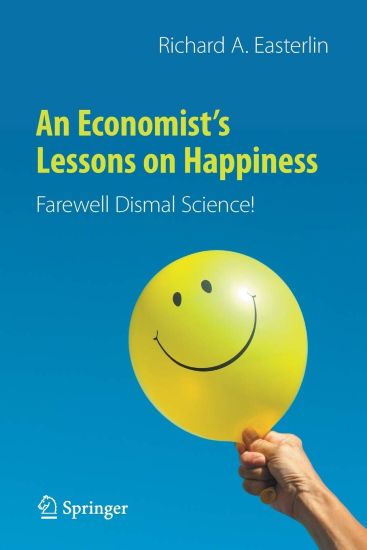
Once called the “dismal science,” economics now offers prescriptions for improving people’s happiness. In this book Richard Easterlin, the “father of happiness economics,” draws on a half-century of his own research and that conducted by fellow economists and psychologists to answer in plain language questions like: Can happiness be measured? Will more money make me happier? What about finding a partner? Getting married? Having a baby? More exercise? Does religion help? Who is happier—women or men, young or old, rich or poor? How does happiness change as we go through different stages of life? Public policy is also in the mix: Can the government increase people’s happiness? Should the government increase their happiness? Which countries are the happiest and why? Does a country need to be rich to be happy? Does economic growth improve the human lot? Some of the answers are surprising (no, more money won’t do the trick; neither will economic growth; babies are a mixed blessing!), but they are all based on reason and well-vetted evidence from the fields of economics and psychology. In closing, Easterlin traces the genesis of the ongoing “Happiness Revolution” and considers its implications for people’s lives down the road.
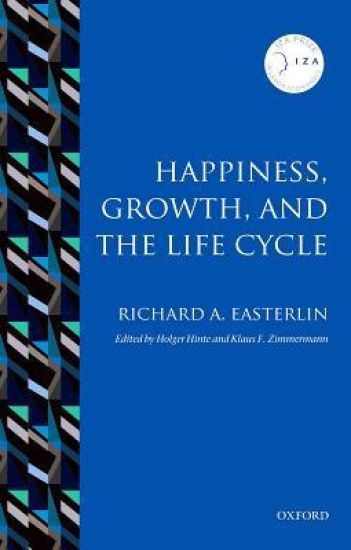
Published with the IZA, this volume presents Richard Easterlin's outstanding research on the analysis of subjective well-being, and on the relationship between demographic developments and economic outcomes. In both fields, his work has laid the foundations for enlarging the scope of traditional economic analysis and has increased our understanding of behaviour in several important domains, such as fertility choices, labour market behaviour, and the determinants of individual well-being. In various seminal contributions, Easterlin has demonstrated the importance of material aspirations and relative economic status for human behaviour. This book is a collection of 11 of his key papers, revised and edited to make a cohesive book. New material includes an Introduction from the editors, two section Introductions from Easterlin, and an Epilogue from Easterlin.
""Population Redistribution And Economic Growth United States, 1870-1950, V2: Analyses Of Economic Change"" is a book written by Simon Kuznets that focuses on the economic changes that occurred in the United States between 1870 and 1950. The book is the second volume of a two-part series and examines the relationship between population redistribution and economic growth during this period. Kuznets, a Nobel Prize-winning economist, uses statistical analysis to explore the factors that contributed to economic growth in the United States during this time. He examines the impact of population shifts on economic growth, including the movement of people from rural areas to cities and the influx of immigrants. The book also explores the role of technological advancements, such as the development of the railroad and the growth of the manufacturing industry, in driving economic growth. Kuznets analyzes the impact of these changes on income distribution and social mobility, as well as the overall economic well-being of the country. Overall, ""Population Redistribution And Economic Growth United States, 1870-1950, V2: Analyses Of Economic Change"" is a comprehensive study of the economic changes that occurred in the United States during a critical period in its history. It provides valuable insights into the factors that contributed to economic growth and the impact of this growth on society as a whole.Introduction By Dorothy Swaine Thomas. In Three Volumes. Volume 1, Methodological Considerations And Reference Tables; Volume 2, Analyses Of Economic Change; Volume 3, Demographic Analyses And Interrelations.This scarce antiquarian book is a facsimile reprint of the old original and may contain some imperfections such as library marks and notations. Because we believe this work is culturally important, we have made it available as part of our commitment for protecting, preserving, and promoting the world's literature in affordable, high quality, modern editions, that are true to their original work.
The second in a series of books published with the IZA, this volume presents Richard Easterlin's outstanding research on the analysis of subjective well-being, and on the relationship between demographic developments and economic outcomes. In both fields, his work has laid the foundations for enlarging the scope of traditional economic analysis and has increased our understanding of behaviour in several important domains, such as fertility choices, labour market behaviour, and the determinants of individual well-being. In various seminal contributions, Easterlin has demonstrated the importance of material aspirations and relative economic status for human behaviour. This book is a collection of 11 of his key papers, revised and edited to make a cohesive book. New material includes an Introduction from the editors, two section Introductions from Easterlin, and an Epilogue from Easterlin.
Where is rapid economic growth taking us? Why has its spread throughout the world been so limited? What are the causes of the great twentieth century advance in life expectancy? Of the revolution in childbearing that is bringing fertility worldwide to near replacement levels? Have free markets been the source of human improvement? Economics provides a start on these questions, but only a start, argues economist Richard A. Easterlin. To answer them calls for merging economics with concepts and data from other social sciences, and with quantitative and qualitative history. Easterlin demonstrates this approach in seeking answers to these and other questions about world or American experience in the last two centuries, drawing on economics, demography, sociology, history, and psychology. The opening chapter gives an autobiographical account of the evolution of this approach, and why Easterlin is a 'reluctant economist'.
One of Julian Simon's last works-in-progress--cut short just before completion by his death in early 1998--The Great Breakthrough and Its Cause explores the question of why human progress accelerated in Western Europe starting around 1750. Why did life expectancy, the household consumption level, speeds of travel and communication, the literacy rate, and other aspects of the standard of living leap above those in the previous centuries and millennia? What forces caused this extraordinary development to occur when it did--or even to occur at all--rather than centuries or millennia earlier or later?Simon answers this question by arguing persuasively that the total quantity of humanity--and the nexus of human numbers with technology--has been the main driving force behind what he calls "Sudden Modern Progress." Further, he continues, if population numbers had risen more rapidly than they did, the "Great Breakthrough" would have occurred earlier. He also asserts that institutional changes, phenomena often credited for human progress, are from a very long-run perspective a result of population growth. And finally, he seeks to refute two seeming counterexamples, China and India, that reached high population densities prior to the modern period without accelerated growth in consumer welfare. In his inimitable style, Simon meticulously backs up his arguments with extensive use of a wide variety of data. Along the way, he also takes on the arguments of other writers on the subject of population growth and progress, such as Joel Mokyr and Eric Jones.Completed and polished by Timur Kuran, this exploration into the great explosion of consumer welfare will stimulate, challenge, and foster high-level intellectual debate on the question of human progress. It will be of particular interest to demographers, economic historians, and a broad array of social scientists.The late Julian Simon was most recently Professor of Business Administration, University of Maryland, College Park.
Taking a longer view than most literature on economic development, Richard A. Easterlin stresses the enormous contrast between the collective experience of the last half century in both developed and developing countries and what has gone before. An economic historian and demographer, the author writes in the tradition of the "new economic history," drawing on economic theory and quantitative evidence to interpret the historical experience of economic theory and population growth. He reaches beyond the usual disciplinary limits to draw, as appropriate, on sociology, political science, psychology, anthropology, and the history of science. The book will be of interest not only to social scientists but to all readers concerned with where we have been and where we are going.". . . Easterlin is both an economic historian and a demographer, and it is the combination of these two disciplines and the fine balance between theory and experience that make this well-written, refreshingly optimistic book excellent reading." --Population and Development Review"In this masterful synthesis, Richard Easterlin draws on the disciplines of economic history, demography, sociology, political science, psychology, and the history of science to present an integrated explation of the origins of modern economic growth and of the mortality revolution. . . . His book should be easily accessible to non-specialists and will give them a sense of why economic history can inform our understanding of the future." --Dora L. Costa, Massachusetts Institute of Technology, EH.Net and H-Net"Growth Triumphant is, simply, a fascinating book. Easterlin has woven together a history of economic growth, economic development, human mortality and morbidity, the connections each has with the others, and the implications of this nexus of forces on the future. . . . This book deserves a wide audience." --Choice"In what must surely be the most fair-minded, well-balanced, and scrupulously reasoned and researched book on the sensational subjects implied in its title--the Industrial Revolution, the mortality and fertility revolutions, and the prospects for future happiness for the human race--Professor Easterlin has set in place the capstone of his research career." --Journal of Economic HistoryRichard A. Easterlin is Professor of Economics, University of Southern California.
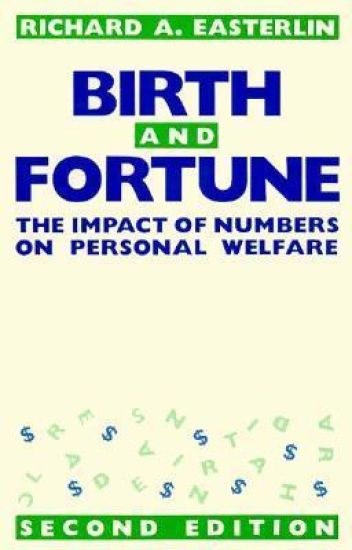
In this influential work, Richard A. Easterlin shows how the size of a generation—the number of persons born in a particular year—directly and indirectly affects the personal welfare of its members, the make-up and breakdown of the family, and the general well being of the economy. "[Easterlin] has made clear, I think unambiguously, that the baby-boom generation is economically underprivileged merely because of its size. And in showing this, he demonstrates that population size can be as restrictive as a factor as sex, race, or class on equality of opportunity in the U.S."—Jeffrey Madrick, Business Week
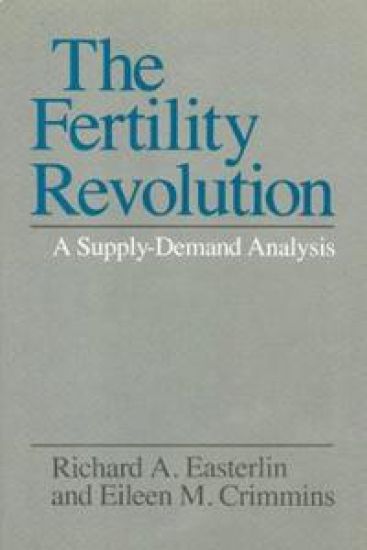
For most of human history a "natural fertility" regime has prevailed throughout the world: there has been almost no conscious limitation of family size within marriage, and women have spent their reproductive lives tied to the "wheel of childbearing." Only recently in developed countries has fertility been brought under conscious control by individual couples and childbearing fallen to an average of two births per woman. The explanation of this "fertility revolution" is the main concern of this book. Richard A. Easterlin and Eileen M. Crimmins present and test a fertility theory that has gained increasing attention over the last decade, a "supply-demand theory" that integrates economic and sociological approaches to fertility determination. The results of the tests, which draw on data from four developing countries—Colombia, India, Sri Lanka, and Taiwan—are highly consistent, though a number of the conclusions are likely to arouse controversy. For example, couples' motivation for fertility control appears to be the prime mover in the fertility revolution, rather than access to family planning services or unfavorable attitudes toward such services. The interdisciplinary approach and nontechnical exposition of this study will attract a wide readership among economists, sociologists, demographers, anthropologists, statisticians, biologists, and others.
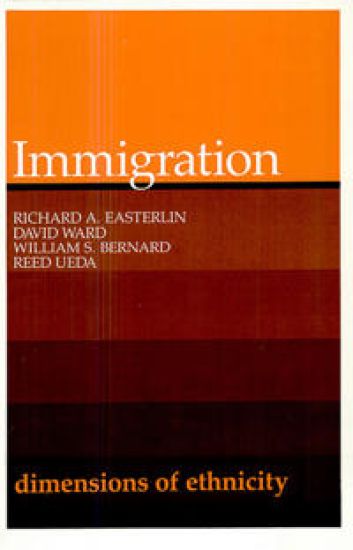
The monumental Harvard Encyclopedia of American Ethnic Groups is the most authoritative single source available on the history, culture, and distinctive characteristics of ethnic groups in the United States. The Dimensions of Ethnicity series is designed to make this landmark scholarship available to everyone in a series of handy paperbound student editions. Selections in this series will include outstanding articles that illuminate the social dynamics of a pluralistic nation or masterfully summarize the experience of key groups. Written by the best-qualified scholars in each field, Dimensions of Ethnicity titles will reflect the complex interplay between assimilation and pluralism that is a central theme of the American experience.This concise volume recounts the social and economic characteristics of successive waves of immigrants, where they settled, and how they achieved citizenship.