Kirjojen hintavertailu. Mukana 12 595 353 kirjaa ja 12 kauppaa.

Kirjailija

Richard A. L. Jones

Kirjat ja teokset yhdessä paikassa: 6 kirjaa, julkaisuja vuosilta 1999-2008, suosituimpien joukossa Soft Condensed Matter. Vertaile teosten hintoja ja tarkista saatavuus suomalaisista kirjakaupoista.

Mukana myös kirjoitusasut: Richard A.L. Jones

6 kirjaa

Kirjojen julkaisuhaarukka 1999-2008.

Pehmeät koneet

Pehmeät koneet

Richard A.L. Jones

Terra Cognita
2008
nidottu
Nanoteknologiaa pidetään mikroelektroniikan ja bioteknologian veroisena teollisena lupauksena, uuden kasvun tuojana. Sen tuotokset asettuvat mikroeliöiden ja atomien kokojen väliin, metrin miljardisosan suuruusluokkaan. Pehmeät koneet esittelee nanoteknologian tieteellisen perustan. Sen piirissä toimivat samat luonnonlait kuin meidän maailmassammekin, mutta niistä ilmenee meille kummallisia piirteitä, erityisesti Brownin liike ja suuri tarttuvuus. Ja uudet piirteet johtavat erittäin suuriin teknisiin haasteisiin.
Soft Machines

Soft Machines

Richard A. L. Jones

Oxford University Press
2007
nidottu
Enthusiasts look forward to a time when tiny machines reassemble matter and process information with unparalleled power and precision. But is their vision realistic? Where is the science heading? As nanotechnology (a new technology that many believe will transform society in the next one hundred years) rises higher in the news agenda and popular consciousness, there is a real need for a book which discusses clearly the science on which this technology will be based. Whilst it is most easy to simply imagine these tiny machines as scaled-down versions of the macroscopic machines we are all familiar with, the way things behave on small scales is quite different to the way they behave on large scales. Engineering on the nanoscale will use very different principles to those we are used to in our everyday lives, and the materials used in nanotehnology will be soft and mutable, rather than hard and unyielding. "Soft Machines" explains in a lively and very accessible manner why the nanoworld is so different to the macro-world which we are all familiar with. Why does nature engineer things in the way it does, and how can we learn to use these unfamiliar principles to create valuable new materials and artefacts which will have a profound effect on medicine, electronics, energy and the environment in the twenty-first century. With a firmer understanding of the likely relationship between nanotechnology and nature itself, we can gain a much clearer notion of what dangers this powerful technology may potentially pose, as well as come to realise that nanotechnology will have more in common with biology than with conventional engineering.
Soft Machines

Soft Machines

Richard A. L. Jones

Oxford University Press
2004
sidottu
Enthusiasts look forward to a time when tiny machines reassemble matter and process information with unparalleled power and precision. But is their vision realistic? Where is the science heading? As nanotechnology (a new technology that many believe will transform society in the next one hundred years) rises higher in the news agenda and popular consciousness, there is a real need for a book which discusses clearly the science on which this technology will be based. Whilst it is most easy to simply imagine these tiny machines as scaled-down versions of the macroscopic machines we are all familiar with, the way things behave on small scales is quite different to the way they behave on large scales. Engineering on the nanoscale will use very different principles to those we are used to in our everyday lives, and the materials used in nanotehnology will be soft and mutable, rather than hard and unyielding. "Soft Machines" explains in a lively and very accessible manner why the nanoworld is so different to the macro-world which we are all familiar with. Why does nature engineer things in the way it does, and how can we learn to use these unfamiliar principles to create valuable new materials and artefacts which will have a profound effect on medicine, electronics, energy and the environment in the twenty-first century. With a firmer understanding of the likely relationship between nanotechnology and nature itself, we can gain a much clearer notion of what dangers this powerful technology may potentially pose, as well as come to realise that nanotechnology will have more in common with biology than with conventional engineering.

Soft Condensed Matter

Soft Condensed Matter

Richard A.L. Jones

Oxford University Press
2002
sidottu
The physics of soft condensed matter is probably one of the most 'fashionable' areas in the physical sciences today. This book offers a coherent and clear introduction to the properties and behaviour of soft matter. It begins with a treatment of the general underlying principles: the relation of the structure and dynamics of solids and liquids to intermolecular forces, the thermodynamics and kinetics of phase transitions, and the principles of self-assembly. Then the specific properties of colloids, polymers, liquid crystals and self-assembling amphiphilic systems are treated within this framework. A concluding chapter illustrates how principles of soft matter physics can be used to understand properties of biological systems. The focus on the essentials and the straightforward approach make the book suitable for students with either a theoretical or an experimental bias. The level is appropriate for final year undergraduates and beginning graduate students in physics, chemistry, materials science, and chemical engineering.
Soft Condensed Matter

Soft Condensed Matter

Richard A.L. Jones

Oxford University Press
2002
nidottu
Offers a coherent introduction to the properties and behaviour of soft matter. This title includes colloids, polymers, liquid crystals, and amphiphiles. It is suitable for advanced undergraduate and beginning graduate students of physics, chemistry, materials science, and chemical engineering.
Polymers at Surfaces and Interfaces

Polymers at Surfaces and Interfaces

Richard A. L. Jones; Randal W. Richards

Cambridge University Press
1999
pokkari
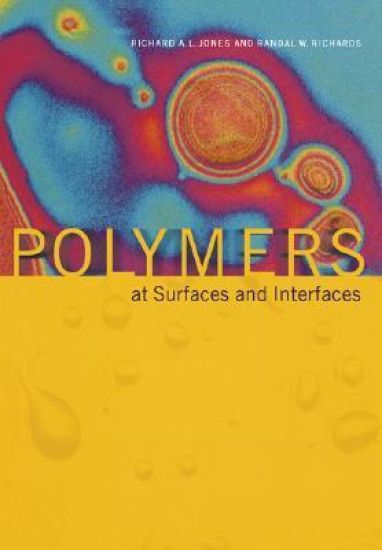
This text deals from a fundamental viewpoint with the behaviour of polymers at surfaces and interfaces. Topics covered include the nature and properties of the surface of a polymer melt, the structure of interfaces between different polymers and between polymers and non-polymers, the molecular basis of adhesion, and the properties of polymers at liquid surfaces. Emphasis is placed on the underlying physical principles. Statistical mechanics models of the behaviour of polymers near interfaces are introduced, with the emphasis on theory that is tractable and applicable to experimental situations. Advanced undergraduates, graduate students and research workers in physics, chemistry and materials science with an interest in polymers will find this book of value.