Kirjojen hintavertailu. Mukana 12 547 500 kirjaa ja 12 kauppaa.

Kirjailija

Richard A. Posner

Kirjat ja teokset yhdessä paikassa: 50 kirjaa, julkaisuja vuosilta 1983-2019, suosituimpien joukossa The Quotable Judge Posner. Vertaile teosten hintoja ja tarkista saatavuus suomalaisista kirjakaupoista.

Mukana myös kirjoitusasut: Richard A Posner

50 kirjaa

Kirjojen julkaisuhaarukka 1983-2019.

Uncommon Sense

Uncommon Sense

Gary S. Becker; Richard A. Posner

University of Chicago Press
2009
sidottu
On December 5, 2004, the still-developing blogosphere took one of its biggest steps toward mainstream credibility, as Nobel Prize - winning economist Gary S. Becker and renowned jurist and legal scholar Richard A. Posner announced the formation of the Becker-Posner Blog. In no time, the blog had established a wide readership and reputation as a reliable source of lively, thought-provoking commentary on current events, its pithy and profound weekly essays highlighting the value of economic reasoning when applied to unexpected topics. "Uncommon Sense" gathers the most important and innovative entries from the blog, arranged by topic, along with updates and even reconsiderations when subsequent events have shed new light on a question. Whether it's Posner making the economic case for the legalization of gay marriage, Becker arguing in favor of the sale of human organs for transplant, or even the pair of scholars vigorously disagreeing about the utility of collective punishment, the writing is always clear, the interplay energetic, and the resulting discussion deeply informed and intellectually substantial. To have a single thinker of the stature of a Becker or Posner addressing questions of this nature would make for fascinating reading; to have both, writing and responding to each other, is an exceptionally rare treat. With "Uncommon Sense", they invite the adventurous reader to join them on a whirlwind intellectual journey. All they ask is that you leave your preconceptions behind.
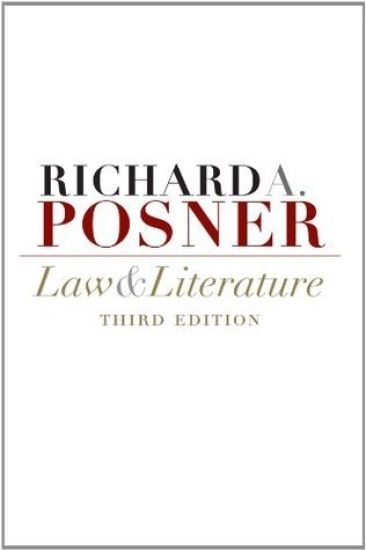
Law and Literature

Law and Literature

Richard A. Posner

Harvard University Press
2009
nidottu
Hailed in its first edition as an “outstanding work, as stimulating as it is intellectually distinguished” (New York Times), Law and Literature has handily lived up to the Washington Post’s prediction that the book would “remain essential reading for many years to come.” This third edition, extensively revised and enlarged, is the only comprehensive book-length treatment of the field. It continues to emphasize the essential differences between law and literature, which are rooted in the different social functions of legal and literary texts. But it also explores areas of mutual illumination and expands its range to include new topics such as the cruel and unusual punishments clause of the Constitution, illegal immigration, surveillance, global warming and bioterrorism, and plagiarism.In this edition, literary works from classics by Homer, Shakespeare, Milton, Dostoevsky, Melville, Kafka, and Camus to contemporary fiction by Tom Wolfe, Margaret Atwood, John Grisham, and Joyce Carol Oates come under Richard Posner’s scrutiny, as does the film The Matrix.The book remains the most clear, acute account of the intersection of law and literature.
Uncertain Shield

Uncertain Shield

Richard A. Posner

Rowman Littlefield Publishers
2006
sidottu
Ever since the publication in 2004 of the 9/11 Commission Report, the U.S. intelligence community has been in the throes of a convulsive movement for reform. In Preventing Surprise Attacks (2005), Richard A. Posner carried the story of the reform movement up to the enactment of the Intelligence Reform and Terrorism Prevention Act of 2004, which produced a defective plan for reorganizing the intelligence system, partly as result of the failure of the 9/11 Commission and Congress to bring historical, comparative, and scholarly perspectives to bear issues. At that time, however, the new structure had not yet been built. Posner's new book brings the story up to date. He argues that the decisions about structure that the Administration has made in implementation of the Act are creating too top-heavy, too centralized, an intelligence system. The book * exposes fallacies in criticisms of the performance of the U.S. intelligence services; * analyzes structures and priorities for directing and coordinating U.S. intelligence in the era of global terrorism; * presents new evidence for the need to create a domestic intelligence agency separate from the FBI, and a detailed blueprint for such an agency; * incorporates a wealth of material based on developments since the first book, including the report of the presidential commission on weapons of mass destruction and the botched response to Hurricane Katrina; * exposes the inadequacy of the national security computer networks; * critically examines Congress's performance in the intelligence field, and raises constitutional issues concerning the respective powers of Congress and the President; * emphasizes the importance of reforms that do not require questionable organizational changes. The book is published in cooperation with the Hoover Institution
Catastrophe

Catastrophe

Richard A. Posner

Oxford University Press Inc
2006
nidottu
Catastrophic risks are much greater than is commonly appreciated. Collision with an asteroid, runaway global warming, voraciously replicating nanomachines, a pandemic of gene-spliced smallpox launched by bioterrorists, and a world-ending accident in a high-energy particle accelerator, are among the possible extinction events that are sufficiently likely to warrant careful study. How should we respond to events that, for a variety of psychological and cultural reasons, we find it hard to wrap our minds around? Posner argues that realism about science and scientists, innovative applications of cost-benefit analysis, a scientifically literate legal profession, unprecedented international cooperation, and a pragmatic attitude toward civil liberties are among the keys to coping effectively with the catastrophic risks.
Law, Pragmatism, and Democracy

Law, Pragmatism, and Democracy

Richard A. Posner

Harvard University Press
2005
nidottu
A liberal state is a representative democracy constrained by the rule of law. Richard Posner argues for a conception of the liberal state based on pragmatic theories of government. He views the actions of elected officials as guided by interests rather than by reason and the decisions of judges by discretion rather than by rules. He emphasizes the institutional and material, rather than moral and deliberative, factors in democratic decision making.Posner argues that democracy is best viewed as a competition for power by means of regular elections. Citizens should not be expected to play a significant role in making complex public policy regarding, say, taxes or missile defense. The great advantage of democracy is not that it is the rule of the wise or the good but that it enables stability and orderly succession in government and limits the tendency of rulers to enrich or empower themselves to the disadvantage of the public. Posner’s theory steers between political theorists’ concept of deliberative democracy on the left and economists’ public-choice theory on the right. It makes a significant contribution to the theory of democracy—and to the theory of law as well, by showing that the principles that inform Schumpeterian democratic theory also inform the theory and practice of adjudication. The book argues for law and democracy as twin halves of a pragmatic theory of American government.
Frontiers of Legal Theory

Frontiers of Legal Theory

Richard A. Posner

Harvard University Press
2004
nidottu
The most exciting development in legal thinking since World War II has been the growth of interdisciplinary legal studies—the application of the social sciences and the humanities to law in the hope of making law less formalistic, more practical, better grounded empirically, bettered tailored to social goals. Judge Richard A. Posner has been a leader in this movement, and his new book explores its rapidly expanding frontier.The book examines five principal areas or directions of interdisciplinary study: economics, history, psychology, the epistemology of law and the empirical study of law. These approaches are seen to interpenetrate and to compose a coherent body of legal theory—a unified framework for understanding such seemingly disparate phenomena as the economics of free speech, the intellectual history of economic analysis of law, the relation between income and liberty, the law of possession, the psychology of legal decisionmaking, the role of emotion in law, and the use of citation analysis to evaluate judges and law professors. The book carries on Posner’s project of analyzing the law as an institution of social governance.
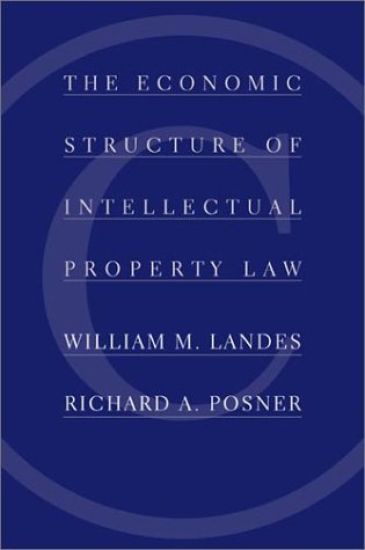
The Economic Structure of Intellectual Property Law

The Economic Structure of Intellectual Property Law

William M. Landes; Richard A. Posner

The Belknap Press
2003
sidottu
This book takes a fresh look at the most dynamic area of American law today, comprising the fields of copyright, patent, trademark, trade secrecy, publicity rights, and misappropriation. Topics range from copyright in private letters to defensive patenting of business methods, from moral rights in the visual arts to the banking of trademarks, from the impact of the court of patent appeals to the management of Mickey Mouse. The history and political science of intellectual property law, the challenge of digitization, the many statutes and judge-made doctrines, and the interplay with antitrust principles are all examined. The treatment is both positive (oriented toward understanding the law as it is) and normative (oriented to the reform of the law). Previous analyses have tended to overlook the paradox that expanding intellectual property rights can effectively reduce the amount of new intellectual property by raising the creators' input costs. Those analyses have also failed to integrate the fields of intellectual property law. They have failed as well to integrate intellectual property law with the law of physical property, overlooking the many economic and legal-doctrinal parallels.This book demonstrates the fundamental economic rationality of intellectual property law, but is sympathetic to critics who believe that in recent decades Congress and the courts have gone too far in the creation and protection of intellectual property rights.
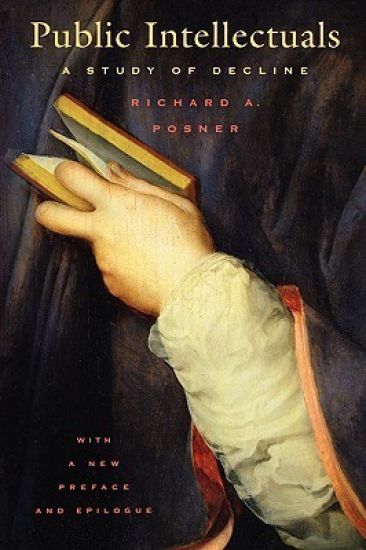
Public Intellectuals

Public Intellectuals

Richard A. Posner

Harvard University Press
2003
nidottu
In this timely book, the first comprehensive study of the modern American public intellectual--that individual who speaks to the public on issues of political or ideological moment--Richard Posner charts the decline of a venerable institution that included worthies from Socrates to John Dewey.With the rapid growth of the media in recent years, highly visible forums for discussion have multiplied, while greater academic specialization has yielded a growing number of narrowly trained scholars. Posner tracks these two trends to their inevitable intersection: a proliferation of modern academics commenting on topics outside their ken. The resulting scene--one of off-the-cuff pronouncements, erroneous predictions, and ignorant policy proposals--compares poorly with the performance of earlier public intellectuals, largely nonacademics whose erudition and breadth of knowledge were well suited to public discourse.Leveling a balanced attack on liberal and conservative pundits alike, Posner describes the styles and genres, constraints and incentives, of the activity of public intellectuals. He identifies a market for this activity--one with recognizable patterns and conventions but an absence of quality controls. And he offers modest proposals for improving the performance of this market--and the quality of public discussion in America today.This paperback edition contains a new preface and and a new epilogue.
The Problematics of Moral and Legal Theory

The Problematics of Moral and Legal Theory

Richard A. Posner

The Belknap Press
2002
nidottu
Ambitious legal thinkers have become mesmerized by moral philosophy, believing that great figures in the philosophical tradition hold the keys to understanding and improving law and justice and even to resolving the most contentious issues of constitutional law. They are wrong, contends Richard Posner in this book. Posner characterizes the current preoccupation with moral and constitutional theory as the latest form of legal mystification—an evasion of the real need of American law, which is for a greater understanding of the social, economic, and political facts out of which great legal controversies arise. In pursuit of that understanding, Posner advocates a rebuilding of the law on the pragmatic basis of open-minded and systematic empirical inquiry and the rejection of cant and nostalgia—the true professionalism foreseen by Oliver Wendell Holmes a century ago. A bracing book that pulls no punches and leaves no pieties unpunctured or sacred cows unkicked, The Problematics of Moral and Legal Theory offers a sweeping tour of the current scene in legal studies—and a hopeful prospect for its future.
Antitrust Law, Second Edition

Antitrust Law, Second Edition

Richard A. Posner

University of Chicago Press
2001
sidottu
When it was first published a quarter of a century ago, Richard A. Posner's exposition and defence of an economic approach to antitrust law was a jeremiad against the intellectual disarray that then characterized the field. As other perspectives on antitrust law have fallen away, Posner's book has played a major role in transforming the field of antitrust law into a body of economically rational principles largely in accord with the ideas set forth in the first edition. Today's antitrust professionals may disagree on specific practices and rules, but most litigators, prosecutors, judges and scholars agree that the primary goal of antitrust law should be to promote economic welfare, and that economic theory should be used to determine how well business practices conform to that goal. In this thoroughly revised edition, Posner explains the economic approach to new generations of lawyers and students. He updates and amplifies his approach as it applies to the developments, both legal and economic, in the antitrust field since 1976. The "new economy", for example, has presented a host of difficult antitrust questions, and in an entirely new chapter, Posner explains how the economic approach can be applied to new industries, such as software manufacturers, Internet service providers and those that provide communications equipment and services. "The antitrust laws are here to stay", Posner writes, "and the practical question is how to administer them better - more rationally, more accurately, more expeditiously, more efficiently". This fully revised classic should continue to be a standard work in the field.
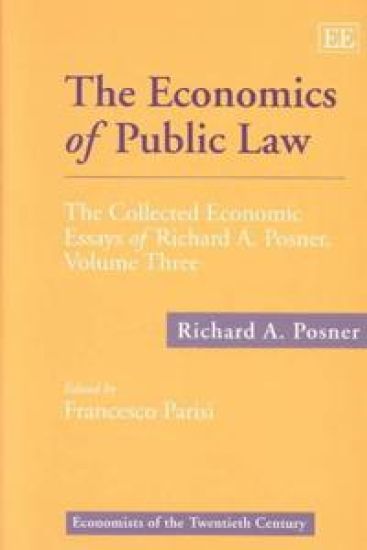
The Economics of Public Law

The Economics of Public Law

Richard A. Posner

Edward Elgar Publishing Ltd
2001
sidottu
Judge Richard A. Posner's work on the economics of public law is a critical component of the interaction between the new law and economics movement and public choice theory. It exemplifies the parallel influence that these two important intellectual movements have had on the current understanding of legal institutions. Together with an insightful introduction by Francesco Parisi, this volume brings together his most important contributions on areas such as: the economics of constitutional law and legislationthe economics of criminal lawthe economics of labour law and employment discriminationthe economics of antitrust.The Economics of Public Law will be essential reading for economists, lawyers and judges alike.
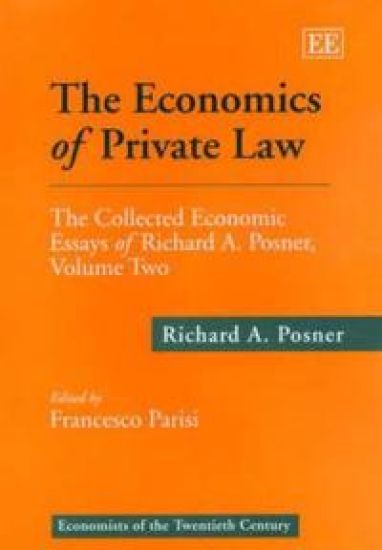
The Economics of Private Law

The Economics of Private Law

Richard A. Posner

Edward Elgar Publishing Ltd
2001
sidottu
The pioneering work of Judge Richard Posner has brought to light the broad relevance of economics to virtually all areas of law. During the last three decades, Judge Posner has provided seminal contributions to the development of an overarching economic theory of law, with applications including traditional legal subjects, such as torts and contracts, as well as non-standard topics, such as his study of primitive law and ancient customs. This selection of Posner's essays reveals the importance of economic efficiency as a driving force in the formation of private law. The rigorous and insightful introduction by Francisco Parisi discusses Posner's unparalleled influence on the evolution of law and economics and the understanding of the economic foundations of private law.In particular he discusses:• anthropology and the emergence of law• tort law• contract law• family law• the economics of privacy.The Economics of Private Law will be essential reading for economists, lawyers and judges alike.
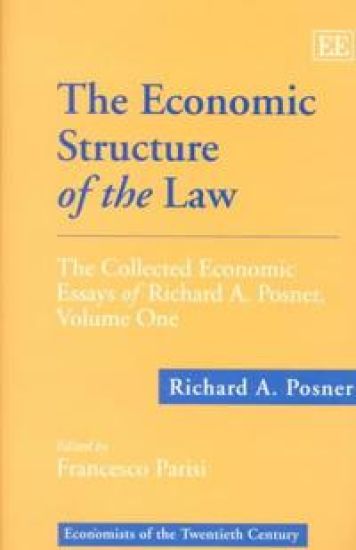
The Economic Structure of the Law

The Economic Structure of the Law

Richard A. Posner

Edward Elgar Publishing Ltd
2000
sidottu
Judge Richard A. Posner is internationally regarded as a leading exponent and a founding father of the law and economics movement. This volume draws together a selection of his most important papers on the methodology and the theory of law and economics to create a valuable collection for scholars and practitioners in the field. It includes a coherent and informative introduction by Professor Francesco Parisi containing salient insights into Judge Posner's work.Themes explored in this volume include:the economics of common lawthe criterion of wealth maximizationan economic approach to judicial rulemakingthe application of finance theory to lawthe methodology of law and economics.The Economic Structure of the Law draws together Judge Posner's seminal contributions on the methodological foundations of law and economics and will be a valuable reference source for economists, lawyers and judges alike.
An Affair of State

An Affair of State

Richard A. Posner

Harvard University Press
2000
nidottu
President Bill Clinton’s year of crisis, which began when his affair with Monica Lewinsky hit the front pages in January 1998, engendered a host of important questions of criminal and constitutional law, public and private morality, and political and cultural conflict.In a book written while the events of the year were unfolding, Richard Posner presents a balanced and scholarly understanding of the crisis that also has the freshness and immediacy of journalism. Posner clarifies the issues and eliminates misunderstandings concerning facts and the law that were relevant to the investigation by Independent Counsel Kenneth Starr and to the impeachment proceeding itself. He explains the legal definitions of obstruction of justice and perjury, which even many lawyers are unfamiliar with. He carefully assesses the conduct of Starr and his prosecutors, including their contacts with the lawyers for Paula Jones and their hardball tactics with Monica Lewinsky and her mother. He compares and contrasts the Clinton affair with Watergate, Iran–Contra, and the impeachment of Andrew Johnson, exploring the subtle relationship between public and private morality. And he examines the place of impeachment in the American constitutional scheme, the pros and cons of impeaching President Clinton, and the major procedural issues raised by both the impeachment in the House and the trial in the Senate. This book, reflecting the breadth of Posner’s experience and expertise, will be the essential foundation for anyone who wants to understand President Clinton’s impeachment ordeal.
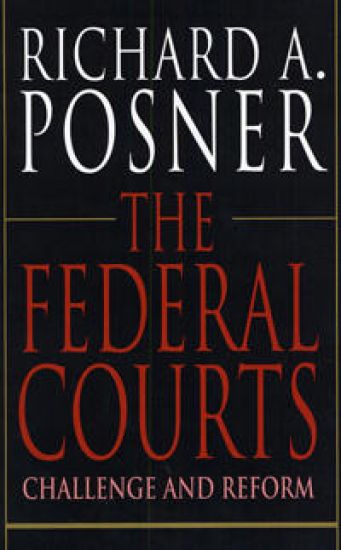
The Federal Courts

The Federal Courts

Richard A. Posner

Harvard University Press
1999
nidottu
The federal courts are the world’s most powerful judiciary and a vital element of the American political system. In recent decades, these courts have experienced unprecedented growth in caseload and personnel. Many judges and lawyers believe that a “crisis in quantity” is imperiling the ability of the federal judiciary to perform its historic function of administering justice fairly and expeditiously.In a substantially revised edition of his widely acclaimed 1985 book The Federal Courts: Crisis and Reform, Chief Judge Richard A. Posner of the U.S. Court of Appeals for the Seventh Circuit provides a comprehensive evaluation of the federal judiciary and a detailed program of judicial reform. Drawing on economic and political theory as well as on legal analysis and his own extensive judicial experience, Posner sketches the history of the federal courts, describes the contemporary institution, appraises the concerns that have been expressed with the courts’ performance, and presents a variety of proposals for both short-term and fundamental reform. In contrast to some of the direr prophecies of observers of the federal courts, Posner emphasizes the success of these courts in adapting to steep caseload growth with minimum sacrifice in quality.Although the book ranges over a variety of traditional topics in federal jurisdiction, the focus is steady on federal judicial administration conceived of as an interdisciplinary approach emphasizing system rather than doctrine, statistics rather than impressions, and caseload rather than cases. Like the earlier edition, this book promises to be a landmark in the empirical study of judicial administration.
A Guide to America's Sex Laws

A Guide to America's Sex Laws

Richard A. Posner; Katharine B. Silbaugh

University of Chicago Press
1998
nidottu
A Guide to America's Sex Laws is the first concise compendium of the nation's sex laws. It summarizes the laws regulating personal sexual activity, revealing gaps, anachronisms, anomalies, inequalities, and irrationalities, and providing an empirical basis for studies of sexual regulation. Judge Richard A. Posner and Katharine B. Silbaugh cover broadly defined areas of regulation, providing background and definitions and placing the laws in their historical and constitutional context. From Alabama to Wyoming, this informative and fascinating reference book will be an essential resource."It takes only a few minutes with A Guide to [America's] Sex to realize that the nation's laws governing what two consenting adults can do with one another are an odd jumble."—Eric Fidler, San Diego Commerce"Especially noteworthy is how laws governing various sexual activities vary from state to state."—Library Journal"Fascinating and often surprising facts are concisely documented and conveniently organized in A Guide."—Carlin Meyer, New York Law Journal
Aging and Old Age

Aging and Old Age

Richard A. Posner

University of Chicago Press
1997
nidottu
Are the elderly posing a threat to America's political system with their enormous clout? Are they stretching resources to the breaking point with their growing demands for care? Economist and legal scholar Richard A. Posner explodes the myth that the United States could be on the brink of gerontological disaster. This text seeks to offer fresh insight into a wide range of social and political issues relating to the elderly, such as health care, crime, social security, and discrimination. From the dread of death to the inordinate law-abidingness of the old, from their loquacity to their penny-pinching, Posner paints a surprisingly rich, revealing, and unsentimental portrait of the millions of elderly people in the United States. He explores issues such as age discrimination in employment, creativity and leadership as functions of age, and the changing social status of the elderly. Why are old people, presumably with less to lose, more unwilling to take risks than young people? Why don't the elderly in the United States command the respect and affection they once did and still do in other countries? How does aging affect driving and criminal records? And how does aging relate to creativity across different careers?
Law and Legal Theory in England and America

Law and Legal Theory in England and America

Richard A. Posner

Clarendon Press
1997
sidottu
Richard Posner is famous throughout the legal world for his pioneering and controversial espousal of the belief that the study of law cannot be divorced from the study of economics. Here, in this volume of essays based upon his Clarendon Lectures, he explores the relationship between the legal systems of the UK and USA. The essays in this volume range widely over themes which will be familiar to many students and teachers of law. In the first essay he compares the work of the two most prominent writers on jurisprudence in the second half of this century, one English (HLA Hart) and one American (Ronald Dworkin). His controversial conclusion that trying to define "law" is futile, distracting and illustrative of the impoverishment of traditional legal theory will fascinate students of legal theory. In the second lecture he examines a number of English cases drawn primarily from the two fields in which English and American law overlap most completely - torts and contracts. Here he argues that while in general English judges use their common sense effectively to approximate the results that an economic analyst would recommend they would do even better if they were more receptive to the economic approach to the common law -- if they were, in other words, a little more like American judges. In the third lecture he examines the differences between the English and American legal systems at the administrative or operational level as distinct from the jurisprudential and doctrinal levels. The conclusions drawn from his analysis challenge traditional orthodoxy. His concluding advice to law reformers in both jurisdictions is that piecemeal reform of either system is to be avoided. In this short and highly readable work readers will find much that will delight, stimulate and challenge them.
A Guide to America's Sex Laws

A Guide to America's Sex Laws

Richard A. Posner; Katharine B. Silbaugh

University of Chicago Press
1996
sidottu
Sex, although considered by many in our culture the quintessential private activity, is blanketed by a large number and variety of laws. This text presents a concise compendium of the America's sex laws and brings together in one place, and summarizes, the laws regulating personal sexual activity. In doing so, the book reveals gaps, anachronisms, anomalies, inequalities , and irrationalities, and provides an empirical basis for studies of sexual regulation. In some states, for example, sexual relations between consenting adults of the same sex is a crime, in some states the age of consent to marriage is lower for females than for males, and in some states marital rape is not a crime. Such a mixed quilt of state laws means that a sexual practice that is perfectly legitimate in one state is illegal in another.