Kirjojen hintavertailu. Mukana 12 595 353 kirjaa ja 12 kauppaa.

Kirjailija

Richard B Norgaard

Kirjat ja teokset yhdessä paikassa: 7 kirjaa, julkaisuja vuosilta 1994-2020, suosituimpien joukossa Climate-Challenged Society. Vertaile teosten hintoja ja tarkista saatavuus suomalaisista kirjakaupoista.

Mukana myös kirjoitusasut: Richard B. Norgaard

7 kirjaa

Kirjojen julkaisuhaarukka 1994-2020.

Natural Capital and Human Economic Survival

Natural Capital and Human Economic Survival

Thomas Prugh; Herman Daly; Robert Goodland; John H Cumberland; Richard B Norgaard

CRC Press
2020
nidottu
Most people love nature and consider themselves environmentalists, but nature isn't just pretty and lovable, it is indispensable to our survival and economic activity. That is the most compelling reason for environmental protection. The conventional economic wisdom views land (natural capital) as a small part of the economy, along with capital, labor, technology and so on. The authors argue that this is backwards: that the economy nests within the environment (land) and not the other way around. The authors give a brief history of the origins of conventional economic wisdom and critique it from a the standpoint of ecological economics. They explain what natural capital -our life support system - is and does, and describe the severe strains that have been put on it. They conclude with some policy options, such as green taxes and suggestions for personal action that would conserve natural capital and thus make conserve resources for present and future generations. Natural Capital and Human Economic Survival is written for environmentalists, environmental studies majors and anyone concerned about the flaws of mainstream economics - how it has led us into unsustainable ways of living - and who would like to learn about alternatives that are more sustainable.
Development Betrayed

Development Betrayed

Richard B Norgaard

Routledge
2015
sidottu
Modernity promised control over nature through science, material abundance through technology and effective government through rational, social organization. Instead of leading to this promised land it has brought us to the brink of environmental and cultural disaster. Why has there been this gap between modernity's aspirations and its achievements? Development Betrayed offers a powerful answer to this question. Development with its unshakeable commitment to the idea of progress, is rooted in modernism and has been betrayed by each of its major tenets. Attempts to control nature have led to the brink of environmental catastrophe. Western technologies have proved inappropriate for the needs of the South, and governments are unable to respond effectively to the crises that have resulted. Offering a thorough and lively critiques of the ideas behind development, Richard Norgaard also offers an alternative co-evolutionary paradigm, in which development is portrayed as a co-evolution between cultural and ecological systems. Rather than a future with all peoples merging to one best way of knowing and doing things, he envisions a future of a patchwork quilt of cultures with real possibilities for harmony.
An Introduction to Ecological Economics

An Introduction to Ecological Economics

Robert Costanza; John H Cumberland; Herman Daly; Robert Goodland; Richard B Norgaard; Ida Kubiszewski; Carol Franco

CRC Press Inc
2014
sidottu
From Empty-World Economics to Full-World EconomicsEcological economics explores new ways of thinking about how we manage our lives and our planet to achieve a sustainable, equitable, and prosperous future. Ecological economics extends and integrates the study and management of both "nature's household" and "humankind's household"—An Introduction to Ecological Economics, Second Edition, the first update and expansion of this classic text in 15 years, describes new approaches to achieving a sustainable and desirable human presence on Earth. Written by the top experts in the field, it addresses the necessity for an innovative approach to integrated environmental, social, and economic analysis and management, and describes policies aimed at achieving our shared goals. Demands a Departure from Business as UsualThe book begins with a description of prevailing interdependent environmental, economic, and social issues and their underlying causes, and offers guidance on designing policies and instruments capable of adequately coping with these problems. It documents the historical development of the disciplines of economics and ecology, and explores how they have evolved so differently from a shared conceptual base. Structured into four sections, it also presents various ideas and models in their proper chronological context, details the fundamental principles of ecological economics, and outlines prospects for the future. What’s New in the Second Edition:Includes several new pieces and updates in each sectionAdds a series of independently authored "boxes" to expand and update information in the current textAddresses the historical development of economics and ecology and the recent progress in integrating the study of humans and the rest of natureCovers the basic concepts and applications of ecological economics in language accessible to a broad audience An Introduction to Ecological Economics, Second Edition can be used in an introductory undergraduate or graduate course; requires no prior knowledge of mathematics, economics, or ecology; provides a unified understanding of natural and human-dominated ecosystems; and reintegrates the market economy within society and the rest of nature.
Climate-Challenged Society

Climate-Challenged Society

John S. Dryzek; Richard B. Norgaard; David Schlosberg

Oxford University Press
2013
sidottu
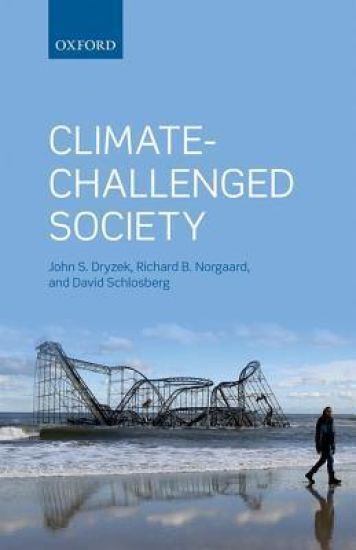
This book is an original, accessible, and thought-provoking introduction to the severe and broad-ranging challenges that climate change presents and how societies can respond. It synthesizes and deploys cutting-edge scholarship on the range of social, economic, political, and philosophical issues surrounding climate change. The treatment is introductory, but the book is written "with attitude", for nobody has yet charted in coherent, integrative, and effective fashion a way to move societies beyond their current paralysis as they face the challenges of climate change. The coverage begins with an examination of science, public opinion, and policy making, with special attention to organized climate change denial. The book then moves to economic analysis and its limits; different kinds of policies; climate justice; governance at all levels from the local to the global; and the challenge of an emerging "Anthropocene" in which the mostly unintended consequences of human action drive the earth system into a more chaotic and unstable era. The conclusion considers the prospects for fundamental transition in ideas, movements, economics, and governance.
Climate-Challenged Society

Climate-Challenged Society

John S. Dryzek; Richard B. Norgaard; David Schlosberg

Oxford University Press
2013
nidottu
This book is an original, accessible, and thought-provoking introduction to the severe and broad-ranging challenges that climate change presents and how societies can respond. It synthesizes and deploys cutting-edge scholarship on the range of social, economic, political, and philosophical issues surrounding climate change. The treatment is introductory, but the book is written "with attitude", for nobody has yet charted in coherent, integrative, and effective fashion a way to move societies beyond their current paralysis as they face the challenges of climate change. The coverage begins with an examination of science, public opinion, and policy making, with special attention to organized climate change denial. The book then moves to economic analysis and its limits; different kinds of policies; climate justice; governance at all levels from the local to the global; and the challenge of an emerging "Anthropocene" in which the mostly unintended consequences of human action drive the earth system into a more chaotic and unstable era. The conclusion considers the prospects for fundamental transition in ideas, movements, economics, and governance.
Natural Capital and Human Economic Survival

Natural Capital and Human Economic Survival

Thomas Prugh; Herman Daly; Robert Goodland; John H Cumberland; Richard B Norgaard

CRC Press Inc
1999
sidottu
Most people love nature and consider themselves environmentalists, but nature isn't just pretty and lovable, it is indispensable to our survival and economic activity. That is the most compelling reason for environmental protection. The conventional economic wisdom views land (natural capital) as a small part of the economy, along with capital, labor, technology and so on. The authors argue that this is backwards: that the economy nests within the environment (land) and not the other way around. The authors give a brief history of the origins of conventional economic wisdom and critique it from a the standpoint of ecological economics. They explain what natural capital -our life support system - is and does, and describe the severe strains that have been put on it. They conclude with some policy options, such as green taxes and suggestions for personal action that would conserve natural capital and thus make conserve resources for present and future generations. Natural Capital and Human Economic Survival is written for environmentalists, environmental studies majors and anyone concerned about the flaws of mainstream economics - how it has led us into unsustainable ways of living - and who would like to learn about alternatives that are more sustainable.
Development Betrayed

Development Betrayed

Richard B Norgaard

Routledge
1994
nidottu
Modernity promised control over nature through science, material abundance through technology and effective government through rational, social organization. Instead of leading to this promised land it has brought us to the brink of environmental and cultural disaster. Why has there been this gap between modernity's aspirations and its achievements? Development Betrayed offers a powerful answer to this question. Development with its unshakeable commitment to the idea of progress, is rooted in modernism and has been betrayed by each of its major tenets. Attempts to control nature have led to the brink of environmental catastrophe. Western technologies have proved inappropriate for the needs of the South, and governments are unable to respond effectively to the crises that have resulted. Offering a thorough and lively critiques of the ideas behind development, Richard Norgaard also offers an alternative co-evolutionary paradigm, in which development is portrayed as a co-evolution between cultural and ecological systems. Rather than a future with all peoples merging to one best way of knowing and doing things, he envisions a future of a patchwork quilt of cultures with real possibilities for harmony.