Kirjojen hintavertailu. Mukana 12 595 353 kirjaa ja 12 kauppaa.

Kirjailija

Richard D. Roberts

Kirjat ja teokset yhdessä paikassa: 8 kirjaa, julkaisuja vuosilta 2007-2026, suosituimpien joukossa Noncognitive Skill Assessment in School. Vertaile teosten hintoja ja tarkista saatavuus suomalaisista kirjakaupoista.

Mukana myös kirjoitusasut: Richard D Roberts

8 kirjaa

Kirjojen julkaisuhaarukka 2007-2026.

What We Know About Heuristics and Biases

What We Know About Heuristics and Biases

Franklin Zaromb; Abigail Gertner; Robert Schneider; Jeremy Burrus; Gerald Matthews; Rebecca Rhodes; Richard D Roberts

Routledge
2026
nidottu
People often rely on mental shortcuts, known as heuristics, to help them make judgments and decisions quickly and efficiently. While, generally, these heuristics lead to accurate judgments, in certain circumstances, heuristics can bias problem-solving and decision-making producing errors with serious consequences. What We Know About Heuristics and Biases introduces the literature on heuristics and provides an assessment tool designed to obviate these problems. Measuring six cognitive and social biases—confirmation bias, fundamental attribution error, the bias blind spot, anchoring bias, representativeness bias, and projection bias–this tool provides an innovate and cutting edge method for assessment professionals and researchers in measurement.

What We Know About Heuristics and Biases

What We Know About Heuristics and Biases

Franklin Zaromb; Abigail Gertner; Robert Schneider; Jeremy Burrus; Gerald Matthews; Rebecca Rhodes; Richard D Roberts

Routledge
2026
sidottu
People often rely on mental shortcuts, known as heuristics, to help them make judgments and decisions quickly and efficiently. While, generally, these heuristics lead to accurate judgments, in certain circumstances, heuristics can bias problem-solving and decision-making producing errors with serious consequences. What We Know About Heuristics and Biases introduces the literature on heuristics and provides an assessment tool designed to obviate these problems. Measuring six cognitive and social biases—confirmation bias, fundamental attribution error, the bias blind spot, anchoring bias, representativeness bias, and projection bias–this tool provides an innovate and cutting edge method for assessment professionals and researchers in measurement.

Noncognitive Skill Assessment in School

Noncognitive Skill Assessment in School

Richard D. Roberts; Jonathan E. Martin; Jeremy Burrus

Routledge
2023
sidottu
Noncognitive skills have long been understood to matter in school, workforce, and life—though means to measures these skills have not been formalized by test makers and measurement experts. In this groundbreaking book, Richard Roberts and Jonathan Martin draw together the latest research on the assessment, support, and development of noncognitive skills in schools. With case studies that clearly demonstrate the value of noncognitive skills, and the many complications involved in assessing them productively, this book traces out this new and complex assessment terrain and explains how we might use the new assessment tools we have.
Noncognitive Skill Assessment in School

Noncognitive Skill Assessment in School

Richard D. Roberts; Jonathan E. Martin; Jeremy Burrus

Routledge
2023
nidottu
Noncognitive skills have long been understood to matter in school, workforce, and life—though means to measures these skills have not been formalized by test makers and measurement experts. In this groundbreaking book, Richard Roberts and Jonathan Martin draw together the latest research on the assessment, support, and development of noncognitive skills in schools. With case studies that clearly demonstrate the value of noncognitive skills, and the many complications involved in assessing them productively, this book traces out this new and complex assessment terrain and explains how we might use the new assessment tools we have.
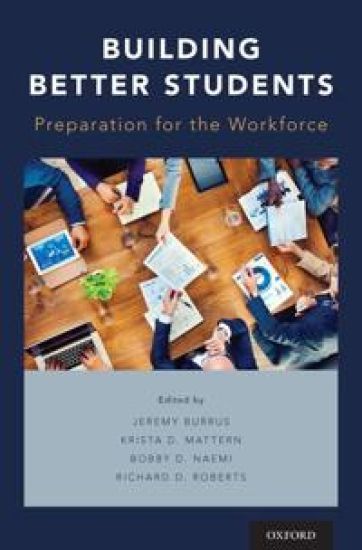
Building Better Students

Building Better Students

Jeremy Burrus; Krista Mattern; Bobby D. Naemi; Richard D. Roberts

Oxford University Press Inc
2017
sidottu
Led by a team of experts, Building Better Students: Preparation for the Workforce discusses a variety of issues surrounding workforce readiness in the 21st century by presenting the latest research, practice, and policy on what is continually emerging as a febrile field. By featuring such topics as how to define and measure workforce readiness; how to prepare students for the workforce; and bridging the gap between college and workforce readiness, this volume is a necessary contribution to today's "skills gap" literature as society works to not only secure our own economic futures, but our children's futures, as well. In this volume, world-class contributors from a variety of backgrounds (including industrial/organizational psychology, personality psychology, and educational assessment) all come together to share their unique perspective on the larger issues at hand. In addition to showcasing cutting-edge research, Building Better Students offers insightful commentary and provides readers with the opportunity to not only reflect on these issues, but how to move the needle further for this generation and beyond.
What We Know about Emotional Intelligence

What We Know about Emotional Intelligence

Moshe Zeidner; Gerald Matthews; Richard D. Roberts

Bradford Books
2012
pokkari
Sorting out the scientific facts from the unsupported hype about emotional intelligence.Emotional intelligence (or EI)-the ability to perceive, regulate, and communicate emotions, to understand emotions in ourselves and others-has been the subject of best-selling books, magazine cover stories, and countless media mentions. It has been touted as a solution for problems ranging from relationship issues to the inadequacies of local schools. But the media hype has far outpaced the scientific research on emotional intelligence. In What We Know about Emotional Intelligence, three experts who are actively involved in research into EI offer a state-of-the-art account of EI in theory and practice. They tell us what we know about EI based not on anecdote or wishful thinking but on science.What We Know about Emotional Intelligence looks at current knowledge about EI with the goal of translating it into practical recommendations in work, school, social, and psychological contexts.
Extending Intelligence

Extending Intelligence

Patrick C. Kyllonen; Richard D. Roberts; Lazar Stankov

Routledge
2010
nidottu
This volume presents research from a variety of perspectives on the enhancement of human intelligence. It is organized around five themes – enhancement via instruction; enhancement via development (over the life cycle); enhancement over time; enhancement via new constructs; and new directions in enhancement. Three key issues are addressed: First, although most of the scientific research on intelligence has concerned what it is, this volume attends to the consequential societal and economic issue concerns of whether it can be increased, and how. Second, intellectual enhancement is particularly important when targeted to minorities and the poor, groups that have typically performed relatively less well on intelligence and achievement measures. This volume reflects the education community's ongoing interest in understanding, and attempting to close, achievement or test score gaps. Third, most of the attention to examining intellectual enhancement, and in accounting for and closing the test-score gap, has focused on general cognitive ability. In line with the current emphasis on considering intelligence from a wider perspective, this volume includes constructs such as emotional and practical intelligence in definitions of intellectual functioning. Extending Intelligence: Enhancement and New Constructs is an essential volume for researchers, students, and professionals in the fields of educational psychology, intelligence, educational measurement and assessment, and critical thinking.
Extending Intelligence

Extending Intelligence

Patrick C. Kyllonen; Richard D. Roberts; Lazar Stankov

Routledge Member of the Taylor and Francis Group
2007
sidottu
This volume presents research from a variety of perspectives on the enhancement of human intelligence. It is organized around five themes – enhancement via instruction; enhancement via development (over the life cycle); enhancement over time; enhancement via new constructs; and new directions in enhancement.Three key issues are addressed:First, although most of the scientific research on intelligence has concerned what it is, this volume attends to the consequential societal and economic issue concerns of whether it can be increased, and how.Second, intellectual enhancement is particularly important when targeted to minorities and the poor, groups that have typically performed relatively less well on intelligence and achievement measures. This volume reflects the education community's ongoing interest in understanding, and attempting to close, achievement or test score gaps.Third, most of the attention to examining intellectual enhancement, and in accounting for and closing the test-score gap, has focused on general cognitive ability. In line with the current emphasis on considering intelligence from a wider perspective, this volume includes constructs such as emotional and practical intelligence in definitions of intellectual functioning.Extending Intelligence: Enhancement and New Constructs is an essential volume for researchers, students, and professionals in the fields of educational psychology, intelligence, educational measurement and assessment, and critical thinking.