Kirjojen hintavertailu. Mukana 12 314 256 kirjaa ja 12 kauppaa.

Kirjailija

Richard E. Darilek

Kirjat ja teokset yhdessä paikassa: 10 kirjaa, julkaisuja vuosilta 1976-2019, suosituimpien joukossa Sustaining the Qatar National Research Fund. Vertaile teosten hintoja ja tarkista saatavuus suomalaisista kirjakaupoista.

Mukana myös kirjoitusasut: Richard E Darilek

10 kirjaa

Kirjojen julkaisuhaarukka 1976-2019.

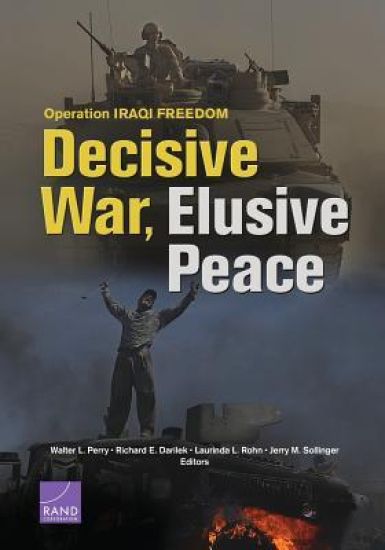
Operation Iraqi Freedom

Operation Iraqi Freedom

Walter L. Perry; Richard E. Darilek; Laurinda L. Rohn; Jerry M. Sollinger

RAND
2016
pokkari
Soon after Operation IRAQI FREEDOM began in March 2003, RAND Arroyo Center began a project, completed in January 2006, to produce an authoritative account of the planning and execution of combat and stability operations in Iraq and to recommend changes to Army plans, operational concepts, doctrine, and Title 10 functions. This report presents a broad overview of the study findings based on unclassified source material.
Strategy-Policy Mismatch

Strategy-Policy Mismatch

Timothy M. Bonds; Eric V. Larson; Derek Eaton; Richard E. Darilek

RAND
2014
pokkari
Although two successive presidents have determined that weapons of mass destruction (WMD) pose the greatest threat to the American people and have listed countering their proliferation as a top strategic priority, neither administration has followed through by allocating appropriate budgetary resources to it. This report addresses and analyzes the ground force capacity and capabilities needed to perform WMD elimination missions and tasks.
Launching the Qatar National Research Fund

Launching the Qatar National Research Fund

Shelly Culbertson; Michael G. Mattock; Bruce R. Nardulli; Abdulrazaq Al-Kuwari; Gary Cecchine; Margaret C. Harrell; John A. Friel; Richard E. Darilek

RAND
2012
pokkari
An overview of the launch of the Qatar National Research Fund (QNRF)--the first research-funding organization of its kind in the Middle East--including the design and implementation of its first programs, from August 2006 through January 2008. It describes the thinking behind the programs, policies, planning methods, and decisions and discuses ways of learning from the first grant cycles and improving upon them, as well as early program results.
Assessing the Value of U.S. Army International Activities

Assessing the Value of U.S. Army International Activities

Jefferson P. Marquis; Richard E. Darilek; Jasen J. Castillo; Cathryn Quantic Thurston; Anny Wong; Cynthia Huger; Andrea Mejia; Jennifer D. P. Moroney; Brian Nichiporuk; Brett Steele

RAND
2006
pokkari
This report presents a framework for assessing U.S. Army International Activities (AIA). It also provides a matrix of eight AIA ends, derived from top-level national and Army guidance, and eight AIA ways, which summarize the various capabilities inherent in AIA programs. In addition, the report describes the new online AIA Knowledge Sharing System (AIAKSS) that is being used to solicit programmatic and assessment data from AIA officials in the Army's Major Commands.
Joint Paths to the Future Force

Joint Paths to the Future Force

Richard E. Darilek; Peter A. Wilson

RAND
2005
pokkari
Presents RAND's analysis of Unified Quest 2004, a wargame cosponsored by Joint Forces Command and the United States Army. This book describes and analyzes a wargame cosponsored by Joint Forces Command and the United States Army that focused on identifying the concepts and capabilities required to counteract an adversary who, having lost most of his conventional capability, seeks victory through a combination of protracted, unconventional operations and use of WMD. The report identifies the wargame's scenario, assumptions, central questions and objectives, study issues, and essential elements of analysis.
Measures of Effectiveness for the Information-age Army

Measures of Effectiveness for the Information-age Army

Richard E. Darilek; Walter Perry; Jerome Bracken; John Gordon; Brian Nichiporuk

RAND
2001
pokkari
The 1990s have witnessed the beginning of what future historians may call the Information Age. While it is clear that information will have a far-reaching effect on a host of activities--including warfare--how to quantify and measure that effect is less clear. The understanding of how to do so is important to the Army, particularly at a time when it is spencing a considerable amount of its scarce investment capital to establish Information-Age links across its forces--the so-called digitization of the Army. As it transforms itself, the Army needs analytic tools to help make the best choices possible. Chief among these tools are good measures of effectiveness (MOEs) that can demonstrate the value of information in terms of military outcomes. This document reports on a small set of Information-Age MOEs developed in an attempt to spark the creation of many more such measures. This research demonstrates that development of MOEs is feasible, not only for combat operations but for stability operations as well.