Kirjojen hintavertailu. Mukana 12 390 323 kirjaa ja 12 kauppaa.

Kirjailija

Richard Flory

Kirjat ja teokset yhdessä paikassa: 5 kirjaa, julkaisuja vuosilta 2008-2020, suosituimpien joukossa Back-Pocket God. Vertaile teosten hintoja ja tarkista saatavuus suomalaisista kirjakaupoista.

5 kirjaa

Kirjojen julkaisuhaarukka 2008-2020.

Back-Pocket God

Back-Pocket God

Melinda Lundquist Denton; Richard Flory; Christian Smith

Oxford University Press Inc
2020
sidottu
More than a decade ago, a group of researchers began to study the religious and spiritual lives of American teenagers. They tracked these young people over the course of a decade, revisiting them periodically to check in on the state -and future- of religion in America, and reporting on their findings in a series of books, beginning with Soul Searching (2005). Now, with Back-Pocket God, this mammoth research project comes to its conclusion. What have we learned about the changing shape of religion in America? Back-Pocket God explores continuity and change among young people from their teenage years through the latter stages of "emerging adulthood." Melinda Lundquist Denton and Richard Flory find that the story of young adult religion is one of an overall decline in commitment and affiliation, and in general, a moving away from organized religion. Yet, there is also a parallel trend in which a small, religiously committed group of emerging adults claim faith as an important fixture in their lives. Emerging adults don't seem so much opposed to religion or to religious organizations, at least in the abstract, as they are uninterested in religion, at least as they have experienced it. Religion is like an app on the ubiquitous smartphones in our back pockets: readily accessible, easy to control, and usefulbut only for limited purposes. Denton and Flory show that some of the popular assumptions about young people and religion are not as clear as what many people seem to believe. The authors challenge the characterizations of religiously unaffiliated emerging adults -sometimes called "religious nones"- as undercover atheists. At the other end of the spectrum, they question the assumption that those who are not religious will return to religion once they marry and have children.
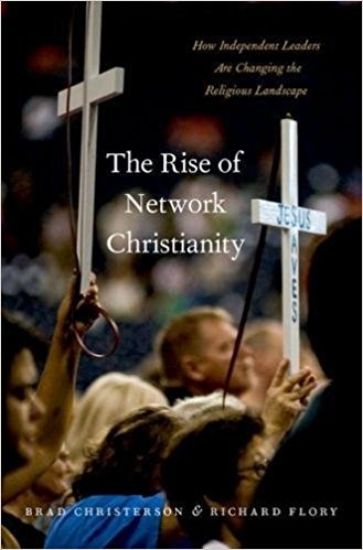
The Rise of Network Christianity

The Rise of Network Christianity

Brad Christerson; Richard Flory

Oxford University Press Inc
2017
sidottu
Why, when traditionally organized religious groups are seeing declining membership and participation, are networks of independent churches growing so explosively? Drawing on in-depth interviews with leaders and participants, The Rise of Network Christianity explains the social forces behind the fastest growing form of Christianity in the U.S., which Brad Christerson and Richard Flory have labeled "Independent Network Christianity" (INC). This form of Christianity emphasizes aggressive engagement with the supernatural, including healing, direct prophecies from God, engaging in "spiritual warfare" against demonic spirits, and social transformation. Christerson and Flory argue that large-scale social changes since the 1970s, including globalization and the digital revolution have given competitive advantages to religious groups organized by networks rather than traditionally organized congregations and denominations. Network forms of church governance allow for experimentation with controversial supernatural practices, innovative finances and marketing, and a highly participatory, unorthodox, and experiential faith, which is attractive in today's unstable religious marketplace. Christerson and Flory argue that as more religious groups imitate this type of governance, religious belief and practice will become more experimental, more oriented around practice than belief, more shaped by the individual religious "consumer" and that authority will become more highly concentrated in the hands of individuals rather than institutions.
Growing Up in America

Growing Up in America

Richard Flory; Korie L. Edwards; Brad Christerson

Stanford University Press
2010
pokkari
People's experiences of racial inequality in adulthood are well documented, but less attention is given to the racial inequalities that children and adolescents face. Growing Up in America provides a rich, first-hand account of the different social worlds that teens of diverse racial and ethnic backgrounds experience. In their own words, these American teens describe, conflicts with parents, pressures from other teens, school experiences, and religious beliefs that drive their various understandings of the world. As the book reveals, teens' unequal experiences have a significant impact on their adult lives and their potential for social mobility. Directly confronting the constellation of advantages and disadvantages white, black, Hispanic, and Asian teens face today, this work provides a framework for understanding the relationship between socialization in adolescence and social inequality in adulthood. By uncovering the role racial and ethnic differences play early on, we can better understand the sources of inequality in American life.
Growing Up in America

Growing Up in America

Richard Flory; Korie L. Edwards; Brad Christerson

Stanford University Press
2010
sidottu
People's experiences of racial inequality in adulthood are well documented, but less attention is given to the racial inequalities that children and adolescents face. Growing Up in America provides a rich, first-hand account of the different social worlds that teens of diverse racial and ethnic backgrounds experience. In their own words, these American teens describe, conflicts with parents, pressures from other teens, school experiences, and religious beliefs that drive their various understandings of the world. As the book reveals, teens' unequal experiences have a significant impact on their adult lives and their potential for social mobility. Directly confronting the constellation of advantages and disadvantages white, black, Hispanic, and Asian teens face today, this work provides a framework for understanding the relationship between socialization in adolescence and social inequality in adulthood. By uncovering the role racial and ethnic differences play early on, we can better understand the sources of inequality in American life.
Finding Faith

Finding Faith

Richard Flory; Donald E. Miller

Rutgers University Press
2008
nidottu
Despite the masses still lining up to enter mega-churches with warehouse-like architecture, casually dressed clergy, and pop Christian music, the "Post-Boomer" generation-those ranging in age from twenty to forty-is having second thoughts. In this perceptive look at the evolving face of Christianity in contemporary culture, sociologists Richard Flory and Donald E. Miller argue that we are on the verge of another potential revolution in how Christians worship and associate with one another. Just as the formative experiences of Baby Boomers were colored by such things as the war in Vietnam, the 1960s, and a dramatic increase in their opportunities for individual expression, so Post-Boomers have grown up in less structured households with working (often divorced) parents. These childhood experiences leave them craving authentic spiritual experience, rather than entertainment, and also cause them to question institutions. Flory and Miller develop a typology that captures four current approaches to the Christian faith and argue that this generation represents a new religious orientation of "expressive communalism," in which they seek spiritual experience and fulfillment in community and through various expressive forms of spirituality, both private and public.