Kirjojen hintavertailu. Mukana 12 505 993 kirjaa ja 12 kauppaa.

Kirjailija

Richard G. Lipsey

Kirjat ja teokset yhdessä paikassa: 9 kirjaa, julkaisuja vuosilta 1997-2022, suosituimpien joukossa Microeconomics plus MyEconLab in CourseCompass plus ebook Student Access Kit. Vertaile teosten hintoja ja tarkista saatavuus suomalaisista kirjakaupoista.

9 kirjaa

Kirjojen julkaisuhaarukka 1997-2022.

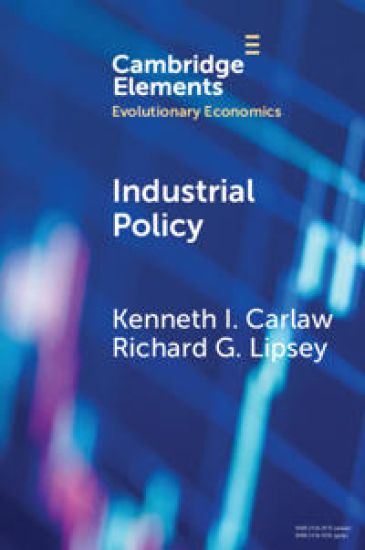
Industrial Policy

Industrial Policy

Kenneth I. Carlaw; Richard G. Lipsey

Cambridge University Press
2022
pokkari
Dismissing industrial policy because 'governments cannot pick winners' is counter-productive. This Element studying selected major innovations illustrates the fact that virtually all major new technologies have been developed by a synergetic cooperation between the public and the private sectors, each doing what it can do best. By examining how R&D is financed, rather than where it takes place, the authors show that the role of the public sector is much more pronounced than is often thought. The nature of the cooperation - who does what - varies with the nature of each innovation so that simple, one-size-fits-all, rules about what each sector should do are suspect. These results are particularly important because they challenge the scepticism in the United states and elsewhere about the importance of industrial policy, a scepticism that threatens to undermine the long-term, and necessary cooperation, between the public and private sectors in promoting growth-inducing innovations.
A Reconsideration of the Theory of Non-Linear Scale Effects

A Reconsideration of the Theory of Non-Linear Scale Effects

Richard G. Lipsey

Cambridge University Press
2018
pokkari
The main thrust of this Element is a critical assessment of the theory and evidence concerning the sources of scale effects. It is argued that the analysis of static scale effects is important because scale effects are embedding in our world, and new technologies associated with an evolving economy often allow their exploitation when they cannot be exploited in less technically advanced and smaller economies. So, although static equilibrium theory is not a good vehicle for studying economic growth, showing how scale effects operate when output varies with given technology helps us to understand the scale effects that occur when output rises as a result of economic growth, even though that is typically driven by technological change.
Microeconomics plus MyEconLab in CourseCompass plus ebook Student Access Kit

Microeconomics plus MyEconLab in CourseCompass plus ebook Student Access Kit

Richard G. Lipsey; Christopher T.S. Ragan; Storer Paul

PEARSON EDUCATION (US)
2007
nidottu
When asked to describe this text, most Lipsey readers use the same word: precise. The authors do not gloss over subjects when presenting economic ideas; rather, they offer a patient explanation of the concept and back it up with the latest research and data. Taken separately, neither theory nor data alone can give students a true understanding of the idea, but when combined these elements give students a complete view of economics in the real world. The Thirteenth Edition is significantly revised to reflect the latest advancements in the field, including major updates to monetary policy, globalization issues, and hot research areas like experimental economics. Economic debates are explored for each major concept, so students learn to analyze policy intuitively and from an economic perspective. MyEconLab now includes a subset of the text's end-of-chapter problems so that assignments can be automatically graded online. MyEconLab in CourseCompass™ provides additional optional customization and communication tools. Instructors who teach distance-learning courses or very large lecture sections find the CourseCompass™ format useful because they can upload course documents and assignments, customize the order of chapters, and use communication features such as Digital Dropbox and Discussion Board. View a demo of MyEconLab. For more information about MyEconLab in CourseCompass™, or to request an Instructor Access Code, visit MyEconLab.
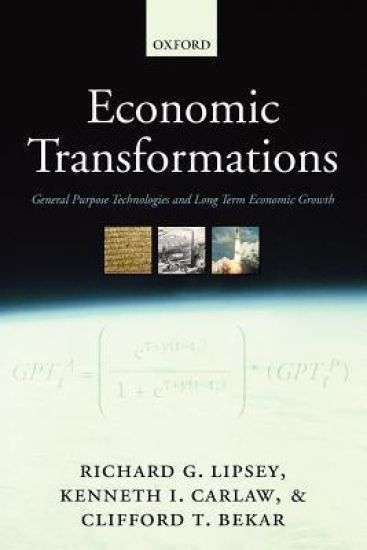
Economic Transformations

Economic Transformations

Richard G. Lipsey; Kenneth I. Carlaw; Clifford T. Bekar

Oxford University Press
2005
sidottu
This book examines the long term economic growth that has raised the West's material living standards to levels undreamed of by counterparts in any previous time or place. The authors argue that this growth has been driven by technological revolutions that have periodically transformed the West's economic, social and political landscape over the last 10,000 years and allowed the West to become, until recently, the world's only dominant technological force. Unique in the diversity of the analytical techniques used, the book begins with a discussion of the causes and consequences of economic growth and technological change. The authors argue that long term economic growth is largely driven by pervasive technologies now known as General Purpose (GPTs). They establish an alternative to the standard growth models that use an aggregate production function and then introduce the concept of GPTs, complete with a study of how these technologies have transformed the West since the Neolithic Agricultural Revolution. Early modern science is given more importance than in most other treatments and the 19th century demographic revolution is studied with a combination of formal models of population dynamics and historical analysis. The authors argue that once sustained growth was established in the West, formal models can shed much light on its subsequent behaviour. They build non-conventional, dynamic, non-stationary equilibrium models of GPT-driven growth that incorporate a range of phenomena that their historical studies show to be important but which are excluded from other GPT models in the interests of analytical tractability. The book concludes with a study of the policy implications that follow from their unique approach.
Economic Transformations

Economic Transformations

Richard G. Lipsey; Kenneth I. Carlaw; Clifford T. Bekar

Oxford University Press
2005
nidottu
This book examines the long term economic growth that has raised the West's material living standards to levels undreamed of by counterparts in any previous time or place. The authors argue that this growth has been driven by technological revolutions that have periodically transformed the West's economic, social and political landscape over the last 10,000 years and allowed the West to become, until recently, the world's only dominant technological force. Unique in the diversity of the analytical techniques used, the book begins with a discussion of the causes and consequences of economic growth and technological change. The authors argue that long term economic growth is largely driven by pervasive technologies now known as General Purpose (GPTs). They establish an alternative to the standard growth models that use an aggregate production function and then introduce the concept of GPTs, complete with a study of how these technologies have transformed the West since the Neolithic Agricultural Revolution. Early modern science is given more importance than in most other treatments and the 19th century demographic revolution is studied with a combination of formal models of population dynamics and historical analysis. The authors argue that once sustained growth was established in the West, formal models can shed much light on its subsequent behaviour. They build non-conventional, dynamic, non-stationary equilibrium models of GPT-driven growth that incorporate a range of phenomena that their historical studies show to be important but which are excluded from other GPT models in the interests of analytical tractability. The book concludes with a study of the policy implications that follow from their unique approach.
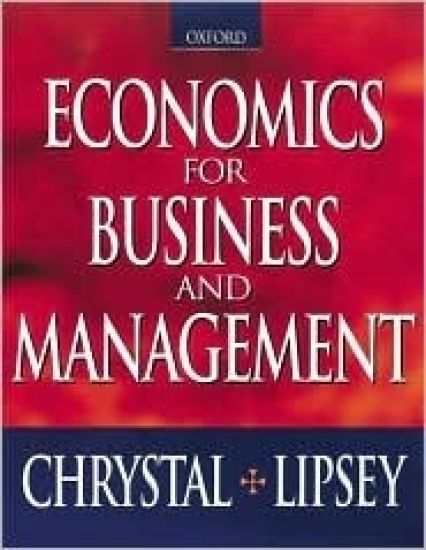
Economics for Business and Management

Economics for Business and Management

K. Alec Chrystal; Richard G. Lipsey

Oxford University Press
1997
nidottu
Economics for Business and Management by Alec Chrystal and Richard Lipsey is a concise introductory economics textbook which has been carefully crafted to meet the needs of business studies and management students. Developed using the authors' highly successful Introduction to Positive Economics as a starting point, the authors have carefully selected essential material, added new coverage, and taken the opportunity to make the text even clearer. The text draws upon Alec Chrystal's extensive experience of teaching economics to management students at City University Business School, London. With the intended readership in mind, the greater part of the text focuses upon microeconomics, including the theory of the firm, consumers and markets, market structures, and the economics of business organizations. Business and management students will also find the text's coverage of the economics of employment and investment particularly helpful. The macroeconomics included has also been chosen to be of maximum benefit to management students, focusing on business cycles and the macroeconomic factors which affect firms (such as inflation and employment), and the balance of payments and exchange rates. Economics for Business and Management includes case studies and case examples which are essential for understanding the business context of economics. Other learning aids include chapter introductions, chapter summaries, topics for review, and end of chapter questions.
Microeconomics, Growth and Political Economy

Microeconomics, Growth and Political Economy

Richard G. Lipsey

Edward Elgar Publishing Ltd
1997
sidottu
Microeconomics, Growth and Political Economy is the first of two volumes which collect together many of Professor Lipsey's writings on economics, some of which are previously unpublished or currently inaccessible. This book contains papers on economic growth and technical change, monetary and value theory, the theory of second best, international trade theory, political economy and methodology. A separate book, On the Foundations of Monopolistic Competition and Economic Geography, contains works on oligopoly and location theory, all coauthored with Curtis Eaton.The book begins with a new autobiographical introduction to the intellectual development, personal achievements and the fields of interest of Richard G. Lipsey and is divided into five parts. The first part considers various aspects of economic growth and technical change taking into account the structuralist view, markets and the globalization of the economy. Part two is concerned with the microeconomic issues of second-best theory and monetary and value theory. The third part looks at trade theory and surveys customs unions and competitiveness. Political economy is considered in the fourth part, which contains essays on topics such as the balance of payments, the survival of the market economy, international liquidity theory and American trade policy. The final part features papers on methodology.Microeconomics, Growth and Political Economy is an essential reference companion to the work of Richard G. Lipsey, one of the most important economists of our generation.
Macroeconomic Theory and Policy

Macroeconomic Theory and Policy

Richard G. Lipsey

Edward Elgar Publishing Ltd
1997
sidottu
Macroeconomic Theory and Policy is the second collection of Richard G. Lipsey's essays and contains material that has previously remained unpublished or has not been widely available. The book considers the macroeconomic issues of unemployment, inflation and policies to combat inflation, the Keynesian macroeconomy and supply side economics.The book begins with a new autobiographical introduction to the intellectual development, personal achievements and the fields of interest of Richard G. Lipsey and is then divided into five parts. Part one considers the Phillips Curve, wage rates and profits. The second part discusses the various theories of the causes of inflation and explores issues such as the depreciation of money, monetarism and cost-push versus demand-pull inflation. Part three looks at anti-inflation policies, focusing on incomes policies, credit and monetary policy and wage-price controls among other issues. Keynesian macroeconomics is evaluated in the fourth section, as well as inflation and the national income model. The final part considers supply-side economics.Macroeconomic Theory and Policy is an essential reference companion to the work of Richard G. Lipsey, one of the most important economists of our generation.
On the Foundations of Monopolistic Competition and Economic Geography

On the Foundations of Monopolistic Competition and Economic Geography

B. C. Eaton; Richard G. Lipsey

Edward Elgar Publishing Ltd
1997
sidottu
On the Foundations of Monopolistic Competition and Economic Geography presents important work by B. Curtis Eaton and Richard G. Lipsey on product differentiation, including studies of spatial differentiation and the industrial structures that give rise to this phenomenon.The book opens with an introductory overview essay and explains why the authors reject the neoclassical, competitive vision of the economy. The essays included cover issues such as: the theory of multinational plant location, product differentiation, monopoly, models of value theory, capital with special reference to entry and exit barriers and entry equilibrium, the existence of pure profit and the theory of market pre-emption.This volume will be welcomed by academics and researchers interested in the microeconomic issues of competition, monopoly, firm behaviour and markets.