Kirjojen hintavertailu. Mukana 12 595 353 kirjaa ja 12 kauppaa.

Kirjailija

Richard H. Immerman

Kirjat ja teokset yhdessä paikassa: 9 kirjaa, julkaisuja vuosilta 1982-2014, suosituimpien joukossa Waging Peace. Vertaile teosten hintoja ja tarkista saatavuus suomalaisista kirjakaupoista.

9 kirjaa

Kirjojen julkaisuhaarukka 1982-2014.

The Hidden Hand

The Hidden Hand

Richard H. Immerman

Wiley-Blackwell (an imprint of John Wiley Sons Ltd)
2014
nidottu
THE HIDDEN HAND Since its inception in 1947, the Central Intelligence Agency has played an outsized role in the political life of the United States, whether by formulating and implementing policy or by fueling popular culture and imagination. The Hidden Hand is an accessible and up-to-date history of the agency that succinctly takes the reader from its early days of intelligence gathering and analysis to its more recent involvement in the execution of foreign policy through covert operations, psychological warfare, and other programs. In manageable chapters and easy-to-digest prose, the author — a respected scholar who has researched intelligence for more than 30 years and also served as a high-ranking officer in the intelligence community — covers all aspects of the CIA from its mission to its performance to its record. He draws on the latest evidence and research to assess the agency’s successes and failures over the last half century, highlighting key operations of the past and present. Throughout, his assessment is balanced and thorough with an eye on the complex and controversial nature of the subject. This is a masterful account that demythologizes the CIA’s role in America’s global affairs while addressing its integral place within American political and popular culture.
The Hidden Hand

The Hidden Hand

Richard H. Immerman

Wiley-Blackwell (an imprint of John Wiley Sons Ltd)
2014
sidottu
THE HIDDEN HAND Since its inception in 1947, the Central Intelligence Agency has played an outsized role in the political life of the United States, whether by formulating and implementing policy or by fueling popular culture and imagination. The Hidden Hand is an accessible and up-to-date history of the agency that succinctly takes the reader from its early days of intelligence gathering and analysis to its more recent involvement in the execution of foreign policy through covert operations, psychological warfare, and other programs. In manageable chapters and easy-to-digest prose, the author — a respected scholar who has researched intelligence for more than 30 years and also served as a high-ranking officer in the intelligence community — covers all aspects of the CIA from its mission to its performance to its record. He draws on the latest evidence and research to assess the agency’s successes and failures over the last half century, highlighting key operations of the past and present. Throughout, his assessment is balanced and thorough with an eye on the complex and controversial nature of the subject. This is a masterful account that demythologizes the CIA’s role in America’s global affairs while addressing its integral place within American political and popular culture.
Empire for Liberty

Empire for Liberty

Richard H. Immerman

Princeton University Press
2012
pokkari
How could the United States, a nation founded on the principles of liberty and equality, have produced Abu Ghraib, torture memos, Plamegate, and warrantless wiretaps? Did America set out to become an empire? And if so, how has it reconciled its imperialism--and in some cases, its crimes--with the idea of liberty so forcefully expressed in the Declaration of Independence? Empire for Liberty tells the story of men who used the rhetoric of liberty to further their imperial ambitions, and reveals that the quest for empire has guided the nation's architects from the very beginning--and continues to do so today. Historian Richard Immerman paints nuanced portraits of six exceptional public figures who manifestly influenced the course of American empire: Benjamin Franklin, John Quincy Adams, William Henry Seward, Henry Cabot Lodge, John Foster Dulles, and Paul Wolfowitz. Each played a pivotal role as empire builder and, with the exception of Adams, did so without occupying the presidency. Taking readers from the founding of the republic to the Global War on Terror, Immerman shows how each individual's influence arose from a keen sensitivity to the concerns of his times; how the trajectory of American empire was relentless if not straight; and how these shrewd and powerful individuals shaped their rhetoric about liberty to suit their needs. But as Immerman demonstrates in this timely and provocative book, liberty and empire were on a collision course. And in the Global War on Terror and the occupation of Iraq, they violently collided.
Milton S. Eisenhower, Educational Statesman

Milton S. Eisenhower, Educational Statesman

Stephen E. Ambrose; Richard H. Immerman

Johns Hopkins University Press
2009
pokkari
Milton S. Eisenhower was one of the most honored and influential statesmen this country has produced. His career spanned government and higher education, and he was a shaping force in both. This biography by Stephen E. Ambrose and Richard H. Immerman traces the 34th President's younger brother's path from small-town Kansas into the Washington bureaucracy and on through the presidencies of Kansas State, Penn State, and Johns Hopkins. Because Eisenhower himself wrote about his government service in two books, Ambrose and Immerman have concentrated instead on his career as an educator. The portrait they paint is based upon extensive research and interviewing, but it is richly colored with anecdotes, opinions, and personal narrative. The portrait of Milton Eisenhower that emerges in this book is of a personable, diplomatic, highly effective administrator-innovative, intuitive, abundantly energetic, tenacious, and combative when necessary. The final section of the book depicts a spirited octogenarian whose contributions to American life continued even after more than a decade of official "retirement."
The Central Intelligence Agency

The Central Intelligence Agency

Athan G. Theoharis; Richard H. Immerman; Kathryn Olmsted; John Prados

Greenwood Press
2005
sidottu
Created in 1947, the Central Intelligence Agency plays an important part in the nation's intelligence activities, and is currently playing a vital role in the war on terrorism. While the agency is often in the news and portrayed in television shows and films, it remains one of the most secretive and misunderstood organizations in the United States. This work provides an in-depth look into the Central Intelligence Agency and how its responsibilities affect American life. After a brief history of the agency, chapters describe its organization, intelligence/counterintelligence, covert operations, controversies, key events, and notable people.
Waging Peace

Waging Peace

Robert R. Bowie; Richard H. Immerman

Oxford University Press Inc
2000
nidottu
Waging Peace offers the first fully comprehensive study of Eisenhower's 'New Look' programme of national security, which provided the groundwork for the next three decades of America's Cold War strategy. Though the Cold War itself and the idea of containment originated under Truman, it was left to Eisenhower to develop the first coherent and sustainable strategy for addressing the issues unique to the nuclear age. To this end, he designated a decision-making system centered around the National Security Council to take full advantage of the expertise and data from various departments and agencies and of the judgment of his principal advisors. The result was the formation of a "long haul" strategy of preventing war and Soviet expansion and of mitigating Soviet hostility. Only now, in the aftermath of the Cold War, can Eisenhower's achievement be fully appreciated. Waging Peace will be of interest to scholars and students of the Eisenhower era, diplomatic history, the cold war, and contemporary foreign policy.
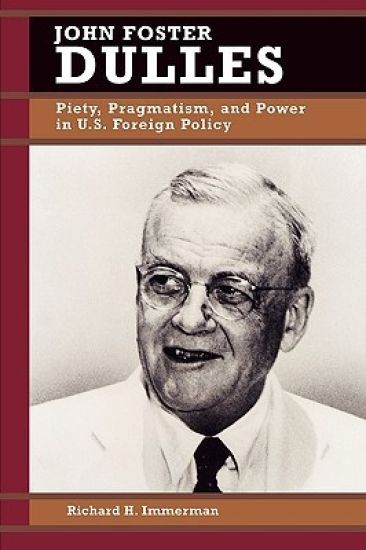
John Foster Dulles

John Foster Dulles

Richard H. Immerman

Rowman Littlefield
1998
nidottu
John Foster Dulles was one of the most influential and controversial figures in the history of twentieth-century U.S. foreign relations. Active in the field for decades, Dulles reflected and was a reflection of the tension that pervaded U.S. international conduct from its evolution as a global power in the early twentieth century through its emergence as the 'leader of the Free World' during the Cold War. His life and career embody the best and most troubling aspects of American foreign policy as it progressed toward international supremacy while swaying between altruism and self-interest. In this biography, Richard Immerman traces Dulles's path from his early days growing up in the parsonage of the First Presbyterian Church of Watertown, N.Y., through his years of amassing influence and power as an international business lawyer and adviser, to his service as President Eisenhower's secretary of state. This volume illuminates not only the history of modern U.S. foreign policy, but its search for a twentieth-century identity. Sophisticated yet accessible, John Foster Dulles: Piety, Pragmatism, and Power in U.S. Foreign Policy is an important resource for graduate and undergraduate courses in U.S. history and U.S. foreign relations.
Waging Peace

Waging Peace

Robert R. Bowie; Richard H. Immerman

Oxford University Press Inc
1998
sidottu
Waging Peace offers the first fully comprehensive study of Eisenhower's "New Look" program of national security, which provided the groundwork for the next three decades of America's Cold War strategy. Though the Cold War itself and the idea of containment originated under Truman, it was left to Eisenhower to develop the first coherent and sustainable strategy for addressing the issues unique to the nuclear age. To this end, he designated a decision-making system centered around the National Security Council to take full advantage of the expertise and data from various departments and agencies and of the judgment of his principal advisors. The result was the formation of a "long haul" strategy of preventing war and Soviet expansion and of mitigating Soviet hostility. Only now, in the aftermath of the Cold War, can Eisenhower's achievement be fully appreciated. Waging Peace will be of interest to scholars and students of the Eisenhower era, diplomatic history, the cold war, and contemporary foreign policy.
The CIA in Guatemala

The CIA in Guatemala

Richard H. Immerman

University of Texas Press
1982
pokkari
Using documents obtained through the Freedom of Information Act, recently opened archival collections, and interviews with the actual participants, Immerman provides us with a definitive, powerfully written, and tension-packed account of the United States' clandestine operations in Guatemala and their consequences in Latin America today.