Kirjojen hintavertailu. Mukana 12 546 140 kirjaa ja 12 kauppaa.

Kirjailija

Richard J.A. Talbert

Kirjat ja teokset yhdessä paikassa: 9 kirjaa, julkaisuja vuosilta 1987-2023, suosituimpien joukossa Challenges of Mapping the Classical World. Vertaile teosten hintoja ja tarkista saatavuus suomalaisista kirjakaupoista.

Mukana myös kirjoitusasut: Richard J. A. Talbert

9 kirjaa

Kirjojen julkaisuhaarukka 1987-2023.

Challenges of Mapping the Classical World

Challenges of Mapping the Classical World

Richard J.A. Talbert

Routledge
2018
sidottu
Challenges of Mapping the Classical World collects together in one volume fourteen varied items written by Richard Talbert over the past thirty years. They cohere around the theme of mapping the classical world since the nineteenth century. All were originally prompted by Talbert’s commission in the late 1980s to produce a definitive classical atlas after more than a century of failed attempts by the Kieperts and others. These he evaluates, as well as probing the Smith/Grove atlas, a successful twenty-year initiative launched in the mid-1850s, with a cartographic approach that departs radically from established practice. Talbert’s initial vision for the international collaborative project that resulted in the Barrington Atlas of the Greek and Roman World (2000) is presented, and the successive twice-yearly reports on its progress from 1991 through to completion are published here for the first time. A further item reflects retrospectively on the project’s cartographic challenges and on how developments in digital map production were decisive in overcoming them. This volume will be invaluable to anyone with an interest in the development and growing impact of mapping the classical world.
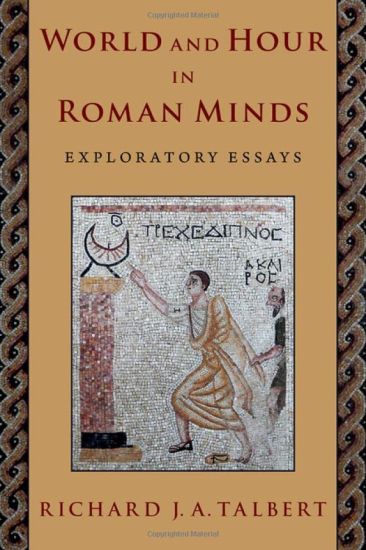
World and Hour in Roman Minds

World and Hour in Roman Minds

Richard J. A. Talbert

OXFORD UNIVERSITY PRESS INC
2023
sidottu
World and Hour in Roman Minds: Exploratory Essays seeks to penetrate Romans' consciousness of space and time, aspects of antiquity currently attracting intense interest. Historian Richard Talbert presents here a cohesive selection of nineteen essays, published over the course of thirty years, all but one previously appearing in widely scattered publications. Now reinforced by an Introduction and textually and visually updated, these essays document the progress of pioneering efforts to glimpse the worldviews of Romans up and down the social scale--even Julius Caesar and Claudius--and to reassess the communicative role of Roman mapping along with its strengths and limitations. Talbert interprets the Antonine Itinerary and Artemidorus and Peutinger maps afresh, visualizing the latter with a wider perspective than in previous scholarship and probing the challenges of its design, production and copying. He also casts doubt, however, on the idea that Romans conceptualized their long-distance roads as an interconnected system, as did certain comparable premodern states across the Americas and Asia. The most recent essays share findings that emerge with a shift of focus from space to time, specifically Romans' daily timekeeping by hours--another neglected dimension of their social mentalité. Talbert suggests that Romans' tracking of time should be regarded as uncannily similar to that of the Japanese before Westernization. Throughout, the essays are unified by the methods applied. The value of broader, often comparative, approaches is demonstrated, as well as the creative potential of untapped testimony and digital technology--altogether an invaluable platform to stimulate further inquiry.
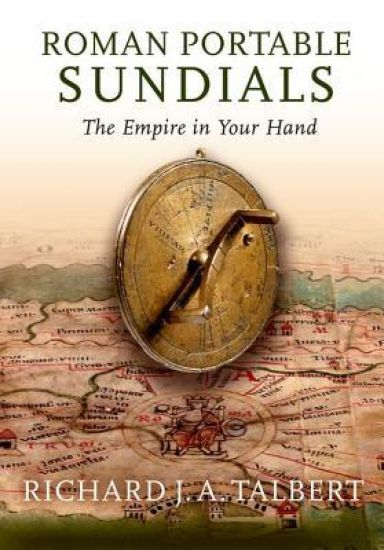
Roman Portable Sundials

Roman Portable Sundials

Richard J.A. Talbert

Oxford University Press Inc
2020
nidottu
In an unscientific era when maps were rarities, how did ancient Romans envisage their far flung empire? This was done by various means for certain, including with the aid of an ingenious type of portable sundial that has barely attracted notice. As the Romans understood before the first century BCE, to track the passage of the sun across the sky hour-by-hour one needed to know one's latitude and the time of year, and that, furthermore, sundials did not have to be fixed objects. These portable instruments, crafted in bronze, were adjustable for the changes of latitude to be expected on long journeys--say, for instance, from Britain to Spain, or from Alexandria to Rome, or even on a Mediterranean tour. For convenient reference, these sundials incorporated lists of twenty to thirty names of cities or regions, each with its specific latitude. One of the insights of Roman Portable Sundials is that the choice of locations offers unique clues to the mental world-map and self-identity of individuals able to visualize Rome's vast empire latitudinally. The sixteen such sundials known to date share common features but designers also vied to create enhancements. Comparison with modern calculations shows that often the latitudes listed are incorrect, in which case the sundial may not perform at its best. But then the nature of Romans' time-consciousness (or lack of it) must be taken into consideration. Richard Talbert suspects that owners might prize these sundials not so much for practical use but rather as prestige objects attesting to scientific awareness as well as imperial mastery of time and space. In retrospect, they may be seen as Roman precursors to comparable Islamic and European instruments from the Middle Ages onwards, and even to today's luxury watches which display eye-catching proof of their purchasers' wealth, sophistication, and cosmopolitanism. Richly enhanced with detailed photographs, line drawings, maps, a gazetteer, and a table of latitudes and locations, Roman Portable Sundials brings these overlooked gadgets out of the shadows at last to reveal their hitherto untapped layers of meaning.
Challenges of Mapping the Classical World

Challenges of Mapping the Classical World

Richard J.A. Talbert

Routledge
2020
nidottu
Challenges of Mapping the Classical World collects together in one volume fourteen varied items written by Richard Talbert over the past thirty years. They cohere around the theme of mapping the classical world since the nineteenth century. All were originally prompted by Talbert’s commission in the late 1980s to produce a definitive classical atlas after more than a century of failed attempts by the Kieperts and others. These he evaluates, as well as probing the Smith/Grove atlas, a successful twenty-year initiative launched in the mid-1850s, with a cartographic approach that departs radically from established practice. Talbert’s initial vision for the international collaborative project that resulted in the Barrington Atlas of the Greek and Roman World (2000) is presented, and the successive twice-yearly reports on its progress from 1991 through to completion are published here for the first time. A further item reflects retrospectively on the project’s cartographic challenges and on how developments in digital map production were decisive in overcoming them. This volume will be invaluable to anyone with an interest in the development and growing impact of mapping the classical world.
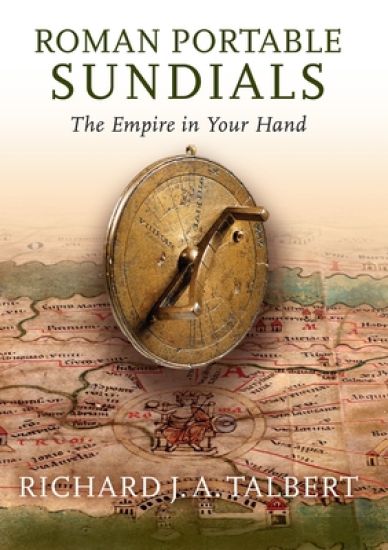
Roman Portable Sundials

Roman Portable Sundials

Richard J.A. Talbert

Oxford University Press Inc
2017
sidottu
In an unscientific era when maps were rarities, how did ancient Romans envisage their far flung empire? This was done by various means for certain, including with the aid of an ingenious type of portable sundial that has barely attracted notice. As the Romans understood before the first century BCE, to track the passage of the sun across the sky hour-by-hour one needed to know one's latitude and the time of year, and that, furthermore, sundials did not have to be fixed objects. These portable instruments, crafted in bronze, were adjustable for the changes of latitude to be expected on long journeys--say, for instance, from Britain to Spain, or from Alexandria to Rome, or even on a Mediterranean tour. For convenient reference, these sundials incorporated lists of twenty to thirty names of cities or regions, each with its specific latitude. One of the insights of Roman Portable Sundials is that the choice of locations offers unique clues to the mental world-map and self-identity of individuals able to visualize Rome's vast empire latitudinally. The sixteen such sundials known to date share common features but designers also vied to create enhancements. Comparison with modern calculations shows that often the latitudes listed are incorrect, in which case the sundial may not perform at its best. But then the nature of Romans' time-consciousness (or lack of it) must be taken into consideration. Richard Talbert suspects that owners might prize these sundials not so much for practical use but rather as prestige objects attesting to scientific awareness as well as imperial mastery of time and space. In retrospect, they may be seen as Roman precursors to comparable Islamic and European instruments from the Middle Ages onwards, and even to today's luxury watches which display eye-catching proof of their purchasers' wealth, sophistication, and cosmopolitanism. Richly enhanced with detailed photographs, line drawings, maps, a gazetteer, and a table of latitudes and locations, Roman Portable Sundials brings these overlooked gadgets out of the shadows at last to reveal their hitherto untapped layers of meaning.
Rome's World

Rome's World

Richard J. A. Talbert

Cambridge University Press
2014
pokkari
The Peutinger Map is the only map of the Roman world to come down to us from antiquity. Today it is among the treasures of the Austrian National Library in Vienna. Richard Talbert's study presented in Rome's World: The Peutinger Map Reconsidered offers a long-overdue reinterpretation and appreciation of the map as a masterpiece of both mapmaking and imperial Roman ideology. Here, the ancient world's traditional span, from the Atlantic to India, is dramatically remolded; lands and routes take pride of place, whereas seas are compressed. Talbert posits that the map's true purpose was not to assist travelers along Rome's highways, but rather to celebrate the restoration of peace and order by Diocletian's Tetrarchy. Such creative cartography, he shows, influenced the development of medieval mapmaking. With the aid of digital technology, this book enables readers to engage with the Peutinger Map in all of its fascinating immensity more closely than ever before.
Rome's World

Rome's World

Richard J. A. Talbert

Cambridge University Press
2010
sidottu
The Peutinger Map is the only map of the Roman world to come down to us from antiquity. Today it is among the treasures of the Austrian National Library in Vienna. Richard Talbert's study presented in Rome's World: The Peutinger Map Reconsidered offers a long-overdue reinterpretation and appreciation of the map as a masterpiece of both mapmaking and imperial Roman ideology. Here, the ancient world's traditional span, from the Atlantic to India, is dramatically remolded; lands and routes take pride of place, whereas seas are compressed. Talbert posits that the map's true purpose was not to assist travelers along Rome's highways, but rather to celebrate the restoration of peace and order by Diocletian's Tetrarchy. Such creative cartography, he shows, influenced the development of medieval mapmaking. With the aid of digital technology, this book enables readers to engage with the Peutinger Map in all of its fascinating immensity more closely than ever before.
The Romans

The Romans

Boatwright Mary T.; Gargola Daniel; Richard J. A. Talbert

Oxford University Press Inc
2004
nidottu
From Village to Empire introduces ancient Rome to readers eager for a concise and engaging understanding of its political, social, and cultural history. It traces Rome's remarkable evolution from monarchy, to republic, to one-man rule by an emperor whose power stretched from Scotland to Iraq and far up the Nile valley.
The Senate of Imperial Rome

The Senate of Imperial Rome

Richard J.A. Talbert

Princeton University Press
1987
pokkari
Richard J. A. Talbert examines the composition, procedure, and functions of the Roman senate during the Principate (30 B.C.-A.D. 238). Although it is of central importance to the period, this great council has not previously received such scholarly treatment. Offering a fresh approach to major ancient authors (Pliny and Tacitus in particular), the book also draws on inscriptions and legal writers never before fully exploited for the study of the senate.