Kirjojen hintavertailu. Mukana 12 336 236 kirjaa ja 12 kauppaa.

Kirjailija

Richard L. Bushman

Kirjat ja teokset yhdessä paikassa: 8 kirjaa, julkaisuja vuosilta 1977-2018, suosituimpien joukossa The American Farmer in the Eighteenth Century. Vertaile teosten hintoja ja tarkista saatavuus suomalaisista kirjakaupoista.

8 kirjaa

Kirjojen julkaisuhaarukka 1977-2018.

The American Farmer in the Eighteenth Century

The American Farmer in the Eighteenth Century

Richard L. Bushman

Yale University Press
2018
sidottu
An illuminating study of America’s agricultural society during the Colonial, Revolutionary, and Founding eras In the eighteenth century, three-quarters of Americans made their living from farms. This authoritative history explores the lives, cultures, and societies of America’s farmers from colonial times through the founding of the nation. Noted historian Richard Bushman explains how all farmers sought to provision themselves while still actively engaged in trade, making both subsistence and commerce vital to farm economies of all sizes. The book describes the tragic effects on the native population of farmers’ efforts to provide farms for their children and examines how climate created the divide between the free North and the slave South. Bushman also traces midcentury rural violence back to the century’s population explosion. An engaging work of historical scholarship, the book draws on a wealth of diaries, letters, and other writings—including the farm papers of Thomas Jefferson and George Washington—to open a window on the men, women, and children who worked the land in early America.
Shifting Borders and a Tattered Passport

Shifting Borders and a Tattered Passport

Armand L. Mauss; Richard L. Bushman

University of Utah Press,U.S.
2012
sidottu
The life of a Mormon intellectual in the secular academic community is likely to include some contradictions between belief, scholarship, and the changing times. In his memoir, Armand L. Mauss recounts his personal and intellectual struggles—inside and outside the LDS world—from his childhood to his days as a graduate student at UC Berkeley in the 1960s through his many years as a professor. As an important and influential observer and author in the Mormon intellectual world, Mauss has witnessed how, in attempting to suppress independent and unsponsored scholarship during the final decades of the twentieth century, LDS leaders deliberately marginalised important intellectual support and resources that could have helped, in the twenty-first century, to refurbish the public image of the church. As a sociologist, he notes how the LDS Church, as a large, complex organisation, strives to adjust its policies and practices in order to maintain an optimal balance between unique, appealing claims on the one hand and public acceptance on the other. He also discusses national and academic controversies over the New Religious Movements of the 1960s and 1970s. Writing in clear language, Mauss shows how he has navigated the boundaries where his faith and academic life intersect, and reveals why a continuing commitment to the LDS Church must be a product of choice more than of natural or supernatural “proof.”
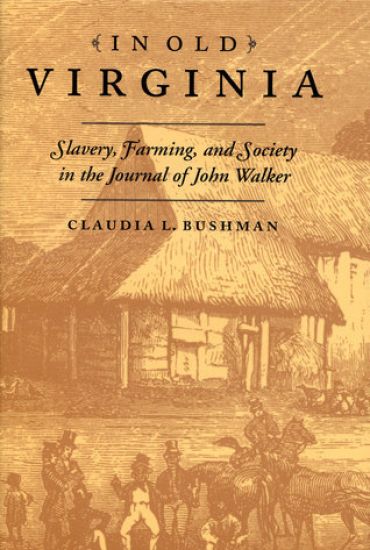
In Old Virginia

In Old Virginia

Richard L. Bushman

Johns Hopkins University Press
2002
sidottu
In 1824, John Walker purchased a 500-acre farm in King and Queen County, Virginia, and began working it with a dozen slaves. The son of a local politician and planter who grew tobacco, Walker lost status when he became a devout Methodist, raised wheat, and treated his slaves like brothers and sisters. He also kept a detailed and fascinating journal. Drawing on this forty-three-year chronicle, Claudia L. Bushman provides a richly illuminating study, a microhistory that is rewarding to read. Walker sets aside most of the "Old South planter" stereotype. He sold wheat in Baltimore and Norfolk and invested in railroad stock, and yet he grew, spun, and wove cotton for clothing, tanned leather, and made shoes. He avoided lavish creature comforts in favor of purchasing the latest farm equipment. So far from losing out to soil exhaustion, he experimented with improved farming methods, nourished his land, and kept his yields high. Walker's journal describes the legal cases he tenaciously pursued, records devotion to the local Methodist church, and explains his practice of Thomsonian medicine on slaves and family members alike. He provides insight into women's work and lays out the drama of blacks and whites living in close intimacy and constant fear. Walker humbly referred to himself as "a poor illiterate worm," but his diary dramatically captures the life of a small planter in antebellum Virginia.
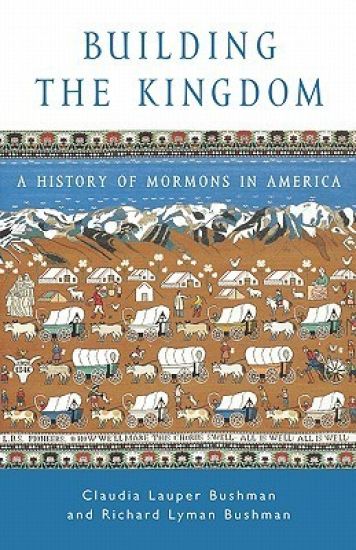
Building the Kingdom

Building the Kingdom

Claudia L. Bushman; Richard L. Bushman

Oxford University Press Inc
2002
nidottu
Building the Kingdom traces the history of The Church of Jesus Christ of Latter Day Saints, commonly known as the Mormon church, which began in America in the early 1800s and continues today throughout the world. The book covers the church's origin and history and includes a well-balanced discussion of difficult issues such as polygamy and the modern Mormon family's struggle to balance religious traditions with the demands of the modern world. The book includes an 8-page section of illustrations. Includes chronology, further reading, and index.
King and People in Provincial Massachusetts

King and People in Provincial Massachusetts

Richard L. Bushman

The University of North Carolina Press
1992
nidottu
The American revolutionaries themselves believed the change from monarchy to republic was the essence of the Revolution. King and People in Provincial Massachusetts explores what monarchy meant to Massachusetts under its second charter and why the momentous change to republican government came about. Richard L. Bushman argues that monarchy entailed more than having a king as head of state: it was an elaborate political culture with implications for social organization as well. Massachusetts, moreover, was entirely loyal to the king and thoroughly imbued with that culture. Why then did the colonies become republican in 1776? The change cannot be attributed to a single thinker such as John Locke or to a strain of political thought such as English country party rhetoric. Instead, it was the result of tensions ingrained in the colonial political system that surfaced with the invasion of parliamentary power into colonial affairs after 1763. The underlying weakness of monarchical government in Massachusetts was the absence of monarchical society -- the intricate web of patronage and dependence that existed in England. But the conflict came from the colonists' conception of rulers as an alien class of exploiters whose interest was the plundering of the colonies. In large part, colonial politics was the effort to restrain official avarice. The author explicates the meaning of ""interest"" in political discourse to show how that conception was central in the thinking of both the popular party and the British ministry. Management of the interest of royal officials was a problem that continually bedeviled both the colonists and the crown. Conflict was perennial because the colonists and the ministry pursued diverging objectives in regulating colonial officialdom. Ultimately the colonists came to see that safety against exploitation by self-interested rulers would be assured only by republican government.
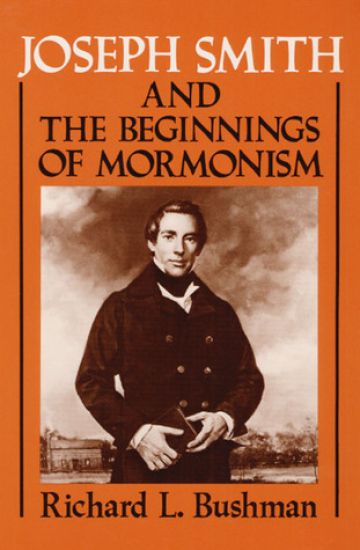
Joseph Smith and the Beginnings of Mormonism

Joseph Smith and the Beginnings of Mormonism

Richard L. Bushman

University of Illinois Press
1987
nidottu
Winner of the David Woolley Evans and Beatrice Evans Biography Award and a History Book Club selection, 1985. The core of Mormon belief was a conviction about actual events. The test of faith was not adherence to a certain confession of faith but belief that Christ was resurrected, that Joseph Smith saw God, that the Book of Mormon was true history, and that Peter, James, and John restored the apostleship. Mormonism was history, not philosophy. It is as history that Richard L. Bushman analyzes the emergence of Mormonism in the early nineteenth century. Bushman, however, brings to his study a unique set of credentials--he is both a prize-winning historian and a faithful member of the Latter-day Saints church. For Mormons and non-Mormons alike, his book provides a very special perspective on an endlessly fascinating subject. Building upon previous accounts and incorporating recently discovered contemporary sources, Bushman focuses on the first twenty-five years of Joseph Smith's life--up to his move to Kirtland, Ohio, in 1831. Bushman shows how the rural Yankee culture of New England and New York--especially evangelical revivalism, Christian rationalism, and folk magic--both influenced and hindered the formation of Smith's new religion. Mormonism, Bushman argues, must be seen not only as the product of this culture, but also as an independent creation based on the revelations of its charismatic leader. In the final analysis, it was Smith's ability to breathe new life into the ancient sacred stories and to make a sacred story out of his own life which accounted for his own extraordinary influence. By presenting Smith and his revelations as they were viewed by the early Mormons themselves, Bushman leads us to a deeper understanding of their faith.
From Puritan to Yankee

From Puritan to Yankee

Richard L. Bushman

Harvard University Press
1980
nidottu
The years from 1690 to 1765 in America have usually been considered a waiting period before the Revolution. Richard L. Bushman, in his penetrating study of colonial Connecticut, takes another view. He shows how, during these years, economic ambition and religious ferment profoundly altered the structure of Puritan society, enlarging the bounds of liberty and inspiring resistance to established authority.This is an investigation of the strains that accompanied the growth of liberty in an authoritarian society. Mr. Bushman traces the deterioration of Puritan social institutions and the consequences for human character. He does this by focusing on day-to-day life in Connecticut—on the farms, in the churches, and in the town meetings. Controversies within the towns over property, money, and church discipline shook the “land of steady habits,” and the mounting frustration of common needs compelled those in authority, in contradiction to Puritan assumptions, to become more responsive to popular demands.In the Puritan setting these tensions were inevitably given a moral significance. Integrating social and economic interpretations, Mr. Bushman explains the Great Awakening of the 1740s as an outgrowth of the stresses placed on the Puritan character. Men, plagued with guilt for pursuing their economic ambitions and resisting their rulers, became highly susceptible to revival preaching.The Awakening gave men a new vision of the good society. The party of the converted, the “New Lights,” which also absorbed people with economic discontents, put unprecedented demands on civil and ecclesiastical authorities. The resulting dissension moved Connecticut, almost unawares, toward republican attitudes and practices. Disturbed by the turmoil, many observers were, by 1765, groping toward a new theory of social order that would reconcile traditional values with their eighteenth-century experiences.Vividly written, full of illustrative detail, the manuscript of this book has been called by Oscar Handlin one of the most important works of American history in recent years.