Kirjojen hintavertailu. Mukana 12 295 350 kirjaa ja 12 kauppaa.

Kirjailija

Richard L. Cleary

Kirjat ja teokset yhdessä paikassa: 7 kirjaa, julkaisuja vuosilta 1998-2025, suosituimpien joukossa Frank Lloyd Wright's Bogk House. Vertaile teosten hintoja ja tarkista saatavuus suomalaisista kirjakaupoista.

Mukana myös kirjoitusasut: Richard L Cleary

7 kirjaa

Kirjojen julkaisuhaarukka 1998-2025.

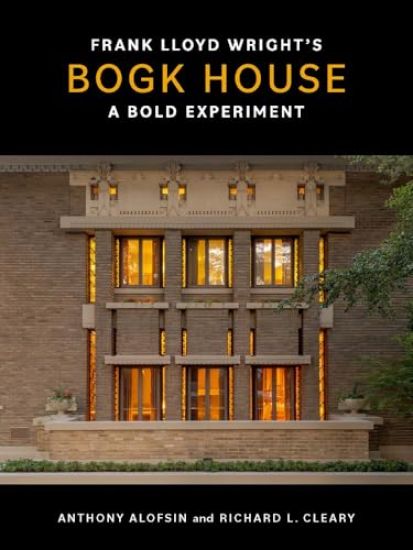
Frank Lloyd Wright's Bogk House

Frank Lloyd Wright's Bogk House

Anthony Alofsin; Richard L. Cleary

YALE UNIVERSITY PRESS
2025
sidottu
A trove of insights into and images of an important, little-known Frank Lloyd Wright building The house that Frank Lloyd Wright designed for Frederick C. and Katherine G. Bogk in Milwaukee, Wisconsin, in 1916 occupies a unique position in Wright’s career: it is the only fully realized house designed in the teens that demonstrates his fascination with Primitivism, the use of non-Western sources as an inspiration for modern design. This book traces Wright’s exploration alongside the stories of an immigrant family’s rise and Milwaukee’s emergence as a vibrant city. It also documents the interiors, relatively unchanged for over a century, that represent Wright’s approach to total design. Written by two eminent architectural historians and Wright scholars, Anthony Alofsin and Richard L. Cleary, this book offers new insight into the evolution of Wright’s design process during the least understood decade of his career. The book draws on a fascinating cache of unpublished letters, photographs, drawings, and documents in the private archive of the Elsner family, who owned the house from 1955 to 2023. The book also features new photography of the Bogk House by Alexander Vertikoff, renowned for his use of natural light. Distributed for Frank Lloyd Wright’s Burnham Block, Inc.
The Architecture of the Playing Field

The Architecture of the Playing Field

Richard L. Cleary

UNIVERSITY OF TEXAS PRESS
2025
sidottu
A novel exploration of playing fields as aesthetic and architectural spaces that frame athletes’ creativity and spectators’ evolving experiences of sport. The playing field is more than an arena for sporting rivalry. It is a laboratory of invention, where athletes and coaches create new uses for the human body in response to the constraints and affordances of space. Indeed, Richard Cleary argues that, from translucent squash courts to the NBA three-point line to the city streets used by skateboarders, all sports have embedded spatial relationships that are also charged with social significance. The Architecture of the Playing Field explores the aesthetic and physical experiences of the grounds on which we compete. Cleary digs into the perspectives of spectators, athletes, coaches, and umpires-perspectives that have changed along with the shifting configuration and mediation of the field, from early live sports coverage to today’s TV broadcasts overlaid with high-tech graphics and observed from every angle. Cleary shows how rules governing the size, shape, and divisions of the field reflect sports’ entwinement with societies at large, in particular the politics of race and gender. Mindful as well that some sports resist containment, he analyzes the disruptive use of space by snowboarders and parkour athletes. The Architecture of the Playing Field sensitizes us to the interplay of settings and bodies in motion fundamental to the power of sport.
The Place Royale and Urban Design in the Ancien Régime

The Place Royale and Urban Design in the Ancien Régime

Richard L. Cleary

Cambridge University Press
2011
pokkari
Originally published in 1999, this study was the first to examine a unique urban phenomenon that is closely associated with French monarchy in the age of absolutism. A distinct type of city square, the Places Royales were planned in honour of Louis XIV and his heir, Louis XV. Featuring a free-standing statue of the monarch at its centre, the Place Royale was framed by buildings of uniform, monumental design such as are found in some of the most outstanding examples to have survived, including the Place Vendôme and the Place Stanislas. In this study, Richard Cleary examines the Places Royales in terms of the political mechanisms and design processes through which they were conceived, their intended meanings for contemporaries, and their relationship to the urban fabrics of which they are a part. Also included is a catalogue describing projects for Places Royales in twenty-five cities in France and Canada.
Bridges

Bridges

Richard L. Cleary

WW Norton Co
2007
sidottu
Bridges are such ubiquitous features of the built environment that we cross most of them barely acknowledging their presence. Certain bridges, however, command attention: for their utility facilitating travel from here to there; for their size, setting, beauty, or historical associations. Ordinary or spellbinding, every bridge is a response to a problem—the spanning of a river or other obstacle, solved more or less elegantly. This visual sourcebook surveys American bridges from coast to coast in terms of four fundamental structural types (beam, arch, truss, and suspension) and the special category of movable bridges (swing, lift, and bascule) showing how similar structural ideas have been addressed by different designers, refined over time, and rendered in various building materials. A special feature is "A Call for Preservation" of the American bridge engineering heritage by Eric DeLony, formerly chief of the Historic American Engineering Record, National Park Service.
The Place Royale and Urban Design in the Ancien Régime

The Place Royale and Urban Design in the Ancien Régime

Richard L. Cleary

Cambridge University Press
1998
sidottu
The Place Royale and Urban Design in the Ancien Régime is the first study to examine a unique urban phenomenon that is closely associated with French monarchy in the age of absolutism. A distinct type of city square, the places royales were planned in honour of Louis XIV and his heir, Louis XV. Featuring a free-standing statue of the monarch at its centre, the Place Royale was framed by buildings of uniform, monumental design such as are found in some of the most outstanding examples to have survived, including the Place Vendôme and the Place Stanislas. In this study, Richard Cleary examines the Places Royales in terms of the political mechanisms and design processes through which they were conceived, their intended meanings for contemporaries, and their relationship to the urban fabrics of which they are a part. Also included is a catalogue describing projects for Places Royales in twenty-five cities in France and Canada.