Kirjojen hintavertailu. Mukana 12 181 951 kirjaa ja 12 kauppaa.

Kirjailija

Richard Mayer

Kirjat ja teokset yhdessä paikassa: 5 kirjaa, julkaisuja vuosilta 1990-2010, suosituimpien joukossa Applying the Science of Learning. Vertaile teosten hintoja ja tarkista saatavuus suomalaisista kirjakaupoista.

5 kirjaa

Kirjojen julkaisuhaarukka 1990-2010.

Applying the Science of Learning
A concrete guide to the science of learning, instruction, and assessment written in a friendly tone and presented in a dynamic format. The underlying premise of Applying the Science of Learning is that educators can better help students learn if they understand the processes through which student learning takes place. In this clear and concise first edition text, educational psychology scholar Richard Mayer teaches readers how to apply the science of learning through understanding the reciprocal relationships between learning, instruction, and assessment. Utilizing the significant advances in scientific learning research over the last 25 years, this introductory text identifies the features of science of learning that are most relevant to education, explores the possible prescriptions of these findings for instructional methods, and highlights the essentials of evaluating instructional effectiveness through assessment. Applying the Science of Learning is also presented in an easy-to-read modular design and with a conversational tone — making it particularly student-friendly, whether it is being used as a supplement to a core textbook or as a standalone course text.
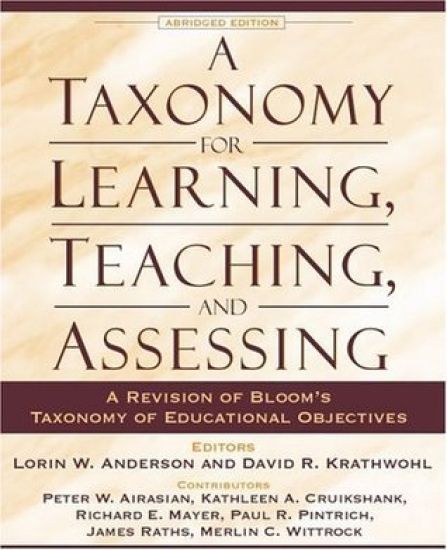
Taxonomy for Learning, Teaching, and Assessing, A

Taxonomy for Learning, Teaching, and Assessing, A

Lorin Anderson; David Krathwohl; Peter Airasian; Kathleen Cruikshank; Richard Mayer; Paul Pintrich; James Raths; Merlin Wittrock

Pearson
2001
nidottu
Embodying advances in cognitive psychology since the publication of Bloom's taxonomy, this revision of that framework is designed to help teachers understand and implement standards-based curriculums as well as facilitate constructing and analyzing their own. A revision only in the sense that it builds on the original framework, it is a completely new manuscript in both text and organization. Its two-dimensional framework interrelates knowledge with the cognitive processes students use to gain and work with knowledge. Together, these define the goals, curriculum standards, and objectives students are expected to learn. The framework facilitates the exploration of curriculums from four perspectives-what is intended to be taught, how it is to be taught, how learning is to be assessed, and how well the intended aims, instruction and assessments are aligned for effective education. This "revisited" framework allows you to connect learning from all these perspectives.
Taxonomy for Learning, Teaching, and Assessing, A

Taxonomy for Learning, Teaching, and Assessing, A

Lorin Anderson; David Krathwohl; Peter Airasian; Kathleen Cruikshank; Richard Mayer; Paul Pintrich; James Raths; Merlin Wittrock

Pearson
2001
sidottu
Drawing heavily from Bloom's Taxonomy, this new book helps teachers understand and implement a standards-based curriculum. An extraordinary group of cognitive psychologists, curriculum specialists, teacher-educators, and researchers have developed a two-dimensional framework, focusing on knowledge and cognitive processes, that defines what students are expected to learn in school. A series of vignettes-written by and for teachers-illustrates how to use this unique framework. A revision only in the sense that it builds on the original framework, it is a completely new manuscript in both text and organization. Its two-dimensional framework interrelates knowledge with the cognitive processes students use to gain and work with knowledge. Together, these define the goals, curriculum standards, and objectives students are expected to learn. The framework facilitates the exploration of curriculums from four perspectives-what is intended to be taught, how it is to be taught, how learning is to be assessed, and how well the intended aims, instruction and assessments are aligned for effective education. This "revisited" framework allows you to connect learning from all these perspectives. This "Professional Edition" includes an additional section ("The Taxonomy in Perspective,") which is not available in the "Revisited for Teachers" edition of the book.
Public Management in an Interconnected World

Public Management in an Interconnected World

Mary T. Bailey; Richard Mayer

Praeger Publishers Inc
1992
sidottu
This collection of essays seeks to improve decision making among public administrators who operate organizations in an increasingly complex and interdependent world. Contributors with different expertise examine the theories and experience of public management in an effort to find ways to deal more effectively with the complex programs, policies, and problems confronting academecians and professionals in all the social and behavioral sciences.This entirely new analysis builds upon the thinking of two Minnowbrook conferences that have studied basic theory and decision making in public administration. An introduction looks back toward these conferences, and an epilogue looks ahead. The first part of the work finds a new multiversalist paradigm by studying the implications of interconnectedness for public managers. The second part of the book analyzes the reality and other challenges to the emergence of new public administration practice. Interconnectness, democracy, and epistemology is the subject of the third part of this study of major new directions in the field. A lengthy bibliography completes the overview that the book offers.
Saudi Arabian Industrial Investment

Saudi Arabian Industrial Investment

Richard Mayer; Wahib A Soufi

Praeger Publishers Inc
1990
sidottu
The future for all the nations of the world, whether diverse- or single-commodity countries, is bound up in effective economic development. In particular, an understanding of the relationship between a government and its private business sector is becoming an increasingly important factor in the management of economic growth. This work presents the results of a study that focuses on efforts to stimulate private industrial investment in the manufacturing sector of the Saudi Arabian economy. The conclusions help to shed light on the interplay of government-business relationships not only in Saudi Arabia, but in other developing countries as well.The study, conducted in 1986, included a series of interviews with manufacturing executives, government officials, and chamber of commerce members. Wahib Soufi and Richard Mayer begin their analysis with an overview of government and business in Saudi Arabia, assessing the role played by Islamic law and the need for diversification. They follow this by sketching a conceptual framework for examining government-business relationships, and outlining issues relevant to promoting industrial development. A set of three chapters explore the results of the survey data, detailing the perceptions of the Saudi private business sector, comparing business and government perceptions, and finally, evaluating the effect of communications, expectations, and perceptions on the government-business relationship. The concluding chapter reexamines these conclusions on the basis of information available three years after the initial study, and is followed by a selective bibliography. This important study will be a valuable resource for corporate managers and government officials involved in economic planning, and a useful reference tool for college courses in business and economic policy and for public and academic libraries.