Kirjojen hintavertailu. Mukana 12 390 323 kirjaa ja 12 kauppaa.

Kirjailija

Richard McCleary

Kirjat ja teokset yhdessä paikassa: 5 kirjaa, julkaisuja vuosilta 1980-2019, suosituimpien joukossa Design and Analysis of Time Series Experiments. Vertaile teosten hintoja ja tarkista saatavuus suomalaisista kirjakaupoista.

5 kirjaa

Kirjojen julkaisuhaarukka 1980-2019.

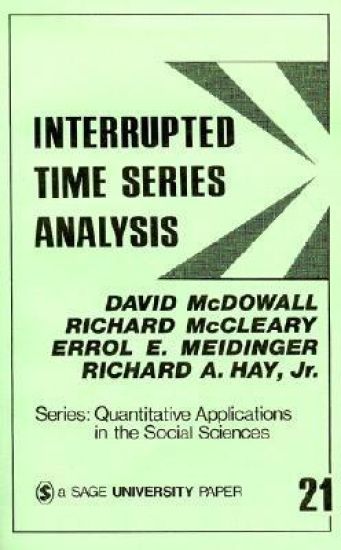
Interrupted Time Series Analysis

Interrupted Time Series Analysis

David McDowall; Richard McCleary; Bradley J. Bartos

Oxford University Press Inc
2019
nidottu
Interrupted Time Series Analysis develops a comprehensive set of models and methods for drawing causal inferences from time series. It provides example analyses of social, behavioral, and biomedical time series to illustrate a general strategy for building AutoRegressive Integrated Moving Average (ARIMA) impact models. Additionally, the book supplements the classic Box-Jenkins-Tiao model-building strategy with recent auxiliary tests for transformation, differencing, and model selection. Not only does the text discuss new developments, including the prospects for widespread adoption of Bayesian hypothesis testing and synthetic control group designs, but it makes optimal use of graphical illustrations in its examples. With forty completed example analyses that demonstrate the implications of model properties, Interrupted Time Series Analysis will be a key inter-disciplinary text in classrooms, workshops, and short-courses for researchers familiar with time series data or cross-sectional regression analysis but limited background in the structure of time series processes and experiments.
Interrupted Time Series Analysis

Interrupted Time Series Analysis

David McDowall; Richard McCleary; Bradley J. Bartos

Oxford University Press Inc
2019
sidottu
Interrupted Time Series Analysis develops a comprehensive set of models and methods for drawing causal inferences from time series. It provides example analyses of social, behavioral, and biomedical time series to illustrate a general strategy for building AutoRegressive Integrated Moving Average (ARIMA) impact models. Additionally, the book supplements the classic Box-Jenkins-Tiao model-building strategy with recent auxiliary tests for transformation, differencing, and model selection. Not only does the text discuss new developments, including the prospects for widespread adoption of Bayesian hypothesis testing and synthetic control group designs, but it makes optimal use of graphical illustrations in its examples. With forty completed example analyses that demonstrate the implications of model properties, Interrupted Time Series Analysis will be a key inter-disciplinary text in classrooms, workshops, and short-courses for researchers familiar with time series data or cross-sectional regression analysis but limited background in the structure of time series processes and experiments.
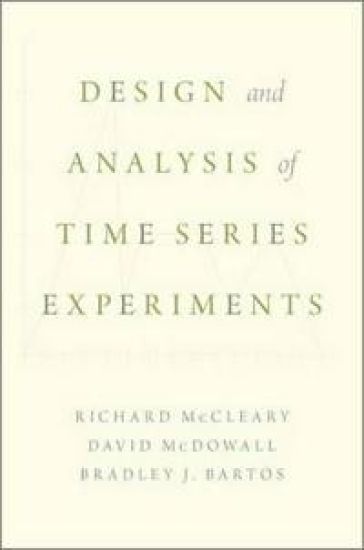
Design and Analysis of Time Series Experiments

Design and Analysis of Time Series Experiments

Richard McCleary; David McDowall; Bradley Bartos

Oxford University Press Inc
2017
nidottu
Design and Analysis of Time Series Experiments presents the elements of statistical time series analysis while also addressing recent developments in research design and causal modeling. A distinguishing feature of the book is its integration of design and analysis of time series experiments. Drawing examples from criminology, economics, education, pharmacology, public policy, program evaluation, public health, and psychology, Design and Analysis of Time Series Experiments is addressed to researchers and graduate students in a wide range of behavioral, biomedical and social sciences. Readers learn not only how-to skills but, also the underlying rationales for the design features and the analytical methods. ARIMA algebra, Box-Jenkins-Tiao models and model-building strategies, forecasting, and Box-Tiao impact models are developed in separate chapters. The presentation of the models and model-building assumes only exposure to an introductory statistics course, with more difficult mathematical material relegated to appendices. Separate chapters cover threats to statistical conclusion validity, internal validity, construct validity, and external validity with an emphasis on how these threats arise in time series experiments. Design structures for controlling the threats are presented and illustrated through examples. The chapters on statistical conclusion validity and internal validity introduce Bayesian methods, counterfactual causality and synthetic control group designs. Building on the earlier of the authors, Design and Analysis of Time Series Experiments includes more recent developments in modeling, and considers design issues in greater detail than any existing work. Additionally, the book appeals to those who want to conduct or interpret time series experiments, as well as to those interested in research designs for causal inference.
Design and Analysis of Time Series Experiments

Design and Analysis of Time Series Experiments

Richard McCleary; David McDowall; Bradley Bartos

Oxford University Press Inc
2017
sidottu
Design and Analysis of Time Series Experiments presents the elements of statistical time series analysis while also addressing recent developments in research design and causal modeling. A distinguishing feature of the book is its integration of design and analysis of time series experiments. Drawing examples from criminology, economics, education, pharmacology, public policy, program evaluation, public health, and psychology, Design and Analysis of Time Series Experiments is addressed to researchers and graduate students in a wide range of behavioral, biomedical and social sciences. Readers learn not only how-to skills but, also the underlying rationales for the design features and the analytical methods. ARIMA algebra, Box-Jenkins-Tiao models and model-building strategies, forecasting, and Box-Tiao impact models are developed in separate chapters. The presentation of the models and model-building assumes only exposure to an introductory statistics course, with more difficult mathematical material relegated to appendices. Separate chapters cover threats to statistical conclusion validity, internal validity, construct validity, and external validity with an emphasis on how these threats arise in time series experiments. Design structures for controlling the threats are presented and illustrated through examples. The chapters on statistical conclusion validity and internal validity introduce Bayesian methods, counterfactual causality and synthetic control group designs. Building on the earlier of the authors, Design and Analysis of Time Series Experiments includes more recent developments in modeling, and considers design issues in greater detail than any existing work. Additionally, the book appeals to those who want to conduct or interpret time series experiments, as well as to those interested in research designs for causal inference.