Kirjojen hintavertailu. Mukana 12 390 323 kirjaa ja 12 kauppaa.

Kirjailija

Richard P. Wayne

Kirjat ja teokset yhdessä paikassa: 4 kirjaa, julkaisuja vuosilta 1994-2010, suosituimpien joukossa Atmospheric Chemistry. Vertaile teosten hintoja ja tarkista saatavuus suomalaisista kirjakaupoista.

Mukana myös kirjoitusasut: Richard P Wayne

4 kirjaa

Kirjojen julkaisuhaarukka 1994-2010.

Atmospheric Chemistry

Atmospheric Chemistry

Ann M Holloway; Richard P Wayne

Royal Society of Chemistry
2010
sidottu
Atmospheric Chemistry provides readers with a basic knowledge of the chemistry of Earth's atmosphere, and an understanding of the role that chemical transformations play in this vital part of our environment. The composition of the 'natural' atmosphere (troposphere, stratosphere and mesosphere) is described in terms of the physical and chemical cycles that govern the behaviour of the major and the many minor species present, and of the atmospheric lifetimes of those species. An extension of these ideas leads to a discussion of the impacts of Man's activities on the atmosphere, and to an understanding of some of the most important environmental issues of our time. One thread of the book explains how living organisms alter the composition and pressures in the atmosphere, modify temperatures, and change the intensity and wavelength-distribution of light arriving from the Sun. Meanwhile, the living organisms on Earth have depended on these very same environmental conditions being satisfactory for the maintenance and evolution of life. There thus appear to be two-way interactions between life and the atmosphere. Man, just one species of living organism, has developed an unfortunate ability to interfere with the feedbacks that seem to have maintained the atmosphere to be supportive of surface life for more than 3.5 billion years. This book will help chemists to understand the background to the problems that arise from such interference. The structure of the book and the development of the subject deviate somewhat from those usually encountered. Important and recurring concepts are presented in outline first, before more detailed discussions of the atmospheric behaviour of specific chemical species. Examples of such themes are the sources and sinks of trace gases, and their budgets and lifetimes. That is, the emphasis is initially on the principles of the subject, with the finer points emerging at later points in the book, sometimes in several successive chapters. In this way, some of the core material gets repeated exposure, but in new ways and in new contexts. The book is written at a level that makes it accessible to undergraduate chemists, and in a manner that should make it interesting to them. However, the material presented forms a solid base for those who are extending their studies to a higher level, and it will also provide non-specialists with the background to an understanding of Man's several and varied threats to the atmosphere. Well-informed citizens can then better assess measures proposed to prevent or alleviate the potential damage, and policy makers more realistically formulate the necessary controls on a sound scientific foundation.
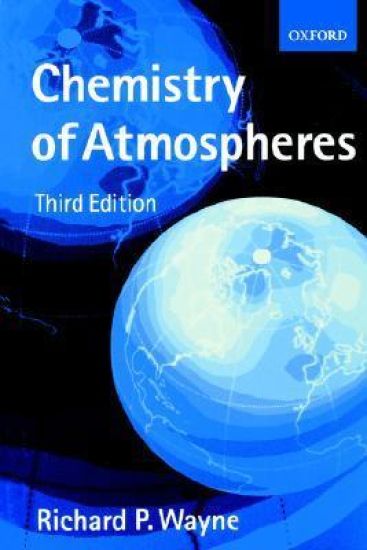
Chemistry of Atmospheres

Chemistry of Atmospheres

Richard P. Wayne

Oxford University Press
2000
nidottu
Atmospheric chemistry has been the focus of much research activity in recent years, and there is now heightened public awareness of the environmental issues in which it plays a part. In a clear, readable style, this important book looks at the insights and interpretations afforded by the research, and places in context the exciting, dramatic, and sometimes disturbing findings. Like its highly successful predecessor, this new edition lays down the principles of atmospheric chemistry and provides the necessary background for more detailed study. The text has been thoroughly revised and expanded throughout to take into account recent advances in atmospheric science that include a host of new atmospheric measurements, extended laboratory experiments, ever more sophisticated models, and ingenious interpretations of the phenomena. Heterogeneous processes are now known to be of great significance in the chemistry of the Earth's atmosphere, and new sections of the book discuss the influence of such processes on both the stratosphere and the troposphere. A major eruption, that of Mount Pinatubo, has highlighted how volcanoes can influence 'natural' atmospheric chemistry, and the opportunity is taken to examine the effects of the gases and particles produced in such eruptions. The startling discovery of the 'Antarctic ozone hole' has now been matched by observations of similar ozone losses in the Arctic; both phenomena are explored in more depth than before, and the whole question of trends in stratospheric ozone concentrations is updated. New topics in tropospheric chemistry that are discussed in this edition for the first time include the atmospheric chemistry of biogenic hydrocarbons, of aromatic compounds, and of halogens and halogen-containing species. Several aspects have been added to the examination of air pollution, including the effects of biomass burning. Rapid changes in the composition of the Earth's atmosphere, apparently a result of man's activities, are apparently even having an effect on global climate, and recent assessments of the Intergovernmental Panel on Climate Change are presented in this context. Air transport continues to expand, and the influence of aircraft on atmospheric chemistry and, indeed, on climate has excited interest that is explained here. Moving away from Earth, information gathered by the Voyager, Galileo, and other space missions, which have provided a new understanding of the atmosphere of the planets other than our own, is also discussed and brought up to date. This book does not attempt to suggest answers to the environmental problems facing us, but it lays the foundations for the study of atmospheric chemistry on which rational decisions will need to be based. A multidisciplinary approach is taken throughout in order to highlight the interplay between the atmosphere of a planet and other parts of the environment. This feature makes the book full of interest for chemists, physicists, biologists, and other scientists alike, and accessible to all of them. Readers will find the book an excellent introduction to an exciting topic, and a fascinating source of information about a part of science that is proving to be of key importance.
Photochemistry

Photochemistry

Carol E. Wayne; Richard P. Wayne

Oxford University Press
1996
nidottu
Photochemistry is the study of the interaction of light with matter. This fascinating subject is explained in a clear yet comprehensive manner. Aimed at an undergraduate audience, the text describes the `new' chemistry that follows the absorption of light, and explains how light has this extraordinary influence on chemical behaviour. Examples of established principles are presented examining the way in which life and the other natural processes depend on photochemistry, and also how photochemistry can be used in a variety of applications.
Chemical Instrumentation

Chemical Instrumentation

Richard P. Wayne

Oxford University Press
1994
nidottu
Instrumentation, often of a highly sophisticated kind, lies behind many of the most interesting aspects of contemporary chemistry. Some techniques - such as NMR - owe their existance to electronic instrumentation; others have been made simpler, more reliable, and more precise. Yet undergraduates reading chemistry often have only the most rudimentary understanding to be performed. This book aims to introduce chemists to some of the building blocks and devices that make up the most important instruments used in industry and research. It is not a book about electronics or about detailed circuit design, though the first chapter reviews the principles. Simple measuring devices are discussed before the introduction of the constituent elements of more complex devices, and emphasis is given to the enhancement of signal-to-noise ratios, which often lies at the heart of some of the most demanding measurements in the chemical sciences. This clearly written text will provide a basic understanding of how instrumentation works and thus help chemists use what is available both correctly and effectively.