Kirjojen hintavertailu. Mukana 12 390 323 kirjaa ja 12 kauppaa.

Kirjailija

Richard Pithouse

Kirjat ja teokset yhdessä paikassa: 3 kirjaa, julkaisuja vuosilta 2016-2022, suosituimpien joukossa Washington Bullets. Vertaile teosten hintoja ja tarkista saatavuus suomalaisista kirjakaupoista.

3 kirjaa

Kirjojen julkaisuhaarukka 2016-2022.

Washington Bullets

Washington Bullets

Vijay Prashad; Evo Morales; Richard Pithouse

Inkani Books
2022
pokkari
Washington Bullets is written in the best traditions of Marxist journalism and history-writing. It is a book of fluent and readable stories, full of detail about US imperialism, but never letting the minutiae obscure the larger political point. It is a book that could easily have been a song of despair - a lament of lost causes; it is, after all, a roll call of butchers and assassins; of plots against people's movements and governments; of the assassinations of socialists, Marxists, communists all over the Third World by the country where liberty is a statue.Despite all this, Washington Bullets is a book about possibilities, about hope, about genuine heroes. One such is Thomas Sankara of Burkina Faso - also assassinated - who said: 'You cannot carry out fundamental change without a certain amount of madness. In this case, it comes from nonconformity, the courage to turn your back on the old formulas, the courage to invent the future. It took the madmen of yesterday for us to be able to act with extreme clarity today. I want to be one of those madmen. We must dare to invent the future.'Washington Bullets is a book infused with this madness, the madness that dares to invent the future.
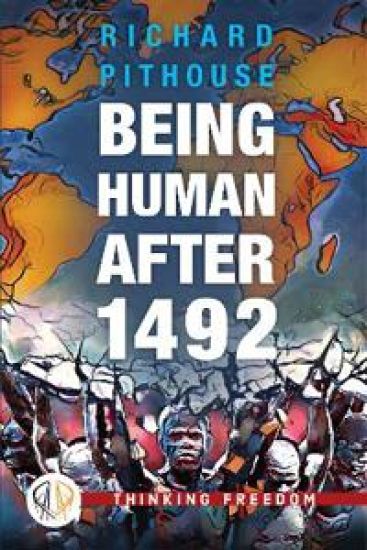
Being Human After 1492

Being Human After 1492

Richard Pithouse

Daraja Press
2020
nidottu
The pamphlet begins with two letters written by Paul the Apostle in which Christianity first acquires a universal address. The new religion came to exclude people who were not Christians from the count of the human. This became explicit around a thousand years later when Pope Urban II authorised the First Crusade. In 1492 planetary history was split in to two. Muhammad XII of Granada conceded defeat to Isabella and Ferdinand, the Catholic monarchs of Portugal and Spain, who went on to expel the Jews from the territory under their control. Europe became a Christian project. In the same year Christopher Columbus arrived in the Caribbean and Europe also became an imperial project with a planetary reach. The origins of the racial ideology can be seen in this period, in which ideas about religion came to be entangled with fantastical ideas about the imagined purity of blood. But it was in the English colony of Virginia in the seventeenth century that the legitimation for the exclusion from the count of the human began to move from claims made in the name of religion to claims made in the name of science. This is the point at which modern racism, rooted in the appearance of the body, began to cast its malignant shadow across the planet. The author argues that the struggle to put an end to the epoch of world history that opened in 1492 will require new ideas, and new practices. It follows the Caribbean tradition that runs from Aim C saire to Frantz Fanon and Sylvia Wynter in affirming the need for a counter-humanism, a radical humanism, a humanism that, in C saire's famous phrases, is "made to the measure of the world". There is a need for a shift in the ground of reason towards the lived experience and struggles of people rendered, in Wynter's phrase, as 'pariahs outside of the new order'. This pamphlet is part of the Thinking Freedom series published by Daraja Press.
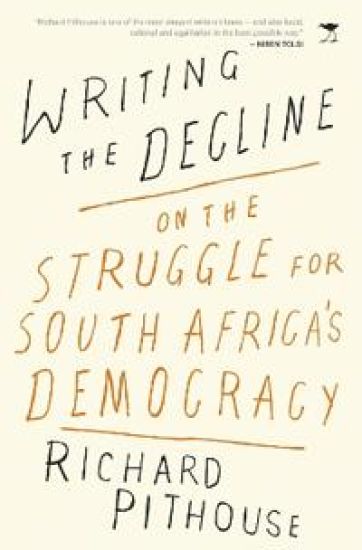
Writing the decline

Writing the decline

Richard Pithouse

JACANA MEDIA (PTY) LTD
2016
nidottu
Richard Pithouse, an activist intellectual who has been an important contributor to the South African public sphere for twenty years, offers a penetrating and beautifully written exploration of the escalating crisis in South Africa in the Zuma era. Writing the Decline, often written with a view from the underside of society but also always acutely aware of global developments, brings activist and academic knowledge together to provide a searing account of our condition. It takes on xenophobia, racism, homophobia, inequality and political repression. In a moment when old certainties are breaking down, and new ideas and social forces are taking the stage, this book offers a compelling invitation to take democracy seriously.