Kirjojen hintavertailu. Mukana 12 595 353 kirjaa ja 12 kauppaa.

Kirjailija

Richard Stern

Kirjat ja teokset yhdessä paikassa: 10 kirjaa, julkaisuja vuosilta 1987-2017, suosituimpien joukossa Unlocking Commercial Financing for Clean Energy in East Asia. Vertaile teosten hintoja ja tarkista saatavuus suomalaisista kirjakaupoista.

10 kirjaa

Kirjojen julkaisuhaarukka 1987-2017.

Other Men's Daughters

Other Men's Daughters

Philip Roth; Richard Stern

The New York Review of Books, Inc
2017
nidottu
"Until the day of Merriwether's departure from the house--a month after his divorce--the Merriwether family looked like an ideally tranquil one" we read on the first page of Other Men's Daughters. It is the late 1960s, and the streets of Cambridge, Massachusetts, are full of long-haired hippies decked out in colorful garb, but Dr. Robert Merriwether, who teaches at Harvard and has been married for a good long time, hardly takes note. Learned, curious, thoughtful, and a creature of habit, Merriwether is anything but an impulsive man, and yet over the summer, while Sarah, his wife, is away on vacation, he meets a summer student, Cynthia Ryder, and before long the two have fallen into bed and in love. Richard Stern's novel is an elegant and unnerving examination of just how cold and destructive a thing love, "the origin of so much story and disorder," can be.
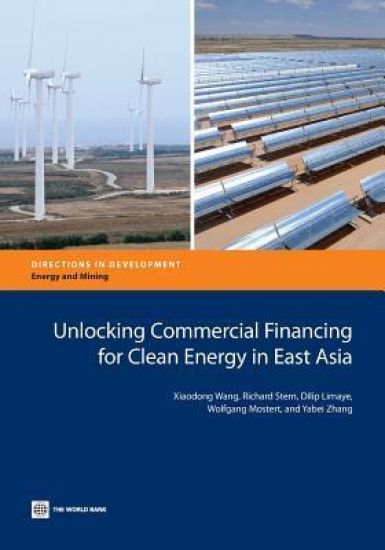
Unlocking Commercial Financing for Clean Energy in East Asia

Unlocking Commercial Financing for Clean Energy in East Asia

Xiaodong Wang; Richard Stern; Dilip Limaye; Wolfgang Mostert; Yabei Zhang

World Bank Publications
2013
nidottu
Unlocking Commercial Financing for Clean Energy in East Asia was written for government decision makers in middle and high-income countries, members of international financing communities, and practitioners. In East Asia, all middle-income countries have national targets for energy efficiency and renewable energy, and some even have targets for carbon reduction. However, a major hurdle to achieving a sustainable energy path is mobilising the required financing. Policy makers must determine how to unlock commercial financing to scale up clean energy investments. This title builds on recent experience in applying public financing instruments and attempts to address the following issues: when and under what circumstances to use public financing instruments, which instrument to select, and how to design and implement them most effectively. First and foremost, effective and conducive policies are essential to catalysing commercial investment in clean energy. Once the right policy regime has been put in place, public financing mechanisms designed to mitigate risks and close financing gaps have proven to play a major catalytic role in kick-starting substantial investments in clean energy. Public financing mechanisms for energy efficiency are particularly important to mitigating financiers' risk perceptions, to aggregating small deals, and to enhancing the interest and capacity of domestic banks. Public financing for renewable energy can provide long-term loan tenure to match the long payback period, mitigate technology risks, and increase access to financing for small and medium enterprises. The selection of public financing instruments should be tailored to the market barriers, the targeted market segments, the regulatory environment, and the maturity of the financial market. Engaging domestic banks through credit lines and guarantees has had the greatest impact in unlocking private financing. Dedicated funds and mezzanine and equity funds can effectively increase access to financing for small and medium enterprises and clean energy start-ups. Finally, the impact of public financing instruments can be substantially increased if they are packaged with technical assistance.
Europe

Europe

Richard Stern; David R. Slavitt

Northwestern University Press
2007
nidottu
Originally published in 1961, this shrewd, smartly written novel follows two American men traveling in Europe. Though both have struck out for the same continent, each man's methods of and motives for travel lead him to have a very different experience. Underlying it all is the premise that ""Europe"" can be a refiner's fire, deeply affecting a person's character. ""Europe"" represents a crucial step in Stern's development as a writer and stands as a witty, sharp point of entry into his writings.
Pacific Tremors

Pacific Tremors

Richard Stern

Northwestern University Press
2007
nidottu
Keneret, the director, and Spear, the Anglo-American historian-critic, have committed the great Hollywood sin: they've gotten old. Spear, fading in the Malibu hills, is consoled and diverted by his wonderful granddaughter, Jennifer, a San Francisco lawyer. Keneret, given one more chance to make a film by Duggan, his mercurial billionaire backer, centers it around Leet de Loor, a young French woman he's discovered in Fiji. As the two brilliant veterans slide towards oblivion, the equally brilliant young women rise in the paradisal new world of the Pacific Rim, even as it trembles in its terrestrial and human faults.
What Is What Was

What Is What Was

Richard Stern

University of Chicago Press
2002
nidottu
"What Is What Was", Richard Stern's fifth "orderly miscellany", is the first to meaningfully combine his fiction and non-fiction. Stories, such as the already well-known "My Ex, the Moral Philosopher", appear among portraits (of the sort Hugh Kenner praise as "almost the invention of a new genre"): Auden, Pound, Ellison, Terkel, W.C. Fields, Bertrand Russell, Walter Benjamin (in both essay and story), Jung and Freud, Hannah Arendt and Martin Heidegger. In the book's seven sections are analyses of the Wimbledon tennis tournament as an Anglification machine, of Silicon Valley at its shaky peak, of James and Dante as travel writers, a Lucretian look at today's cosmology, American fiction in detail and depth, a "thought experiment" for Clarence Thomas, a salvation scheme for Ross Perot, a semi-confession of the writer. The book contains but isn't philosophy, criticism, opinion, reportage or autobiography (although the author says it is as much of this as he plans to write). There is a recurrent theme, the ways in which actuality is made and remade in description, argument and narration, fictional and nonfictional, but above all, "What Is What Was" is a provocative entertainment by a writer who, as Philip Roth once said, "knows as much as anyone writing American prose about family mischief, intellectual shenanigans, love blunders - and about writing American prose".
A Father's Words

A Father's Words

Richard Stern

University of Chicago Press
1990
nidottu
Cy Riemer—fifty-ish, divorced, and father of four—surveys the dispersal of his family with a mixture of anxiety, humor, sadness, and pride. In this wry, moving, and wise novel, Richard Stern offers his masterful portrait of Cy as the quintessential caring yet controlling parent, a relentless seeker of self-knowledge whose search is intensified through conflicts with his brilliant, ne'er-do-well son Jack. The "manipulation of a smart, sane, self-justifying narrator . . . is not the least of Stern's achievements in this delicate fabrication of tough prose and tender adjustment of sentiment."—Geoffrey Wolff, Los Angeles Times "Richard Stern's novels are robustly intelligent, very funny, and beguilingly humane. He knows as much as anyone writing American prose about family mischief, intellectual shenanigans, love blunders—and about writing American prose."—Philip Roth "A delectable rhetorical display. . . . "—The New Yorker "Anyone who has read Richard Stern's previous novels won't need to be told he is an unusually crisp and intelligent writer, with a sharp edge to his wit; and in A Father's Words he runs true to form. Many of the book's pleasures are incidental: jokes, intellectual cadenzas, agile turns of phrase . . . The author's powers of farcical invention climax in a brilliant, bitter episode where . . . the younger man proclaims his final failure . . . Mr. Stern has written an excellent novel."—John Gross, New York Times "Richard Stern is American letters' unsung comic writer about serious matters . . . [A Father's Words] produced in this reviewer an apostolic desire to convince a wider audience to try Stern, especially the vintage Stern."—Doris Grumbach, Chicago Tribune
Golk

Golk

Richard Stern; Jr. Rodgers

University of Chicago Press
1987
nidottu
In midcentury America, the golden age of television, a man named Golk is wreaking havoc with the medium. Through a devastating series of exposures—"You're on Camera"—Golk manipulates the high and mighty, the lowdown and dirty, and the outrageous weird; all are within the compass of Richard Stern in this early novel, a comedy with as many inspired maneuvers as its rambunctious protagonist has for taking the measure of a profligate world. "Golk is a rich and marvelously detailed novel by a man with a cultivated intelligence; it is also the first really good book I have read about television."—Norman Mailer "An original: sharp, funny, intelligent, rare. . . . Working in a clean, oblique style reminiscent of Nathanael West, Mr. Stern has written in Golk a first-rate comic novel, a piece of fiction that is at once about and loaded with that kind of recognition that junkies call the flash."—Joan Didion, National Review "Golk is fantastic, funny, bitter, intelligent without weariness. Best of all Golk is pure—that is to say necessary. Without hokum."—Saul Bellow "Golk (like Golk himself) is a wonderous conception. Its world responds to personification, not analysis, and personify it Mr. Stern has done. A book in a thousand."—Hugh Kenner "What I like about Mr. Stern's fantasy is that it has been conceived and written with so much gaiety. Far from a political melodrama, it reminds me of a René Clair movie, and even the surrealist touches needed to bring out the power and pretense of the television industry are funny rather than symbolically grim."—Alfred Kazin, Reporter "A mighty good book, altogether alive, full of beans and none of them spilled."—Flannery O'Connor