Kirjojen hintavertailu. Mukana 12 241 681 kirjaa ja 12 kauppaa.

Kirjailija

Richard T. Carson

Kirjat ja teokset yhdessä paikassa: 5 kirjaa, julkaisuja vuosilta 2002-2014, suosituimpien joukossa Valuing Oil Spill Prevention. Vertaile teosten hintoja ja tarkista saatavuus suomalaisista kirjakaupoista.

5 kirjaa

Kirjojen julkaisuhaarukka 2002-2014.

Valuing Oil Spill Prevention

Valuing Oil Spill Prevention

Richard T. Carson; Michael B. Conaway; W. Michael Hanemann; Jon A. Krosnick; Robert C. Mitchell; Stanley Presser

Springer
2014
nidottu
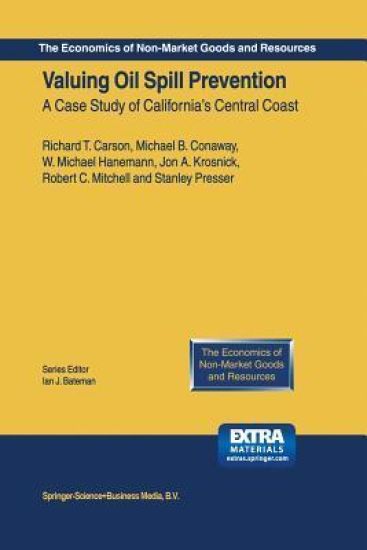
On April 22-23, 1988, approximately 432,000 gallons of San Joaquin Valley crude oil spilled from an aboveground storage tank at a Shell Oil Company refinery into the surrounding environment, including the northern reaches of San Francisco Bay (the Martinez spill). Pursuant to the settlement of the resulting litigation (United States/California v. Shell Oil Co., No. C89-4220, (N.D. Cal1990)), Shell Oil Company provided funding for, among other things, studies to improve future response strategies to oil spills and ensure better restoration of resources and services affected by such spills. The California Oil Spill Contingent Valuation Study was one of the studies funded by the settlement. The purpose of the California Oil Spill (COS) Contingent Valuation (CV) Study was "to execute and document a contingent valuation study of natural resource damages associated with offshore, coastal, or estuarine oil spills in California" (State of California, Department of Justice, Contract Number 89-2126). The COS CV study developed an estimate of per household ex ante economic value for a program to prevent a specified set of natural resource injuries to those species of birds and intertidal life that are consistently affected by oil spills along California's Central Coast. The principal investigators on the COS study team were Richard T. Carson of the University of California, San Diego, and W. Michael Hanemann of the University of California, Berkeley. The study's project manager was Kerry M.
Contingent Valuation

Contingent Valuation

Richard T. Carson

Edward Elgar Publishing Ltd
2011
sidottu
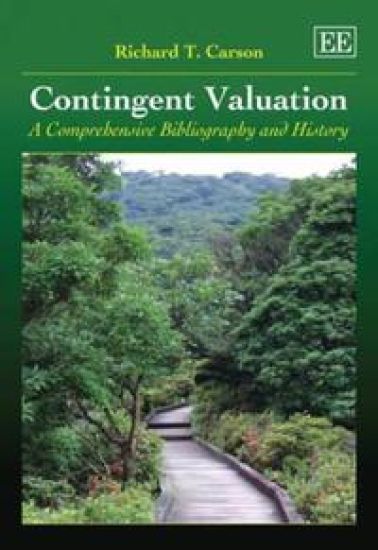
This major reference work - the first of its kind - provides a comprehensive and authoritative introduction to the large and growing literature on contingent valuation. It includes annotated entries on over 7,500 contingent valuation papers and studies from over 130 countries covering both the published and gray literatures. This book provides an interpretive historical account of the development of contingent valuation, the most commonly used approach to placing a value on goods not normally sold in the marketplace. The major fields cataloged here include culture, the environment, and health applications. This bibliography is an ideal starting point for researchers wanting to find other studies that have valued goods or used techniques similar to those they are interested in. For those wanting to conduct meta analyses, the book will serve as an invaluable guide to source material. In addition to the print edition we offer access, for purchasers of the book, to a website providing the contents of as a searchable Word document and in a variety of standard bibliographic database forms. Contingent Valuation is an indispensable reference source for researchers, scholars and policy makers concerned with survey approaches to the problem of environmental valuation.
Valuing Oil Spill Prevention

Valuing Oil Spill Prevention

Richard T. Carson; Michael B. Conaway; W. Michael Hanemann; Jon A. Krosnick; Robert C. Mitchell; Stanley Presser

Springer
2004
sidottu
On April 22-23, 1988, approximately 432,000 gallons of San Joaquin Valley crude oil spilled from an aboveground storage tank at a Shell Oil Company refinery into the surrounding environment, including the northern reaches of San Francisco Bay (the Martinez spill). Pursuant to the settlement of the resulting litigation (United States/California v. Shell Oil Co., No. C89-4220, (N.D. Cal1990)), Shell Oil Company provided funding for, among other things, studies to improve future response strategies to oil spills and ensure better restoration of resources and services affected by such spills. The California Oil Spill Contingent Valuation Study was one of the studies funded by the settlement. The purpose of the California Oil Spill (COS) Contingent Valuation (CV) Study was "to execute and document a contingent valuation study of natural resource damages associated with offshore, coastal, or estuarine oil spills in California" (State of California, Department of Justice, Contract Number 89-2126). The COS CV study developed an estimate of per household ex ante economic value for a program to prevent a specified set of natural resource injuries to those species of birds and intertidal life that are consistently affected by oil spills along California's Central Coast. The principal investigators on the COS study team were Richard T. Carson of the University of California, San Diego, and W. Michael Hanemann of the University of California, Berkeley. The study's project manager was Kerry M.
Economic Valuation with Stated Preference Techniques

Economic Valuation with Stated Preference Techniques

Ian J. Bateman; Richard T. Carson; Brett Day; Michael Hanemann; Nick Hanley; Tannis Hett; Michael Jones-Lee; Graham Loomes

Edward Elgar Publishing Ltd
2004
nidottu
This manual offers a detailed, up-to-date explanation of how to carry out economic valuation using stated preference techniques. It is relevant for the application of these techniques to all non-market goods and services including air and water quality; provision of public open space; health care that is not sold through private markets; risk reduction policies and investments not provided privately; provision of information as with the recorded heritage, the protection of cultural assets and so on. The resulting valuations can be used for a number of purposes including, but not limited to, demonstrating the importance of a good or service; cost-benefit analysis; setting priorities for environmental policy; design of economic instruments; green national/corporate accounting, and natural resource damage assessment. Compiled by the leading experts in the field, this manual starts by explaining the concepts. It shows how to choose the most appropriate technique and how to design the questionnaires. Detailed advice on econometric analysis is provided, as well as explanation of the pitfalls that need to be avoided.
Economic Valuation with Stated Preference Techniques

Economic Valuation with Stated Preference Techniques

Ian J. Bateman; Richard T. Carson; Brett Day; Michael Hanemann; Nick Hanley; Tannis Hett; Michael Jones-Lee; Graham Loomes

Edward Elgar Publishing Ltd
2002
sidottu
This manual offers a detailed, up-to-date explanation of how to carry out economic valuation using stated preference techniques. It is relevant for the application of these techniques to all non-market goods and services including air and water quality; provision of public open space; health care that is not sold through private markets; risk reduction policies and investments not provided privately; provision of information as with the recorded heritage, the protection of cultural assets and so on. The resulting valuations can be used for a number of purposes including, but not limited to, demonstrating the importance of a good or service; cost-benefit analysis; setting priorities for environmental policy; design of economic instruments; green national/corporate accounting, and natural resource damage assessment. Compiled by the leading experts in the field, this manual starts by explaining the concepts. It shows how to choose the most appropriate technique and how to design the questionnaires. Detailed advice on econometric analysis is provided, as well as explanation of the pitfalls that need to be avoided.