Kirjojen hintavertailu. Mukana 12 390 323 kirjaa ja 12 kauppaa.

Kirjailija

Richard T. W. Arthur

Kirjat ja teokset yhdessä paikassa: 7 kirjaa, julkaisuja vuosilta 2014-2025, suosituimpien joukossa An Introduction to Logic - Second Edition. Vertaile teosten hintoja ja tarkista saatavuus suomalaisista kirjakaupoista.

Mukana myös kirjoitusasut: Richard T.W. Arthur

7 kirjaa

Kirjojen julkaisuhaarukka 2014-2025.

Leibniz on the Foundations of the Differential Calculus

Leibniz on the Foundations of the Differential Calculus

Richard T. W. Arthur; David Rabouin

BIRKHAUSER VERLAG AG
2025
nidottu
This monograph presents an interpretive essay on the foundations of Leibniz’s calculus, accompanied by key texts in English translation. The essay examines Leibniz's evolving views on infinitesimals and infinite numbers, tracing their development from his early metaphysical ideas to his mature justifications of the calculus. Leibniz first proposed treating infinitesimals as fictions in the 1670s, in line with the mathematical practices of his time, where abstract concepts could be used in calculations without implying their existence. By 1676, he rejected their status as quantities, yet continued to refine his arguments on this topic into the 1690s. The essay concludes with an analysis of Leibniz’s defense of his calculus in the early 18th century, showing how his later works naturally extended from earlier insights. This monograph will be a valuable resource for scholars and students of Leibniz and the history of science.
Leibniz on Time, Space, and Relativity

Leibniz on Time, Space, and Relativity

Richard T. W. Arthur

Oxford University Press
2021
sidottu
In this book, Arthur gives fresh interpretations of Gottfried Leibniz's theories of time, space, and the relativity of motion, based on a thorough examination of Leibniz's manuscripts as well as his published papers. These are analysed in historical context, but also with an eye to their contemporary relevance. Leibniz's views on relativity have been extremely influential, first on Mach, and then on Einstein, while his novel approach to geometry in his analysis situs inspired many later developments in geometry. Arthur expounds the latter in some detail, explaining its relationship to Leibniz's metaphysics of space and the grounding of motion, and defending Leibniz's views on the relativity of motion against charges of inconsistency. The brilliance of his work on time, though, has not been so well appreciated, and Arthur attempts to remedy this through a detailed discussion of Leibniz's relational theory of time, showing how it underpins his theory of possible worlds, his complex account of contingency, and his highly original treatment of the continuity of time, providing formal treatments in an appendix. In other appendices, Arthur provides translations of previously untranslated writings by Leibniz on analysis situs and on Copernicanism, as well as an essay on Leibniz's philosophy of relations. In his introductory chapter he explains how the framework for the book is provided by the interpretation of Leibniz's metaphysics he defended in his earlier Monads, Composition, and Force (OUP 2018, winner of the 2019 annual JHP Book Prize for best book in the history of philosophy published in 2018).
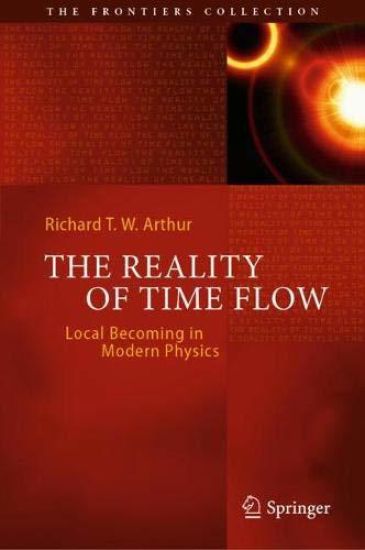
The Reality of Time Flow

The Reality of Time Flow

Richard T. W. Arthur

Springer Nature Switzerland AG
2019
sidottu
It is commonly held that there is no place for the 'now’ in physics, and also that the passing of time is something subjective, having to do with the way reality is experienced but not with the way reality is. Indeed, the majority of modern theoretical physicists and philosophers of physics contend that the passing of time is incompatible with modern physical theory, and excluded in a fundamental description of physical reality. This book provides a forceful rebuttal of such claims. In successive chapters the author explains the historical precedents of the modern opposition to time flow, giving careful expositions of matters relevant to becoming in classical physics, the special and general theories of relativity, and quantum theory, without presupposing prior expertise in these subjects. Analysing the arguments of thinkers ranging from Aristotle, Russell, and Bergson to the proponents of quantum gravity, he contends that the passage of time, understood as a local becoming of events out of those in their past at varying rates, is not only compatible with the theories of modern physics, but implicit in them.
Monads, Composition, and Force

Monads, Composition, and Force

Richard T. W. Arthur

Oxford University Press
2018
sidottu
Leibniz's monads have long been a source of fascination and puzzlement. If monads are merely immaterial, how can they alone constitute reality? In Monads, Composition and Force, Richard T. W. Arthur takes seriously Leibniz's claim of introducing monads to solve the problem of the composition of matter and motion. Going against a trend of idealistic interpretations of Leibniz's thought, Arthur argues that although monads are presupposed as the principles making actual each of the infinite parts of matter, bodies are not composed of them. He offers a fresh interpretation of Leibniz's theory of substance in which monads are enduring primitive forces, corporeal substances are embodied monads, and bodies are aggregates of monads, not mere appearances. In this reading the monads are constitutive unities, constituting an organic unity of function through time, and bodies are phenomenal in two senses; as ever-changing things they are Platonic phenomena and as pluralities, in being perceived together, they are also Democritean phenomena. Arthur argues for this reading by describing how Leibniz's thought is grounded in seventeenth century atomism and the metaphysics of the plurality of forms, showing how his attempt to make this foundation compatible with mechanism undergirds his insightful contributions to biological science and the dynamical foundations he provides for modern physics.
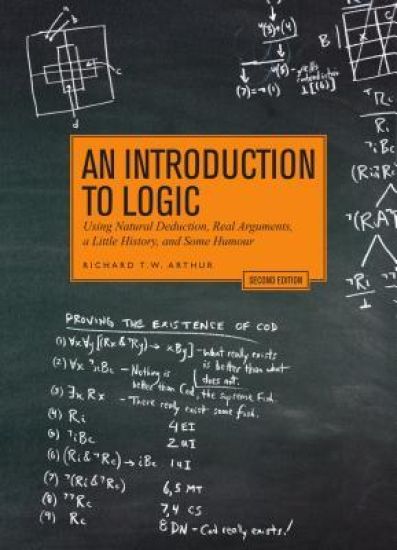
An Introduction to Logic - Second Edition

An Introduction to Logic - Second Edition

Richard T.W. Arthur

Broadview Press Ltd
2016
pokkari
Richard Arthur's Natural Deduction provides a wide-ranging introduction to logic. In lively and readable prose, Arthur presents a new approach to the study of logic, one that seeks to integrate methods of argument analysis developed in modern ""informal logic"" with natural deduction techniques. The dry bones of logic are given flesh by unusual attention to the history of the subject, from Pythagoras, the Stoics, and Indian Buddhist logic, through Lewis Carroll, Venn, and Boole, to Russell, Frege, and Monty Python. In this new edition, more exercises have been added and others have been updated and replaced. Also included are some clarifications of the notions of explanation, validity and formal validity, a more detailed discussion of derivation strategies, and another rule of inference, Reiteration.
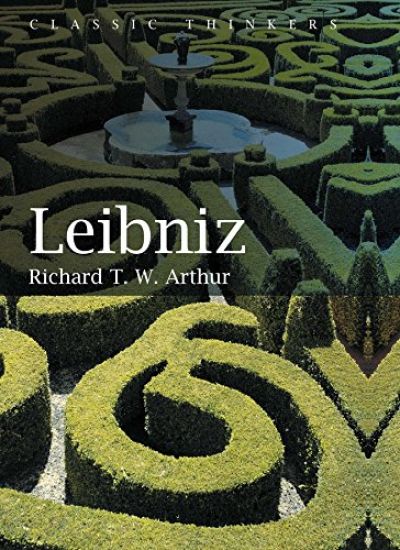
Leibniz

Leibniz

Richard T.W. Arthur

Polity Press
2014
nidottu
Few philosophers have left a legacy like that of Gottfried Wilhelm Leibniz. He has been credited not only with inventing the differential calculus, but also with anticipating the basic ideas of modern logic, information science, and fractal geometry. He made important contributions to such diverse fields as jurisprudence, geology and etymology, while sketching designs for calculating machines, wind pumps, and submarines. But the common presentation of his philosophy as a kind of unworldly idealism is at odds with all this bustling practical activity. In this book Richard. T. W. Arthur offers a fresh reading of Leibniz’s philosophy, clearly situating it in its scientific, political and theological contexts. He argues that Leibniz aimed to provide an improved foundation for the mechanical philosophy based on a new kind of universal language. His contributions to natural philosophy are an integral part of this programme, which his metaphysics, dynamics and organic philosophy were designed to support. Rather than denying that substances really exist in space and time, as the idealist reading proposes, Leibniz sought to provide a deeper understanding of substance and body, and a correct understanding of space as an order of situations and time as an order of successive things. This lively and approachable book will appeal to students of philosophy, as well as anyone seeking a stimulating introduction to Leibniz's thought and its continuing relevance.
Leibniz

Leibniz

Richard T.W. Arthur

Polity Press
2014
sidottu
Few philosophers have left a legacy like that of Gottfried Wilhelm Leibniz. He has been credited not only with inventing the differential calculus, but also with anticipating the basic ideas of modern logic, information science, and fractal geometry. He made important contributions to such diverse fields as jurisprudence, geology and etymology, while sketching designs for calculating machines, wind pumps, and submarines. But the common presentation of his philosophy as a kind of unworldly idealism is at odds with all this bustling practical activity. In this book Richard. T. W. Arthur offers a fresh reading of Leibniz’s philosophy, clearly situating it in its scientific, political and theological contexts. He argues that Leibniz aimed to provide an improved foundation for the mechanical philosophy based on a new kind of universal language. His contributions to natural philosophy are an integral part of this programme, which his metaphysics, dynamics and organic philosophy were designed to support. Rather than denying that substances really exist in space and time, as the idealist reading proposes, Leibniz sought to provide a deeper understanding of substance and body, and a correct understanding of space as an order of situations and time as an order of successive things. This lively and approachable book will appeal to students of philosophy, as well as anyone seeking a stimulating introduction to Leibniz's thought and its continuing relevance.