Kirjojen hintavertailu. Mukana 12 316 290 kirjaa ja 12 kauppaa.

Kirjailija

Richard V. Ericson

Kirjat ja teokset yhdessä paikassa: 10 kirjaa, julkaisuja vuosilta 1982-2006, suosituimpien joukossa Uncertain Business. Vertaile teosten hintoja ja tarkista saatavuus suomalaisista kirjakaupoista.

10 kirjaa

Kirjojen julkaisuhaarukka 1982-2006.

Crime in an Insecure World

Crime in an Insecure World

Richard V. Ericson

Polity Press
2006
sidottu
Crime in an Insecure World investigates the alarming trend across Western societies of treating every imaginable source of harm as a crime. It locates this trend in the 21st century obsession with insecurity fostered by neo-liberal governments. It explains why selected issues of national security (threats of terrorism), social security (benefit system integrity), corporate security (liabilities for harm) and domestic security (anti-social behaviour) are at the top of the political agenda. It documents how this politics of insecurity leads to enormous expenditures on risk assessment and management that ironically reveal the limits of risk-based reasoning and intensify uncertainty. Catastrophic imaginations are fuelled, precautionary logics become pervasive, and extreme security measures are institutionalized. The security measures include the invention of disturbing new forms of ‘counter law’ or ‘law against law’. Counter law criminalizes not only those who actually cause harm, but also those merely suspected of being harmful, as well as authorities who are deemed responsible for security failures. Traditional principles, standards and procedures of criminal law are eroded or eliminated altogether, and civil and administrative law become more salient in processes of criminalization. Counter law also involves the innovative expansion of surveillance technologies and networks. CCTV, smart cards, data matching, data mining, and private policing all facilitate criminalization of the merely suspicious and security failures. Security trumps justice, and uncertainty proves itself. This book is grounded in leading-edge theory and research across academic disciplines. It contributes to the most critical and contested debates in 21st century politics. It is of great interest not only to students of politics, sociology, law, criminology, risk management and public policy, but also to the general reader.

Crime in an Insecure World

Crime in an Insecure World

Richard V. Ericson

Polity Press
2006
nidottu
Crime in an Insecure World investigates the alarming trend across Western societies of treating every imaginable source of harm as a crime. It locates this trend in the 21st century obsession with insecurity fostered by neo-liberal governments. It explains why selected issues of national security (threats of terrorism), social security (benefit system integrity), corporate security (liabilities for harm) and domestic security (anti-social behaviour) are at the top of the political agenda. It documents how this politics of insecurity leads to enormous expenditures on risk assessment and management that ironically reveal the limits of risk-based reasoning and intensify uncertainty. Catastrophic imaginations are fuelled, precautionary logics become pervasive, and extreme security measures are institutionalized. The security measures include the invention of disturbing new forms of ‘counter law’ or ‘law against law’. Counter law criminalizes not only those who actually cause harm, but also those merely suspected of being harmful, as well as authorities who are deemed responsible for security failures. Traditional principles, standards and procedures of criminal law are eroded or eliminated altogether, and civil and administrative law become more salient in processes of criminalization. Counter law also involves the innovative expansion of surveillance technologies and networks. CCTV, smart cards, data matching, data mining, and private policing all facilitate criminalization of the merely suspicious and security failures. Security trumps justice, and uncertainty proves itself. This book is grounded in leading-edge theory and research across academic disciplines. It contributes to the most critical and contested debates in 21st century politics. It is of great interest not only to students of politics, sociology, law, criminology, risk management and public policy, but also to the general reader.

Uncertain Business

Uncertain Business

Aaron Doyle; Richard V. Ericson

University of Toronto Press
2004
sidottu
We live in an age of increasing doubt about whether our institutions and technologies can provide security against risks, many of which they themselves have created. Uncertain Business is an unprecedented inquiry into insurance industry practices and what they tell us about risks and uncertainties in contemporary society. The core of the book is ethnographic studies in distinct fields of insurance: premature death, disability, earthquake, and terrorism. These studies reveal that uncertainty pervades different fields of insurance, the very industry that is charged with transforming uncertainty into manageable risk. Scientific data on risk are variously absent, inadequate, controversial, contradictory, and ignored. Insurers impose meaning on uncertainty through non-scientific forms of knowledge that are intuitive, emotional, aesthetic, moral, and speculative. Nevertheless, the nature of uncertainty and the response to it varies substantially across the fields studied, showing how contemporary society is characterized by competing risk logics. Insurers' perceptions and decisions about uncertainty - with potential for windfall profits as well as catastrophic losses - create crises in insurance availability and provoke new forms of inequality and exclusion. Hence, while the insurance industry is a central bulwark against uncertainty, insurers also play a key role in fostering it.
Uncertain Business

Uncertain Business

Aaron Doyle; Richard V. Ericson

University of Toronto Press
2004
pokkari
We live in an age of increasing doubt about whether our institutions and technologies can provide security against risks, many of which they themselves have created. Uncertain Business is an unprecedented inquiry into insurance industry practices and what they tell us about risks and uncertainties in contemporary society. The core of the book is ethnographic studies in distinct fields of insurance: premature death, disability, earthquake, and terrorism. These studies reveal that uncertainty pervades different fields of insurance, the very industry that is charged with transforming uncertainty into manageable risk. Scientific data on risk are variously absent, inadequate, controversial, contradictory, and ignored. Insurers impose meaning on uncertainty through non-scientific forms of knowledge that are intuitive, emotional, aesthetic, moral, and speculative. Nevertheless, the nature of uncertainty and the response to it varies substantially across the fields studied, showing how contemporary society is characterized by competing risk logics. Insurers' perceptions and decisions about uncertainty - with potential for windfall profits as well as catastrophic losses - create crises in insurance availability and provoke new forms of inequality and exclusion. Hence, while the insurance industry is a central bulwark against uncertainty, insurers also play a key role in fostering it.
Insurance As Governance

Insurance As Governance

Dean Barry; Aaron Doyle; Richard V. Ericson

University of Toronto Press
2003
sidottu
Insurance as Governance is the first major sociological study of the insurance industry. It examines how the industry controls our institutions and daily lives in ways that are largely invisible, and how it thereby functions as a form of government beyond the state. Drawing on extensive ethnographic research on industry practices, the work penetrates the complexities of the insurance industry and demonstrates why it is such a powerful and pervasive institution. The authors advance the concept of moral risk as they consider how insurance companies partner with governments and corporations in the negotiation of economic policy. In effect, Insurance as Governance documents liberal theory at work. It offers a major case study of liberal governance beyond the state and explores such larger issues as how insurance is increasingly liberal rather than welfarist in orientation, and how insurance is the vanguard of liberalization in governance throughout postindustrial societies. Wide-ranging in scope and original in approach, the text provides a sophisticated integration of empirical data and theoretical approaches relating to insurance, risk, governance, and security.
Insurance As Governance

Insurance As Governance

Dean Barry; Aaron Doyle; Richard V. Ericson

University of Toronto Press
2003
pokkari
Insurance as Governance is the first major sociological study of the insurance industry. It examines how the industry controls our institutions and daily lives in ways that are largely invisible, and how it thereby functions as a form of government beyond the state. Drawing on extensive ethnographic research on industry practices, the work penetrates the complexities of the insurance industry and demonstrates why it is such a powerful and pervasive institution. The authors advance the concept of moral risk as they consider how insurance companies partner with governments and corporations in the negotiation of economic policy. In effect, Insurance as Governance documents liberal theory at work. It offers a major case study of liberal governance beyond the state and explores such larger issues as how insurance is increasingly liberal rather than welfarist in orientation, and how insurance is the vanguard of liberalization in governance throughout postindustrial societies. Wide-ranging in scope and original in approach, the text provides a sophisticated integration of empirical data and theoretical approaches relating to insurance, risk, governance, and security.
Policing the Risk Society

Policing the Risk Society

Richard V. Ericson; Kevin D. Haggerty

Clarendon Press
1997
nidottu
In this provocative new book, Richard Ericson and Kevin Haggerty contend that the police have become information brokers to institutions such as insurance companies and health and welfare organizations that operate based on a knowledge of risk. In turn, these institutions influence the ways that police officers think and act. A critical review of existing research reveals the need to study police interaction with institutions as well as individuals. These institutions are part of an emerging "risk society" where knowledge of risk is used to control danger. The authors examine different aspects of police involvement; the use of surveillance technologies and the collection of data on securities, careers and different social, ethnic, age and gender groups. They conclude by looking at how police organizations have been forced to develop new communications rules and technologies to meet external demands for knowledge of risk. This is the first book in this field to include detailed evidence of some of the central tenets of the risk society. It also includes a sophisticated examination of the risk society theory that will advance readers' knowledge considerably. With this book, the authors revolutionize the study of policing, and their work will impact heavily on scholars in criminology, social theory, and communications as well as policing and the public.
Policing the Risk Society

Policing the Risk Society

Richard V. Ericson; Kevin D. Haggerty

Clarendon Press
1997
sidottu
In this provocative new book, Richard Ericson and Kevin Haggerty contend that the police have become information brokers to institutions such as insurance companies and health and welfare organizations that operate based on a knowledge of risk. In turn, these institutions influence the ways that police officers think and act. A critical review of existing research reveals the need to study police interaction with institutions as well as individuals. These institutions are part of an emerging "risk society" where knowledge of risk is used to control danger. The authors examine different aspects of police involvement; the use of surveillance technologies and the collection of data on securities, careers and different social, ethnic, age and gender groups. They conclude by looking at how police organizations have been forced to develop new communications rules and technologies to meet external demands for knowledge of risk. This is the first book in this field to include detailed evidence of some of the central tenets of the risk society. It also includes a sophisticated examination of the risk society theory that will advance readers' knowledge considerably. With this book, the authors revolutionize the study of policing, and their work will impact heavily on scholars in criminology, social theory, and communications as well as policing and the public.
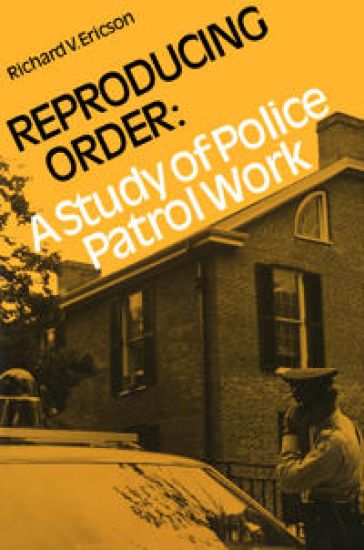
Reproducing Order

Reproducing Order

Richard V. Ericson

University of Toronto Press
1982
pokkari
Professor Ericson and his colleagues followed the work of patrol officers in a large Canadian regional police force. From their direct observations comes a wealth of information, quantitatively assembled and qualitatively discussed, with insights into the nature of policing. This book reveals that the police are not mere 'referees' of our legal lives, blowing the whistle on our infractions. They are censors of certain types of possibly wrong actions. They are selective in their invocation of criminal law and use the law artfully to restore settings to orderliness. Ericson emphasizes the routine manner in which the patrol officer intervenes and gains compliance fron the citizenry. He demonstrates that when the criminal process is invoked, the police maintain fundamental control over the court outcome. Using these findings, he addresses basic questions about the role of police in relation to crime and how it is produced, literally, by the patrol officer. Crime is also seen as the primary basis of police legitimacy, which in turn enables the police to engage in broad surveillance and information-gathering. The author's conclusions about the nature of policing and his discussion of the implications of proposals for reform of police, will generate better-informed deliberation in political and public decision-making and in the general study of sociological theory.
The Ordering of Justice

The Ordering of Justice

Patricia M. Baranek; Richard V. Ericson

University of Toronto Press
1982
pokkari
From the point of his arrest through to the final disposition of his case, the authors follow the accused as he proceeds through the criminal control system. They draw a picture of one who is dependent upon the orders and decisions of the police, crown attorney, defence lawyer, and judge and not a defendant with significant autonomy. Substudies conducted under a program of the Centre of Criminology provide empirical material on patrol police, detectives, crown attorneys and defence lawyers and are complemented by the authors’ own interviews of accused persons. They produce a unique picture of the person who stands accused: unlike the official agents who are regular and experienced participants in the criminal process, the accused is a ‘one-shot’ player. As a dependant he is subject to the orders and decisions of the official criminal control agents; he fails to exercise what appear externally as his formal rights because the apparent costs exceed the advantages. He complies with police searches, fails to remain silent, fails to call a third party, gives a statement, often does not obtain a lawyer, routinely accepts his lawyer’s advice, rarely demands a trial, often remains silent in court, and very rarely considers an appeal. The ordering which the accused meets out of court is reproduced in the public forum of the court. Through the display of formal legal rationality there and in the belief that matters ‘could have been a lot worse,’ he experiences the ‘majesty, justice, and mercy’ of the criminal process and, in turn, accords legitimacy to the actions taken against him. The authors discuss prospects for changing the criminal process and conclude that the range of reforms that have been advocated, and sometimes implemented, does not lead to an alteration of the accused’s position within the ordering of justice because the system is not truly adversarial. Rather, it serves the interests of the state in ordering the population as well as professional interests of those who man the system.