Kirjojen hintavertailu. Mukana 12 318 370 kirjaa ja 12 kauppaa.

Kirjailija

Richard W. Brislin

Kirjat ja teokset yhdessä paikassa: 4 kirjaa, julkaisuja vuosilta 1994-2000, suosituimpien joukossa Turning Bricks Into Jade. Vertaile teosten hintoja ja tarkista saatavuus suomalaisista kirjakaupoista.

4 kirjaa

Kirjojen julkaisuhaarukka 1994-2000.

Turning Bricks Into Jade

Turning Bricks Into Jade

David Williams; Julie Haiyan Chao; Mary Wang; Richard W. Brislin; Wei-zhong Wang

Intercultural Press
2000
pokkari
The Chinese are fond of using four-character phrases, known as cheng yu, to improve their writing style. The Chinese characters on the cover spell out one such idiom: pao zhuan yin yu. Translated literally, this would be "throw bricks attract jade." It can also express the idea of throwing out something of little value to induce a potential business partner to offer something more valuable. The authors of Turning Bricks into Jade, a more idiomatic rendering of pao zhuan yin yu, like to think of each critical incident in this collection as a brick, which, when combined with similar bricks, good sense and effort, can be used to construct relationships more valuable even than jade. A critical incident is a story about cross-cultural conflict or misunderstanding. Many of the forty-one incidents are based on actual events that involved one or more of the authors or their acquaintances. Some are a composite of several authors' experiences. You choose one of four or five possible alternatives that explain the misunderstanding. Following each incident is a discussion of possible solutions, based on the authors' experiences and grounded in current research. Misunderstandings between Chinese and American interactants are complicated; there is almost never just one thing going on. One result of this complexity is that many of the incidents have more than one correct explanation. Forty-one Americans and Chinese with considerable experience in both cultures read the collection of incidents for validation. As you work through the incidents, you may feel the need for a more detailed explanation or definition of certain recurring themes. A section on key theoretical concepts in Chinese-American interactions provides such detail. Included are individualism and collectivism, guanxi (interpersonal connections), hierarchies, gender relations in the workplace, regulations, deference to authority, work incentives and ownership. The Index of Incidents According to Themes and Concepts is also helpful.

Intercultural Interactions

Intercultural Interactions

Kenneth Cushner; Richard W. Brislin

SAGE Publications Inc
1995
sidottu
The first edition of Intercultural Interactions pioneered the 18-theme "culture-general" framework that has become the basis of work and research with a diverse array of populations, from interpreters for the deaf to helping professionals in multicultural settings and businesspeople around the world. Even more comprehensive in its scope and now with a practical new user's guide, the second edition expands coverage to draw the reader in--with more vivid scenarios and examples reflecting changing world events and social milieu. Updated essays integrate these critical incidents, incorporating the most current developments in the field of cross-cultural training. A special chapter, the user's guide provides practical, time-saving suggestions for using the book in a variety of training programs as well as preparing for the cross-cultural experience. Across the spectrum of professional, educational, and personal settings, the second edition of Intercultural Interactions offers a key framework for living, interpreting, and assimilating cross-cultural experiences. This book is integral for use in culture-centered training and research programs, college coursework in psychology and global management, programs for overseas business people and study abroad students, and multicultural health care and mental health settings. [all the quotes here are:] Praise for the first edition . . . "Brislin and his coauthors have developed a most interesting training device designed to aid sojourners, executives, teachers, and others during the inevitable adjustment period they will face whenever they go to another culture or country. The book will primarily be seen as a helpful aid to anyone who is interested in training and evaluating those who are preparing for 'close encounters of the other-culture kind.' However, it will also be welcomed by many academicians as a useful way in which to discuss certain social psychological principles, such as attribution processes or dimensions of interpersonal attraction." --from the Preface by Walter J. Lonner & John W. Berry "The appearance of Intercultural Interactions is a major event for researchers and trainers in the field of cross-cultural communication. The critical incidents and essays presented are intensely practical in their orientation, broad in their coverage of the main problem areas, and deep in the insights they provide." --Geert Hofstede, University of Limburg at Maastricht, The Netherlands "This admirable volume is addressed to the lay person. The purpose of the educational materials in this book is to assist people when they must adjust to life in another country, or to assist them when they are to interact extensively with people from other cultural backgrounds." --Contributions to Indian Sociology "The authors carefully describe the process they used to develop the training materials, giving convincing empirical evidence of their validity. Those who prepare sojourners will find the result of their work to be a highly useful resource." --Review and Expositor
Intercultural Interactions

Intercultural Interactions

Kenneth Cushner; Richard W. Brislin

SAGE Publications Inc
1995
nidottu
The first edition of Intercultural Interactions pioneered the 18-theme "culture-general" framework that has become the basis of work and research with a diverse array of populations, from interpreters for the deaf to helping professionals in multicultural settings and businesspeople around the world. Even more comprehensive in its scope and now with a practical new user's guide, the second edition expands coverage to draw the reader in--with more vivid scenarios and examples reflecting changing world events and social milieu. Updated essays integrate these critical incidents, incorporating the most current developments in the field of cross-cultural training. A special chapter, the user's guide provides practical, time-saving suggestions for using the book in a variety of training programs as well as preparing for the cross-cultural experience. Across the spectrum of professional, educational, and personal settings, the second edition of Intercultural Interactions offers a key framework for living, interpreting, and assimilating cross-cultural experiences. This book is integral for use in culture-centered training and research programs, college coursework in psychology and global management, programs for overseas business people and study abroad students, and multicultural health care and mental health settings. [all the quotes here are:] Praise for the first edition . . . "Brislin and his coauthors have developed a most interesting training device designed to aid sojourners, executives, teachers, and others during the inevitable adjustment period they will face whenever they go to another culture or country. The book will primarily be seen as a helpful aid to anyone who is interested in training and evaluating those who are preparing for 'close encounters of the other-culture kind.' However, it will also be welcomed by many academicians as a useful way in which to discuss certain social psychological principles, such as attribution processes or dimensions of interpersonal attraction." --from the Preface by Walter J. Lonner & John W. Berry "The appearance of Intercultural Interactions is a major event for researchers and trainers in the field of cross-cultural communication. The critical incidents and essays presented are intensely practical in their orientation, broad in their coverage of the main problem areas, and deep in the insights they provide." --Geert Hofstede, University of Limburg at Maastricht, The Netherlands "This admirable volume is addressed to the lay person. The purpose of the educational materials in this book is to assist people when they must adjust to life in another country, or to assist them when they are to interact extensively with people from other cultural backgrounds." --Contributions to Indian Sociology "The authors carefully describe the process they used to develop the training materials, giving convincing empirical evidence of their validity. Those who prepare sojourners will find the result of their work to be a highly useful resource." --Review and Expositor
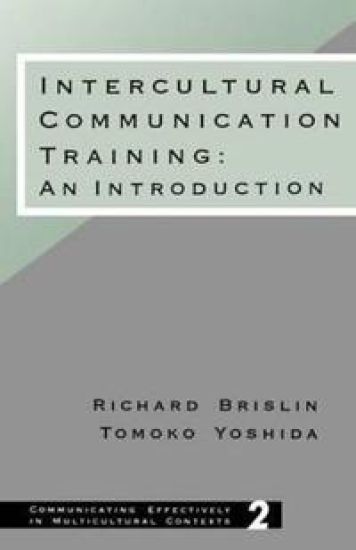
Intercultural Communication Training

Intercultural Communication Training

Richard W. Brislin; Tomoko Yoshida

SAGE Publications Inc
1994
nidottu
"The book is clearly written and includes many examples and analogies to illustrate the authors' main points. . . .The collaboration presents information useful for setting up an intercultural training program but also helpful for those attempting to ascertain the elements of a good program as well as for those interested in the general subject matter. This work will enhance the collections of libraries that support communication and business programs in particular." --The Journal of Academic Librarianship As societies become more global, acquiring an understanding of other cultures and customs becomes a necessity. It is essential to provide effective training programs whether the association is with culturally diverse people within the same city or country, other countries, or across hemispheres. The only comprehensive guidebook of its kind, Intercultural Communication Training provides an organizational framework for planning and establishing intercultural communication training programs. Drawing from intercultural communication and cross-cultural training, this guide emphasizes those aspects of training that explicitly involve face-to-face communication. The approaches this volume covers, such as assessing needs, establishing goals, and building positive attitudes, apply to any situation where good personal relations and effective communication need to be established with people from different cultural backgrounds. This guidebook is an essential tool in designing a training program for scholars, students, counselors, diplomats, social workers, business people, and anyone who needs to increase their knowledge and skills for communication across cultures.