Kirjojen hintavertailu. Mukana 12 317 433 kirjaa ja 12 kauppaa.

Kirjailija

Richard Wendorf

Kirjat ja teokset yhdessä paikassa: 8 kirjaa, julkaisuja vuosilta 1981-2026, suosituimpien joukossa The Perils of Politeness. Vertaile teosten hintoja ja tarkista saatavuus suomalaisista kirjakaupoista.

8 kirjaa

Kirjojen julkaisuhaarukka 1981-2026.

The Perils of Politeness

The Perils of Politeness

Richard Wendorf

REAKTION BOOKS
2026
sidottu
Statesman, wit, writer and arbiter of taste, the 4th Earl of Chesterfield was one of the most influential – and divisive – figures of Georgian Britain. As Lord Macaulay later observed, Chesterfield was ‘what no person in our time has been or can be, a great political leader and at the same time the acknowledged chief of the fashionable world’. This is the first full-scale biography of Chesterfield in nearly a century, drawing on previously unpublished material to reassess his political career, literary output and enduring fascination. Richard Wendorf offers a nuanced reading of Chesterfield’s celebrated letters to his son and examines his embodiment of the virtues and perils of politeness, revealing a figure whose views on sex, marriage, women and hypocrisy continue to provoke lively debate.
The Man Who Looked Too Closely

The Man Who Looked Too Closely

Richard Wendorf

The Conrad Press
2025
nidottu
'Here they go again! Abby and Desi, the amateur sleuths introduced in the pages of 'The Subtle Thief.' find themselves once again awash in the heady waters of New York City's art world - and once again immersed in a mystery that involves not just a dead body but also one of the greatest art thefts in American history. Their closest friends from the previous novel join them as they explore galleries, museums, conservation laboratories, and a remote house hidden in the dunes of the 'horrible Hamptons.' Was it murder or natural causes? Is it a mediocre canvas or a masterpiece in disguise? Leave it to our sparring duo to solve the puzzles and make the headlines through their amorous and investigative pursuits.
The Subtle Thief

The Subtle Thief

Richard Wendorf

The Conrad Press
2023
nidottu
‘The Subtle Thief’ is a witty, elegant, and intriguing murder mystery set in New York’s sophisticated art world. You won’t find street-wise thugs or master criminals here, but rather a heady mix of writers, curators, collectors, art dealers, and enticing sirens whose world is turned upside down when one of them is found dead in their Manhattan apartment. Enter our partners-in-detection (and in bed): Desmond Fairbrother, a handsome and wealthy connoisseur, and Abigail Higginson, a sassy novelist from Boston, who have both made their mark on New York’s literary and artistic scene. What begins as a sexy comedy of manners within Manhattan’s artistic community quickly turns in a different direction as our two sleuths piece together a series of elusive clues. Abby tells the story and Desi solves the mystery as our sparring couple entertain friends and suspects alike until the action reaches its surprising finale. ’If you like ‘Only Murders in the Building’, you’ll love this intriguing mystery tale. Catty, elegant, sophisticated goings-on in the New York art world: what’s not to like?’ Tim Newark, ‘Daily Express’ commentator ‘Artistry finds its author in the epicurean excess and luxurious prose of this murderous exposure of New York’s high life. Art, sex, and food are at the fore and everyone is a suspect.’ Jeremy Black, author of ‘The Pursuit of Poirot’.
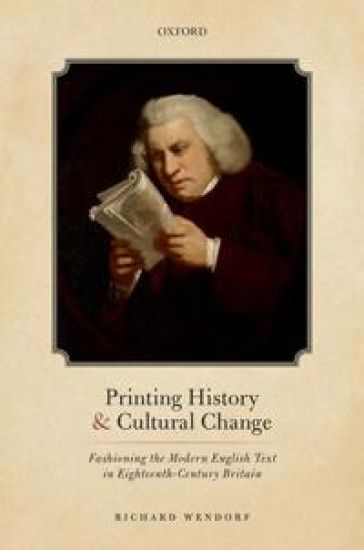
Printing History and Cultural Change

Printing History and Cultural Change

Richard Wendorf

Oxford University Press
2022
sidottu
This study provides one of the most detailed and comprehensive examinations ever devoted to a critical transformation in the material substance of the printed page; it carries out this exploration in the history of the book, moreover, by embedding these typographical changes in the context of other cultural phenomena in eighteenth-century Britain. The gradual abandonment of pervasive capitalization, italics, and caps and small caps in books printed in London, Dublin, and the American colonies between 1740 and 1780 is mapped in five-year increments which reveal that the appearance of the modern page in English began to emerge around 1765. This descriptive and analytical account focuses on poetry, classical texts, Shakespeare, contemporary plays, the novel, the Bible, the Book of Common Prayer, sermons and religious writings, newspapers, magazines, anthologies, government publications, and private correspondence; it also examines the reading public, canon formation, editorial theory and practice, and the role of typography in textual interpretation. These changes in printing conventions are then compared to other aspects of cultural change: the adoption of the Gregorian calendar in 1752, the publication of Johnson's Dictionary in 1755, the transformation of shop signs and the imposition of house numbers in London beginning in 1762, and the evolution of the English language and of English prose style. This study concludes that this fundamental shift in printing conventions was closely tied to a pervasive interest in refinement, regularity, and standardization in the second half of the century--and that it was therefore an important component in the self-conscious process of modernizing British culture.
After Sir Joshua

After Sir Joshua

Richard Wendorf

Yale University Press
2005
sidottu
Following in the methodological footsteps of his prize-winning Sir Joshua Reynolds: The Painter in Society, Richard Wendorf’s new book on British art in the eighteenth and nineteenth centuries is an experiment in cultural history, combining the analysis of specific artistic objects with an exploration of the cultural conditions in which they were created.Themes include an investigation of what happens when a painter dies, the role of writing around and within visual objects, and the nature of evidence in art history. Extended interpretations of some of the most iconic images in British art, including Constable’s Cenotaph, Raeburn’s Skating Minister, Stubbs’s Haymakers and Reapers, and Rossetti’s Prosperpine, Venus Verticordia, and Blessed Damosel, are part of a broader investigation of the ways in which we practice art history today. Published for the Paul Mellon Centre for Studies in British Art
Sir Joshua Reynolds

Sir Joshua Reynolds

Richard Wendorf

Harvard University Press
1996
sidottu
That Sir Joshua Reynolds (1723-1792) became the most fashionable painter of his time was not simply due to his artistic gifts or good fortune. The art of pleasing, Richard Wendorf contends, was as much a part of Reynolds's success--in his life and in his work--as the art of painting. The author's examination of Reynolds's life and career illuminates the nature of eighteenth-century English society in relation to the enterprise of portrait-painting. Conceived as an experiment in cultural criticism, written along the fault lines that separate (but also link) art history and literary studies, "Sir Joshua Reynolds: The Painter in Society" explores the ways in which portrait-painting is embedded in the social fabric of a given culture as well as in the social and professional transaction between the artist and his or her subject. In addition to providing a new view of Reynolds, Wendorf's book develops a thoroughly new way of interpreting portraiture. Wendorf takes us into Reynolds's studio to show us the artist deploying his considerable social and theatrical skills in staging his sittings as carefully orchestrated performances. The painter's difficult relationship with his sister Frances (also an artist and writer), his complicated maneuvering with patrons, the manner in which he set himself up as an artist and businessman, his highly politicized career as the first president of the Royal Academy of Arts: as each of these aspects of Reynolds's practice comes under Wendorf's scrutiny, a new picture of the painter emerges--more sharply defined and fully fleshed than the Reynolds of past portraits, and clearly delineating his capacity for provoking ambivalence among friends and colleagues, and among viewers and readers today.
The Elements of Life

The Elements of Life

Richard Wendorf

Clarendon Press
1992
nidottu
In this ambitious study, Richard Wendorf establishes the grounds of comparison between two arts that have often been linked in a casual way but whose historical interrelations remain almost completely unexplored. By focusing on the great age of English portraiture - from the arrival of Van Dyck to the publication of Boswell's Life of Johnson - the author shows that, despite their obvious differences, visual and verbal portraits often shared similar assumptions about the representation of historical character. Grounded in modern theory devoted to the comparison of literature and painting and to the problem of representation, this book examines each form of portraiture in terms of the other. Among those writers considered are Izaak Walton, John Evelyn, John Aubrey, Roger North, Goldsmith, Johnson, Mrs Piozzi, Boswell; among the artists are Van Dyck, Lely, Samuel Cooper, Jonathan Richardson, Hogarth and Reynolds. The careers of `double agents' (painters, like Richardson and Reynolds, who experimented with biographical writing) are also discussed. The Elements of Life is a ground-breaking critical history of biography and portrait-painting in the seventeenth and eighteenth centuries.
William Collins and Eighteenth-Century English Poetry

William Collins and Eighteenth-Century English Poetry

Richard Wendorf

University of Minnesota Press
1981
nidottu
William Collins and Eighteenth-Century English Poetry was first published in 1981. Minnesota Archive Editions uses digital technology to make long-unavailable books once again accessible, and are published unaltered from the original University of Minnesota Press editions.William Collins (1721–1759) is one of several eighteenth-century poets who have received more attention for what they are said to have anticipated—the full-blooded Romanticism of Wordsworth and Coleridge—than for what they have achieved. Collins's career as a poet was brief, but the handful of major poems that he wrote in the mid -1740s has stirred interest among critics intrigued by the complexity and obscurity of his work and by the illness and possible madness that prematurely ended his life. Combining historical scholarship with close readings of all Collins's poems, Richard Wendorf provides the most comprehensive and detailed study to be devoted to the work of this enigmatic figure and to the forces that shaped his literary career. In doing so, he places Collins within an eighteenth-century poetic context and shows that his gift for myth-making makes him a vital link between the mythic poetry of Shakespeare and Spenser and that of the Romantics.Wendorf's opening and closing chapters examine the relationship between Collins's life and his work, providing an authoritative discussion of his supposed madness and of the myths of insanity that clouded his reputation in the eighteenth and nineteenth centuries. Wendorf argues that Collins's madness is problematical at best, and that much recent criticism is a distortion of his major work, which explores the transcendent powers of the irrational forces within us but is not necessarily the product of madness itself. The book's central chapters trace Collins's development as a poet and offer fresh approaches to his major odes. In these mature poems he turned from his early interest in Augustan poetry to very different sources of inspiration and came to reject the ordered and unified natural world of Pope and Thompson.