Kirjojen hintavertailu. Mukana 12 390 323 kirjaa ja 12 kauppaa.

Kirjailija

Riki Therivel

Kirjat ja teokset yhdessä paikassa: 9 kirjaa, julkaisuja vuosilta 1992-2020, suosituimpien joukossa Strategic Environmental Assessment. Vertaile teosten hintoja ja tarkista saatavuus suomalaisista kirjakaupoista.

9 kirjaa

Kirjojen julkaisuhaarukka 1992-2020.

Environmental Policy and Impact Assessment in Japan

Environmental Policy and Impact Assessment in Japan

Brendan F. D. Barrett; Riki Therivel

Routledge
2020
nidottu
First published in 1991. Japanese attitudes to pollution and environmental protection were distinctly equivocal. The Japanese are a nature-loving people, yet they are responsible for widespread environmental destruction; Japan has some of the world’s strictest environmental quality standards, but the country also has some of the world’s most environmentally damaged areas. In this book the authors present a broad and detailed analysis of policy and process in Japan in the late twentieth century. Brendan Barrett and Riki Therivel, who both have extensive research experience in Japan, describe interest group participation in Japan’s environmental policy-making and give an historical review of the relationship between economic growth and environmental problems. They look at the framework for environmental policy-making and outline the system for environmental management. This is complemented by a discussion of Environmental Impact Assessment, and by live case studies of the practical realities of EIA in Japan. With environmental problems reaching global proportions, countries all over the world have much to learn from the experience of Japan, and the book will be extremely useful to national government officials, to local planning officers responsible for EIA, and to environmental consultants working for commercial and industrial companies. It will also be essential reading for students of geography, environmental studies, Japanese studies and planning economics.
Environmental Policy and Impact Assessment in Japan

Environmental Policy and Impact Assessment in Japan

Brendan F. D. Barrett; Riki Therivel

Routledge
2019
sidottu
First published in 1991. Japanese attitudes to pollution and environmental protection were distinctly equivocal. The Japanese are a nature-loving people, yet they are responsible for widespread environmental destruction; Japan has some of the world’s strictest environmental quality standards, but the country also has some of the world’s most environmentally damaged areas. In this book the authors present a broad and detailed analysis of policy and process in Japan in the late twentieth century. Brendan Barrett and Riki Therivel, who both have extensive research experience in Japan, describe interest group participation in Japan’s environmental policy-making and give an historical review of the relationship between economic growth and environmental problems. They look at the framework for environmental policy-making and outline the system for environmental management. This is complemented by a discussion of Environmental Impact Assessment, and by live case studies of the practical realities of EIA in Japan. With environmental problems reaching global proportions, countries all over the world have much to learn from the experience of Japan, and the book will be extremely useful to national government officials, to local planning officers responsible for EIA, and to environmental consultants working for commercial and industrial companies. It will also be essential reading for students of geography, environmental studies, Japanese studies and planning economics.
Introduction To Environmental Impact Assessment

Introduction To Environmental Impact Assessment

John Glasson; Riki Therivel

Routledge
2019
sidottu
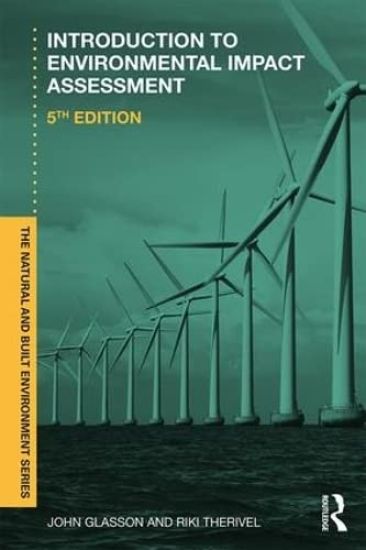
A comprehensive, clearly structured and readable overview of the subject, Introduction to Environmental Impact Assessment has established itself as the leading introduction to EIA worldwide. This fifth edition is a major update reflecting many significant changes in EIA procedures, process, practice and prospects over the last decade. In particular, it includes: a much more international dimension, drawing on EIA activities worldwide; an up-to-date coverage of the revised EU EIA Directive and its implementation; the associated update of contemporary UK procedures and practice; best practice on evolving methods in the EIA process; a rich array of UK and many international case studies; a new coverage of emerging EIA impact topics, including equality/deprivation; culture; resettlement; climate change; ecosystem services; and risk, resilience and cumulative impacts; an appraisal of some next steps in the EIA process, including a more effective and proportionate EIA; the impact of technological change; the changing interpretation of the project; project implementation, monitoring and adaptive management; and moves towards a more integrated impact assessment. Together, these topics act as a kind of action list for future EIA; the development of SEA legislation and practice in the UK, EU and worldwide; and a set of appendices containing key legislation and an EIS review framework.It is also makes full use of colour illustrations and chapter questions for discussion. Written by two authors with extensive research, training and consultancy experience of EIA, this book brings together the most up-to-date information from many sources. Introduction to Environmental Impact Assessment 5th Edition provides a complete, and critical, introductory text that also supports further studies. Students in undergraduate and postgraduate planning programmes will find it essential as a course text, as will students of environmental management/policy, environmental sciences/studies, geography and built environment. Key stakeholders involved in assessment activities – planners, developers, community groups, pressure groups and decision-makers in government and business – will also welcome this latest edition as a very effective means of getting to grips with the many facets of this important and evolving subject that affects a widening range of development projects.
Introduction To Environmental Impact Assessment

Introduction To Environmental Impact Assessment

John Glasson; Riki Therivel

Routledge
2019
nidottu
A comprehensive, clearly structured and readable overview of the subject, Introduction to Environmental Impact Assessment has established itself as the leading introduction to EIA worldwide. This fifth edition is a major update reflecting many significant changes in EIA procedures, process, practice and prospects over the last decade. In particular, it includes: a much more international dimension, drawing on EIA activities worldwide; an up-to-date coverage of the revised EU EIA Directive and its implementation; the associated update of contemporary UK procedures and practice; best practice on evolving methods in the EIA process; a rich array of UK and many international case studies; a new coverage of emerging EIA impact topics, including equality/deprivation; culture; resettlement; climate change; ecosystem services; and risk, resilience and cumulative impacts; an appraisal of some next steps in the EIA process, including a more effective and proportionate EIA; the impact of technological change; the changing interpretation of the project; project implementation, monitoring and adaptive management; and moves towards a more integrated impact assessment. Together, these topics act as a kind of action list for future EIA; the development of SEA legislation and practice in the UK, EU and worldwide; and a set of appendices containing key legislation and an EIS review framework.It is also makes full use of colour illustrations and chapter questions for discussion. Written by two authors with extensive research, training and consultancy experience of EIA, this book brings together the most up-to-date information from many sources. Introduction to Environmental Impact Assessment 5th Edition provides a complete, and critical, introductory text that also supports further studies. Students in undergraduate and postgraduate planning programmes will find it essential as a course text, as will students of environmental management/policy, environmental sciences/studies, geography and built environment. Key stakeholders involved in assessment activities – planners, developers, community groups, pressure groups and decision-makers in government and business – will also welcome this latest edition as a very effective means of getting to grips with the many facets of this important and evolving subject that affects a widening range of development projects.
The Practice of Strategic Environmental Assessment

The Practice of Strategic Environmental Assessment

Riki Therivel; Maria Rosario Paridario

Routledge
2017
sidottu
The practical application of strategic environmental assessment (SEA) is becoming increasingly common. A growing number of SEAs are being undertaken around the world, and several countries have issued guidance on how these should be carried out. However, few countries as yet have formal SEA regulations, and few completed SEAs have demonstrated all the elements of current best practice. The Practice of Strategic Environmental Assessment aims to provide a unique analysis of SEAs which have been undertaken, drawing on a variety of methods and circumstances to illustrate how best practice can be achieved, and providing inspiration for those considering studying, commission or carrying out an SEA. Part I sets the rest of the book in context, giving a review of international SEA guidance and regulations, and discussing models and methodologies. Part II then analyses a comprehensive set of case studies from countries which have extensive experience in SEA, or which provide particularly good examples. The case studies are discussed in three sections ? sectoral SEAs, SEAs of land-use plans and SEAs of policies ? and provide examples of different scales and approaches, as well as country-specific experience. The final chapter draws out some constraints to effective SEA, as well as positive themes which show how effective SEA can contribute to wider environmental assessment. Written by an international team of SEA practitioners and experts, this volume will be of particular use to students of environmental policy and management, environmental consultants, local authorities, policy-makers and anyone involved in the commissioning, process or review of SEAs.
Strategic Environmental Assessment in Action
This practical guide, written by a practitioner for practitioners, presents a coherent and straightforward 'how-to-do-it' approach to the strategic environmental assessment (SEA) process. Part one provides an overview of the aims, principles, advantages and problems of SEA as well as looking at key SEA regulations and their requirements. Part two examines the SEA process in considerable detail including setting the policy context, describing the baseline, identifying alternatives, predicting and evaluating impacts and using the SEA information in decision-making. Part three is devoted to assuring SEA quality with a discussion of resources and capacity building. This new edition incorporates five years' worth of practical application of the SEA Directive and SEA practice more broadly. Additions and updates include:the findings of various reviews into SEA effectiveness and efficiency emerging approaches to identifying and comparing alternatives, cumulative impacts, the likely future baseline without the plan, documenting changes made to the plan in response to the SEA process, and environmental limitsconsideration of both the 'baseline-led' and the 'objectives-led' approach to SEA, and the two approaches' advantages and disadvantagesSEA's links to 'appropriate assessment' of plans under the European Habitats Directive. Employing a host of real-life case studies and examples, each chapter presents a range of techniques and discusses what the final product should look like. Appendices provide a wealth of additional information including text of the SEA Directive and the UNECE Protocol on SEA, and a 'toolkit' of SEA techniques. The approach and techniques in Strategic Environmental Assessment in Action are useful for anyone carrying out or studying SEA at any level, from policy to programme, international to local, but particularly for practitioners responsible for implementing the SEA Directive.
Strategic Environmental Assessment in Action
This practical guide, written by a practitioner for practitioners, presents a coherent and straightforward 'how-to-do-it' approach to the strategic environmental assessment (SEA) process. Part one provides an overview of the aims, principles, advantages and problems of SEA as well as looking at key SEA regulations and their requirements. Part two examines the SEA process in considerable detail including setting the policy context, describing the baseline, identifying alternatives, predicting and evaluating impacts and using the SEA information in decision-making. Part three is devoted to assuring SEA quality with a discussion of resources and capacity building. This new edition incorporates five years' worth of practical application of the SEA Directive and SEA practice more broadly. Additions and updates include:the findings of various reviews into SEA effectiveness and efficiency emerging approaches to identifying and comparing alternatives, cumulative impacts, the likely future baseline without the plan, documenting changes made to the plan in response to the SEA process, and environmental limitsconsideration of both the 'baseline-led' and the 'objectives-led' approach to SEA, and the two approaches' advantages and disadvantagesSEA's links to 'appropriate assessment' of plans under the European Habitats Directive. Employing a host of real-life case studies and examples, each chapter presents a range of techniques and discusses what the final product should look like. Appendices provide a wealth of additional information including text of the SEA Directive and the UNECE Protocol on SEA, and a 'toolkit' of SEA techniques. The approach and techniques in Strategic Environmental Assessment in Action are useful for anyone carrying out or studying SEA at any level, from policy to programme, international to local, but particularly for practitioners responsible for implementing the SEA Directive.
The Practice of Strategic Environmental Assessment

The Practice of Strategic Environmental Assessment

Riki Therivel; Maria Rosario Paridario

Earthscan Ltd
1996
nidottu
The practical application of strategic environmental assessment (SEA) is becoming increasingly common. A growing number of SEAs are being undertaken around the world, and several countries have issued guidance on how these should be carried out. However, few countries as yet have formal SEA regulations, and few completed SEAs have demonstrated all the elements of current best practice. The Practice of Strategic Environmental Assessment aims to provide a unique analysis of SEAs which have been undertaken, drawing on a variety of methods and circumstances to illustrate how best practice can be achieved, and providing inspiration for those considering studying, commission or carrying out an SEA. Part I sets the rest of the book in context, giving a review of international SEA guidance and regulations, and discussing models and methodologies. Part II then analyses a comprehensive set of case studies from countries which have extensive experience in SEA, or which provide particularly good examples. The case studies are discussed in three sections ? sectoral SEAs, SEAs of land-use plans and SEAs of policies ? and provide examples of different scales and approaches, as well as country-specific experience. The final chapter draws out some constraints to effective SEA, as well as positive themes which show how effective SEA can contribute to wider environmental assessment. Written by an international team of SEA practitioners and experts, this volume will be of particular use to students of environmental policy and management, environmental consultants, local authorities, policy-makers and anyone involved in the commissioning, process or review of SEAs.
Strategic Environmental Assessment

Strategic Environmental Assessment

Riki Therivel; Elizabeth Wilson; Donna Heaney; Stewart Thompson

Earthscan Ltd
1992
nidottu
Strategic Environmental Assessment (SEA) is a new approach to environmental assessment, global in scope, which considers the environmental impacts of policies, plans and programmes. It is already in use in a number of countries and is rapidly being adopted by those involved with environmental management and regulation, including governments, official and voluntary sector agencies, academic courses and consultancies. This text defines and analyzes SEA within the overall context of environmental assessment. It introduces and reviews the current state of SEA, evaluates its application in a number of countries with a range of detailed case studies, provides a critique of its techniques and an analysis of its importance for the future.