Kirjojen hintavertailu. Mukana 12 595 353 kirjaa ja 12 kauppaa.

Kirjailija

Rita Barnard

Kirjat ja teokset yhdessä paikassa: 4 kirjaa, julkaisuja vuosilta 1995-2012, suosituimpien joukossa Apartheid and Beyond. Vertaile teosten hintoja ja tarkista saatavuus suomalaisista kirjakaupoista.

4 kirjaa

Kirjojen julkaisuhaarukka 1995-2012.

Apartheid and Beyond

Apartheid and Beyond

Rita Barnard

Oxford University Press Inc
2012
nidottu
Apartheid and Beyond offers trenchant, historically sensitive readings of writings by Coetzee, Gordimer, Fugard, Tlali, Dike, Magona, and Mda, focusing on the intimate relationship between place, subjectivity, and literary form. It also explores the way apartheid functioned in its day-to-day operations as a geographical system of control, exerting its power through such spatial mechanisms as residential segregation, bantustans, passes, and prisons. Throughout the study, Rita Barnard provides historical context by highlighting key events such as colonial occupation, the creation of black townships, migration, forced removals, the emergence of informal settlements, and the gradual integration of white cities. Apartheid and Beyond is both an innovative account of an important body of politically inflected literature and an imaginative reflection on the socio-spatial aspects of the transition from apartheid to democracy.
Apartheid and Beyond

Apartheid and Beyond

Rita Barnard

Oxford University Press Inc
2006
sidottu
Apartheid and Beyond is a major contribution to the study of South African literature, offering innovative readings of writers like Coetzee, Gordimer, Fugard, Tlali, and Mda. Focusing on the relationship between place, subjectivity, and literary form, this study enhances our understanding of apartheid as a geographical form of control and of its imagined and actual transformation.
After the Thrill Is Gone

After the Thrill Is Gone

Grant Farred; Rita Barnard

Duke University Press
2004
pokkari
After the Thrill Is Gone is a serious appraisal of what South African democracy has yielded and has failed to yield in the era following the heady expectations of liberation from apartheid’s multiple repressions. Since that time, South Africa has revealed itself as a turbulent, dynamic nation. After the release of black political prisoners in 1990 and the first national democratic election in 1994, its citizens have witnessed a massive increase in crime, unemployment, and poverty and an educational system in chaos.In a range of politically inflected essays by philosophers, community activists, political scientists, sociologists, literary scholars, and cultural and postcolonial theorists-many of whom are diasporic or resident South Africans-this special issue of SAQ provides a critical look at the realities of black majority governance, at the African National Congress, and at the costs of ANC rule to the populace. One essay draws a condemning sketch of poverty and violence in the townships and the growing communities of squatters that continue despite the emergence of democracy. A philosophical piece contemplates the practice of human rights in a South African society grappling with the memory of apartheid abuses. The fiction and poetry in the collection explore sexual identity, including issues created by the AIDS epidemic, and offer critiques of government policies. Using comic strips, another contributor demonstrates the ability of South African popular culture to satirize the nation’s political status quo. Taken together, the essays in After the Thrill Is Gone open a sobering perspective on South Africa’s recent history, its present, and its future.Contributors. Rita Barnard, Patrick Bond, Ashwin Desai, Emmanuel Chukwudi Eze, Grant Fared, Michiel Heyns, Shaun Irlam, Neil Lazarus, Michael MacDonald, Zine Magubane, Richard Pithouse, Lesego Rampolokeng, Adam Sitze
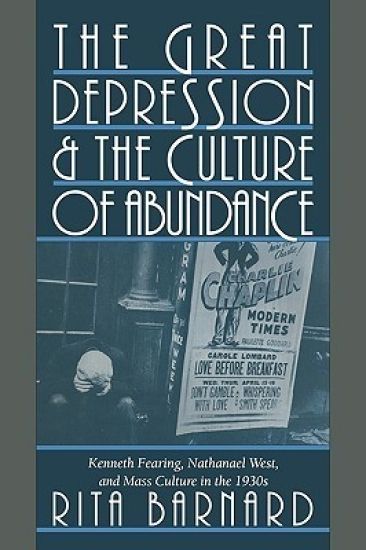
The Great Depression and the Culture of Abundance

The Great Depression and the Culture of Abundance

Rita Barnard

Cambridge University Press
1995
sidottu
Two contradictory, or apparantly contradictory, pairs of terms - depression and abundance, and literature and mass culture - make up the framework of this study in 1930s culture. Rita Barnard suggests that despite the painful national experience of scarcity and poverty, one can detect in the culture of the American thirties the now familiar outlines of an image-mediated, consumer society. She argues that the hierarchical opposition between ‘high art’ and ‘mass culture’ was powerfully contested in cultural productions of the depression era: as book clubs, radio, popular exhibitions, star conductors such as Toscanini and many other vehicles brought high culture to millions of people. In the meantime, writers with ‘serious’ literary interests borrowed from the discourse of the media in their writing. The central figures of this study emerge as pre-eminent - and in some sense prophetic - figures: their poetry and prose illuminate emergent cultural forces which have since attained new stature in our post-modern world. Despite their sharp and often prescient social critique, they are not to be mistaken for elitists, they recognised at once the deceit and the promise of our emergent culture of abundance.