Kirjojen hintavertailu. Mukana 12 595 353 kirjaa ja 12 kauppaa.
Kirjailija
Rob Johnston
Kirjat ja teokset yhdessä paikassa: 5 kirjaa, julkaisuja vuosilta 2002-2013, suosituimpien joukossa Analytic Culture in the Us Intelligence Community: an Ethnographic Study/. Vertaile teosten hintoja ja tarkista saatavuus suomalaisista kirjakaupoista.
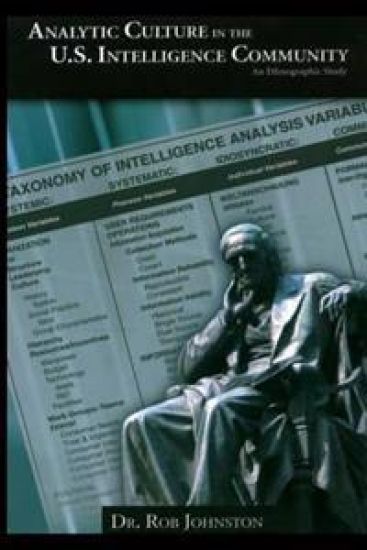
It is a rare season when the intelligence story in the news concerns intelligence analysis, not secret operations abroad. The United States is having such a season as it debates whether intelligence failed in the run-up to both September 11 and the second Iraq war, and so Rob Johnston's wonderful book is perfectly timed to provide the back-story to those headlines. The CIA's Center for the Study of Intelligence is to be commended for having the good sense to find Johnston and the courage to support his work, even though his conclusions are not what many in the world of intelligence analysis would like to hear. He reaches those conclusions through the careful procedures of an anthro-pologist-conducting literally hundreds of interviews and observing and participating in dozens of work groups in intelligence analysis-and so they cannot easily be dismissed as mere opinion, still less as the bitter mutterings of those who have lost out in the bureaucratic wars. His findings constitute not just a strong indictment of the way American intelligence performs analysis, but also, and happily, a guide for how to do better. Johnston finds no baseline standard analytic method. Instead, the most com¬mon practice is to conduct limited brainstorming on the basis of previous analy¬sis, thus producing a bias toward confirming earlier views. The validating of data is questionable-for instance, the Directorate of Operation's (DO) "clean¬ing" of spy reports doesn't permit testing of their validity-reinforcing the tendency to look for data that confirms, not refutes, prevailing hypotheses. The process is risk averse, with considerable managerial conservatism. There is much more emphasis on avoiding error than on imagining surprises. The analytic process is driven by current intelligence, especially the CIA's crown jewel analytic product, the President's Daily Brief (PDB), which might be caricatured as "CNN plus secrets." Johnston doesn't put it quite that way, but the Intelligence Community does more reporting than in-depth analysis. None of the analytic agencies knows much about the analytic techniques of the others. In all, there tends to be much more emphasis on writing and communication skills than on analytic methods. Training is driven more by the druthers of individual analysts than by any strategic view of the agencies and what they need. Most training is on-the-job. Johnston identifies the needs for analysis of at least three different types of consumers-cops, spies, and soldiers. The needs of those consumers produce at least three distinct types of intelligence-investigative or operational, stra tegic, and tactical. The research suggests the need for serious study of analytic methods across all three, guided by professional methodologists. Analysts should have many more opportunities to do fieldwork abroad. They should also move much more often across the agency "stovepipes" they now inhabit. These movements would give them a richer sense for how other agencies do analysis. Together, the analytic agencies should aim to create "communities of practice," with mentoring, analytic practice groups, and various kinds of on-line resources, including forums on methods and problem solving. These communities would be linked to a central repository of lessons learned, based on after-action post-mortems and more formal reviews of strategic intelligence products. These reviews should derive lessons for individuals and for teams and should look at roots of errors and failures. Oral and written histories would serve as other sources of wherewithal for lessons. These communities could also begin to reshape organizations, by rethinking organizational designs, developing more formal socialization programs, testing group configurations for effectiveness, and doing the same for management and leadership practices. Center for the Study of Intelligence, Central Intelligence Agency.
On Creativity, Innovation, and Renewal features the best thinking from top experts on strategic innovation, sparking creativity, and transforming organizations. Written in a concise style that is ideal for the busy executive with little spare time, the book presents a stellar roster of contributors. On Creativity, Innovation, and Renewal is one title in the Leader to Leader Guides, which draw from the most compelling articles that have appeared in Leader to Leader, the Drucker Foundation's award-winning journal.
On Leading Change features the best thinking from top experts on strategies for change, sustaining growth, and leading transition. Written in a concise style that is ideal for the busy executive with little time to read, the book highlights a stellar panel of contributors including Peter Drucker, Peter Senge, William Bridges, and Rosabeth Moss Kanter. On Leading Change is one title in The Leader to Leader Guides four-volume set that draws from the most compelling articles that have appeared in the Drucker Foundation's award-winning journal Leader to Leader.
On High-Performance Organizations features the best thinking from top experts on organizational effectiveness, sustaining growth, and strategy. Written in a concise style that is ideal for the busy executive with little spare time, the book presents a stellar roster of contributors. On High-Performance Organizations is one title in the Leader to Leader Guides, which draw from the most compelling articles that have appeared in Leader to Leader, the Drucker Foundation's award-winning journal.