Kirjojen hintavertailu. Mukana 12 390 323 kirjaa ja 12 kauppaa.

Kirjailija

Rob Vos

Kirjat ja teokset yhdessä paikassa: 6 kirjaa, julkaisuja vuosilta 1994-2013, suosituimpien joukossa Financing Human Development in Africa, Asia and the Middle East. Vertaile teosten hintoja ja tarkista saatavuus suomalaisista kirjakaupoista.

6 kirjaa

Kirjojen julkaisuhaarukka 1994-2013.

Retooling Global Development and Governance

Retooling Global Development and Governance

Manuel Montes; Rob Vos

Bloomsbury Academic
2013
nidottu
This book is available as open access through the Bloomsbury Open Access programme and is available on bloomsburycollections.com. In Retooling Global Development and Governance a team of UN experts debate new ideas about how to overcome deficiencies in the ongoing process of globalization and in the existing mechanisms for global economic governance. They do not claim to offer a blueprint, rather a set of ideas that could become the basis for a coherent "toolbox" designed to guide development policies and international cooperation. Promising directions for reform discussed in the book include: - Strengthening government capacities for formulating and implementing national development strategies - New strategies for ensuring that official development assistance is aligned with national priorities - Enhancing international trade and financial systems so that countries with limited capabilities can successfully integrate into the global economy - Creating new mechanisms for dealing with deficiencies, such as specialized multilateral frameworks through which to govern international migration and labour mobility, international financial regulation, multinational corporations and global value chains regulation and sovereign debt workouts. Above all, the book highlights the need for a strong mechanism for global economic coordination to establish coherence across all areas of global economic governance.
Financing Human Development in Africa, Asia and the Middle East

Financing Human Development in Africa, Asia and the Middle East

Marco V. Sánchez; Rob Vos

Bloomsbury Academic
2013
nidottu
This book is available as open access through the Bloomsbury Open Access programme and is available on bloomsburycollections.com. How much would poor nations need to invest to eliminate poverty, get all children in school and provide adequate basic health care for all? Can they afford it? Financing Human Development in Africa, Asia and the Middle East provides some clear answers to these questions. The contributors assess feasible financing strategies underpinning actions to enhance human development in pursuance of the United Nations’ Millennium Development Goals (MDGs). The contributors analyse these strategies in the context of broader concerns of economic development in nine countries in Africa, Asia and the Middle East. The assessments stress the importance of redesigning macroeconomic policies so as to make these more supportive of long-term economic growth and employment creation, while ensuring sufficient investments in human development in order to end poverty and overcome deep-rooted inequalities.
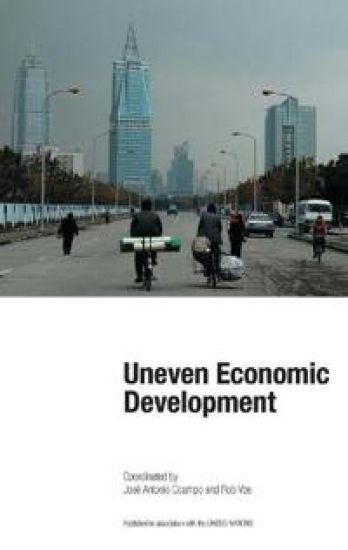
Uneven Economic Development

Uneven Economic Development

Rob Vos

Zed Books Ltd
2009
nidottu
Inequality in the world is high and rising. The problem of global uneven development is central to, and inseparable from, the international development agenda.In Uneven Economic Development, leading economists and development experts examine the causes and implications of international economic divergences. This comprehensive and timely book reviews economic growth and structural change patterns since the 1960s, before critically reviewing the respective role and impact of trade liberalization, macroeconomic policies, governance and institutions on comparative national economic performance, particularly in developing countries. With country studies included to exemplify the issues at hand, this is a definitive guide to identifying, addressing and perhaps even finding a solution to this global phenomena.
The Philippine Economy: Stray Cat of East Asia?

The Philippine Economy: Stray Cat of East Asia?

Rob Vos; Josef T. Yap

Palgrave Macmillan
1996
sidottu
The central argument of this study is that the segmented and oligopolistic financial and commodity markets, large income inequalities, and diverging accumulation behaviour of public and private sector agents are the structural and institutional features underlying the persistent macroeconomic imbalances. These factors also explain why, despite the similarity in initial economic structure and economic policies, the Philippines was systematically outperformed by many of its East Asian neighbours. Several quantitative techniques are applied including a Macroeconomic Social Accounting Framework and Computable General Equilibrium modelling. This provides an integrated and robust framework for policy analysis that is absent in other studies.
Debt and Adjustment in the World Economy
The dismal experience of many developing countries with the use of large inflows of commercial bank loans and official development assistance in the 1970s and 1980s has manifested the continuous external vulnerability of their economies. This study provides a rigorous theoretical and empirical analysis of the international aspects of development finance, Credit-rationing rules set by bank managers and donor governments, together with uncoordinated macroeconomic policies in the industrialized world, tend to create unstable and inadequate external financing conditions for the developing world. This study not only makes overly clear that a global framework is needed to assess the contribution of external financial resources for development, it provides one as well.
Debt and Adjustment in the World Economy
The dismal experience of many developing countries with the use of large inflows of commercial bank loans and official development assistance in the 1970s and 1980s has manifested the continuous external vulnerability of their economies. This study provides a rigorous theoretical and empirical analysis of the international aspects of development finance, Credit-rationing rules set by bank managers and donor governments, together with uncoordinated macroeconomic policies in the industrialized world, tend to create unstable and inadequate external financing conditions for the developing world. This study not only makes overly clear that a global framework is needed to assess the contribution of external financial resources for development, it provides one as well.