Kirjojen hintavertailu. Mukana 12 390 323 kirjaa ja 12 kauppaa.

Kirjailija

Robert A. Beauregard

Kirjat ja teokset yhdessä paikassa: 9 kirjaa, julkaisuja vuosilta 1993-2020, suosituimpien joukossa Planning Matter. Vertaile teosten hintoja ja tarkista saatavuus suomalaisista kirjakaupoista.

9 kirjaa

Kirjojen julkaisuhaarukka 1993-2020.

Advanced Introduction to Planning Theory

Advanced Introduction to Planning Theory

Robert A. Beauregard

Edward Elgar Publishing Ltd
2020
nidottu
Elgar Advanced Introductions are stimulating and thoughtful introductions to major fields in the social sciences and law, expertly written by the world's leading scholars. Designed to be accessible yet rigorous, they offer concise and lucid surveys of the substantive and policy issues associated with discrete subject areas. In this original approach to the world of planning theory, Robert A. Beauregard cuts across the many different ways to think about planning by organizing them around four core tasks: knowing, engaging, prescribing, and executing. In doing so, Beauregard explores how a basic concern with the relationship between knowledge and action has evolved into a complex discussion of democracy, inclusion, and justice. Key features include:a cross-national approach to the topica unique overview of key concepts centred on the profession of urban and regional planningcoverage of historical planning theory as well as recent developments in the fieldan accessible writing style suitable for both those studying urban and regional planning, as well as practicing planners.
Advanced Introduction to Planning Theory

Advanced Introduction to Planning Theory

Robert A. Beauregard

Edward Elgar Publishing Ltd
2020
sidottu
Elgar Advanced Introductions are stimulating and thoughtful introductions to major fields in the social sciences and law, expertly written by the world's leading scholars. Designed to be accessible yet rigorous, they offer concise and lucid surveys of the substantive and policy issues associated with discrete subject areas. In this original approach to the world of planning theory, Robert A. Beauregard cuts across the many different ways to think about planning by organizing them around four core tasks: knowing, engaging, prescribing, and executing. In doing so, Beauregard explores how a basic concern with the relationship between knowledge and action has evolved into a complex discussion of democracy, inclusion, and justice. Key features include:a cross-national approach to the topica unique overview of key concepts centred on the profession of urban and regional planningcoverage of historical planning theory as well as recent developments in the fieldan accessible writing style suitable for both those studying urban and regional planning, as well as practicing planners.
Cities in the Urban Age

Cities in the Urban Age

Robert A. Beauregard

University of Chicago Press
2018
pokkari
We live in a self-proclaimed Urban Age, where we celebrate the city as the source of economic prosperity, a nurturer of social and cultural diversity, and a place primed for democracy. We proclaim the city as the fertile ground from which progress will arise. Without cities, we tell ourselves, human civilization would falter and decay. In Cities in the Urban Age, Robert A. Beauregard argues that this line of thinking is not only hyperbolic—it is too celebratory by half. For Beauregard, the city is a cauldron for four haunting contradictions. First, cities are equally defined by both their wealth and their poverty. Second, cities are simultaneously environmentally destructive and yet promise sustainability. Third, cities encourage rule by political machines and oligarchies, even as they are essentially democratic and at least nominally open to all. And fourth, city life promotes tolerance among disparate groups, even as the friction among them often erupts into violence. Beauregard offers no simple solutions or proposed remedies for these contradictions; indeed, he doesn’t necessarily hold that they need to be resolved, since they are generative of city life. Without these four tensions, cities wouldn’t be cities. Rather, Beauregard argues that only by recognizing these ambiguities and contradictions can we even begin to understand our moral obligations, as well as the clearest paths toward equality, justice, and peace in urban settings.
Planning Matter

Planning Matter

Robert A. Beauregard

University of Chicago Press
2015
sidottu
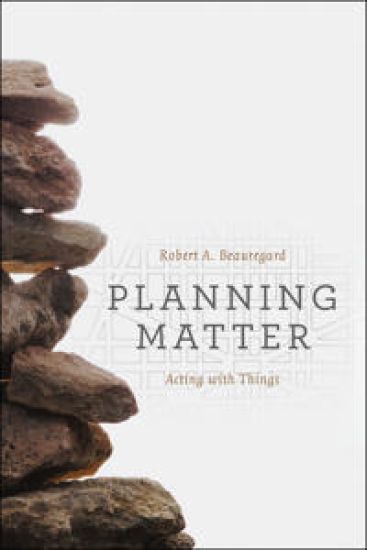
City and regional planners talk constantly about the things of the world-from highway interchanges and retention ponds to zoning documents and conference rooms-yet most seem to have a poor understanding of the materiality of the world in which they're immersed. Too often planners treat built forms, weather patterns, plants, animals, or regulatory technologies as passively awaiting commands rather than actively involved in the workings of cities and regions. In the ambitious and provocative Planning Matter, Robert A. Beauregard sets out to offer a new materialist perspective on planning practice that reveals the many ways in which the nonhuman things of the world mediate what planners say and do. Drawing on actor-network theory and science and technology studies, Beauregard lays out a framework that acknowledges the inevitable insufficiency of our representations of reality while also engaging more holistically with the world in all of its diversity-including human and nonhuman actors alike.
Planning Matter

Planning Matter

Robert A. Beauregard

University of Chicago Press
2015
nidottu
City and regional planners talk constantly about the things of the world-from highway interchanges and retention ponds to zoning documents and conference rooms-yet most seem to have a poor understanding of the materiality of the world in which they're immersed. Too often planners treat built forms, weather patterns, plants, animals, or regulatory technologies as passively awaiting commands rather than actively involved in the workings of cities and regions. In the ambitious and provocative Planning Matter, Robert A. Beauregard sets out to offer a new materialist perspective on planning practice that reveals the many ways in which the nonhuman things of the world mediate what planners say and do. Drawing on actor-network theory and science and technology studies, Beauregard lays out a framework that acknowledges the inevitable insufficiency of our representations of reality while also engaging more holistically with the world in all of its diversity-including human and nonhuman actors alike.
When America Became Suburban

When America Became Suburban

Robert A. Beauregard

University of Minnesota Press
2006
nidottu
In the decades after World War II, the United States became the most prosperous nation in the world and a superpower whose dominance was symbolized by the American suburbs. Spurred by the decline of its industrial cities and by mass suburbanization, people imagined a new national identity—one that emphasized consumerism, social mobility, and a suburban lifestyle. The urbanity of the city was lost. In When America Became Suburban, Robert A. Beauregard examines this historic intersection of urban decline, mass suburbanization, domestic prosperity, and U.S. global aspirations as it unfolded from 1945 to the mid-1970s. Suburban expansion and the subsequent emergence of sprawling Sunbelt cities transformed every aspect of American society. Assessing the global implications of America's suburban way of life as evidence of the superiority of capitalist democracy, Beauregard traces how the suburban ideology enabled America to distinguish itself from both the Communist bloc and Western Europe, thereby deepening its claim of exceptionalism on the world-historical stage.Placing the decline of America's industrial cities and the rise of vast suburban housing and retail spaces into a cultural, political, and global context, Beauregard illuminates how these phenomena contributed to a changing notion of America's identity at home and abroad. When America Became Suburban brings to light the profound implications of de-urbanization: from the siphoning of investments from the cities and the effect on the quality of life for those left behind to a profound shift in national identity.Robert A. Beauregard is a professor in the Graduate School of Architecture, Planning, and Preservation at Columbia University. He is the author of Voices of Decline: The Postwar Fate of U.S. Cities and editor of Economic Restructuring and Political Response and Atop the Urban Hierarchy.
Voices of Decline

Voices of Decline

Robert A. Beauregard

Routledge
2002
sidottu
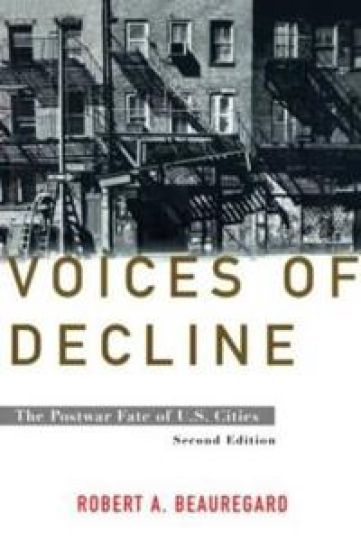
[FOR HISTORY CATALOGS]Drawing on the pronouncements of public commentators, this book portrays the 20th century history of U.S. cities, focusing specifically on how commentators crafted a discourse of urban decline and prosperity peculiar to the post-World War II era. The efforts of these commentators spoke to the foundational ambivalence Americans have toward their cities and, in turn, shaped the choices Americans made as they created and negotiated the country's changing urban landscape. [FOR GEOG/URBAN CATALOGS]Freely crossing disciplinary boundaries, this book uses the words of those who witnessed the cities' distress to portray the postwar discourse on urban decline in the United States. Up-dated and substantially re-written in stronger historical terms, this new edition explores how public debates about the fate of cities drew from and contributed to the choices made by households, investors, and governments as they created and negotiated America's changing urban landscape.
Voices of Decline

Voices of Decline

Robert A. Beauregard

Routledge
2002
nidottu
[FOR HISTORY CATALOGS]Drawing on the pronouncements of public commentators, this book portrays the 20th century history of U.S. cities, focusing specifically on how commentators crafted a discourse of urban decline and prosperity peculiar to the post-World War II era. The efforts of these commentators spoke to the foundational ambivalence Americans have toward their cities and, in turn, shaped the choices Americans made as they created and negotiated the country's changing urban landscape. [FOR GEOG/URBAN CATALOGS]Freely crossing disciplinary boundaries, this book uses the words of those who witnessed the cities' distress to portray the postwar discourse on urban decline in the United States. Up-dated and substantially re-written in stronger historical terms, this new edition explores how public debates about the fate of cities drew from and contributed to the choices made by households, investors, and governments as they created and negotiated America's changing urban landscape.
Voices of Decline

Voices of Decline

Robert A. Beauregard

Blackwell Publishers
1993
nidottu
As World War II faded into the past, urban decline emerged as the dominant motif in the public debate over the fate of the once-mighty cities of many Western industrial nations. Freely crossing disciplinary boundaries, this book uses the words of those who witnessed the cities' distress to portray the postwar discourse on urban decline in the United States. That discourse reshaped the ambivalence Americans have towards their cities, probed the nature of their moral responsibilities, offered advice as to how they should respond, and most importantly, sited in the cities the contradictions of society.