Kirjojen hintavertailu. Mukana 12 595 353 kirjaa ja 12 kauppaa.

Kirjailija

Robert A. Kagan

Kirjat ja teokset yhdessä paikassa: 5 kirjaa, julkaisuja vuosilta 2001-2019, suosituimpien joukossa Law and Society in Transition. Vertaile teosten hintoja ja tarkista saatavuus suomalaisista kirjakaupoista.

5 kirjaa

Kirjojen julkaisuhaarukka 2001-2019.

Adversarial Legalism

Adversarial Legalism

Robert A. Kagan

Harvard University Press
2019
nidottu
In the first edition of this groundbreaking book, Robert Kagan explained why America is much more adversarial—likely to rely on legal threats and lawsuits—than other economically advanced countries, with more prescriptive laws, more costly adjudications, and more severe penalties. This updated edition also addresses the rise of the conservative legal movement and anti-statism in the Republican party, which have put in sharp relief the virtues of adversarial legalism in its ability to empower citizens, lawyers, and judges to mount challenges to the arbitrary or unlawful exercise of government authority.“This is a wonderful piece of work, richly detailed and beautifully written. It is the best, sanest, and most comprehensive evaluation and critique of the American way of law that I have seen. Every serious scholar concerned with justice and efficiency, and every policymaker who is serious about improving the American legal order, should read this trenchant and exciting book.”—Lawrence Friedman, Stanford University“A tour de force. It is an elegantly written, consistently insightful analysis and critique of the American emphasis on litigation and punitive sanctions in the policy and administrative process.”—Charles R. Epp, Law and Society Review

Law and Society in Transition

Law and Society in Transition

Philippe Nonet; Philip Selznick; Robert A. Kagan

Routledge
2017
sidottu
Year by year, law seems to penetrate ever larger realms of social, political, and economic life, generating both praise and blame. Nonet and Selznick's Law and Society in Transition explains in accessible language the primary forms of law as a social, political, and normative phenomenon. They illustrate with great clarity the fundamental difference between repressive law, riddled with raw conflict and the accommodation of special interests, and responsive law, the reasoned effort to realize an ideal of polity. To make jurisprudence relevant, legal, political, and social theory must be reintegrated. As a step in this direction, Nonet and Selznick attempt to recast jurisprudential issues in a social science perspective. They construct a valuable framework for analyzing and assessing the worth of alternative modes of legal ordering. The volume's most enduring contribution is the authors' typology-repressive, autonomous, and responsive law. This typology of law is original and especially useful because it incorporates both political and jurisprudential aspects of law and speaks directly to contemporary struggles over the proper place of law in democratic governance. In his new introduction, Robert A. Kagan recasts this classic text for the contemporary world. He sees a world of responsive law in which legal institutions-courts, regulatory agencies, alternative dispute resolution bodies, police departments-are periodically studied and redesigned to improve their ability to fulfill public expectations. Schools, business corporations, and governmental bureaucracies are more fully pervaded by legal values. Law and Society in Transition describes ways in which law changes and develops. It is an inspiring vision of a politically responsive form of governance, of special interest to those in sociology, law, philosophy, and politics.
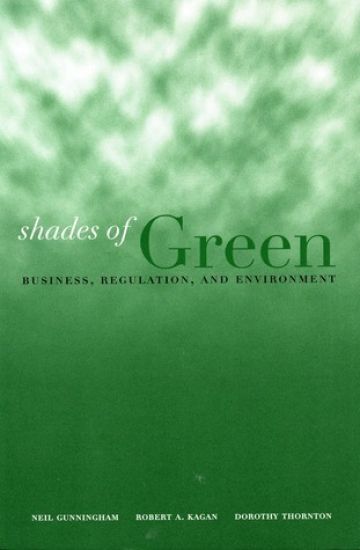
Shades of Green

Shades of Green

Robert A. Kagan; Neil Gunningham; Dorothy Thornton

Stanford University Press
2003
pokkari
How much does regulation matter in shaping corporate behavior? This pathbreaking, in-depth study of fourteen pulp manufacturing mills in the United States, Canada, Australia, and New Zealand reveals that steadily tightening regulatory standards have been crucial for raising environmental performance. But while all firms have shown improvement, some have improved more than others, many going substantially beyond compliance. What explains the variation in compliance? It's not necessarily the differences in regulation in each country. Rather, variation is accounted for by the complex interaction between tightening regulations and a social license to operate (especially pressures from community and environmental activists), economic constraints, and differences in corporate environmental management style. Shades of Green provides the most extensive and systematic empirical study to date of why firms achieve the levels of environmental performance that they do.
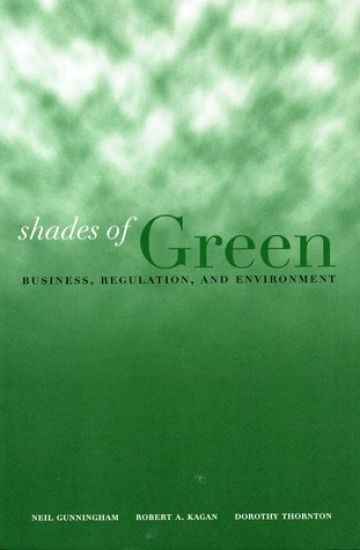
Shades of Green

Shades of Green

Robert A. Kagan; Neil Gunningham; Dorothy Thornton

Stanford University Press
2003
sidottu
How much does regulation matter in shaping corporate behavior? This pathbreaking, in-depth study of fourteen pulp manufacturing mills in the United States, Canada, Australia, and New Zealand reveals that steadily tightening regulatory standards have been crucial for raising environmental performance. But while all firms have shown improvement, some have improved more than others, many going substantially beyond compliance. What explains the variation in compliance? It's not necessarily the differences in regulation in each country. Rather, variation is accounted for by the complex interaction between tightening regulations and a social license to operate (especially pressures from community and environmental activists), economic constraints, and differences in corporate environmental management style. Shades of Green provides the most extensive and systematic empirical study to date of why firms achieve the levels of environmental performance that they do.
Law and Society in Transition

Law and Society in Transition

Philippe Nonet; Philip Selznick; Robert A. Kagan

Transaction Publishers
2001
nidottu
Year by year, law seems to penetrate ever larger realms of social, political, and economic life, generating both praise and blame. Nonet and Selznick's Law and Society in Transition explains in accessible language the primary forms of law as a social, political, and normative phenomenon. They illustrate with great clarity the fundamental difference between repressive law, riddled with raw conflict and the accommodation of special interests, and responsive law, the reasoned effort to realize an ideal of polity. To make jurisprudence relevant, legal, political, and social theory must be reintegrated. As a step in this direction, Nonet and Selznick attempt to recast jurisprudential issues in a social science perspective. They construct a valuable framework for analyzing and assessing the worth of alternative modes of legal ordering. The volume's most enduring contribution is the authors' typology-repressive, autonomous, and responsive law. This typology of law is original and especially useful because it incorporates both political and jurisprudential aspects of law and speaks directly to contemporary struggles over the proper place of law in democratic governance. In his new introduction, Robert A. Kagan recasts this classic text for the contemporary world. He sees a world of responsive law in which legal institutions-courts, regulatory agencies, alternative dispute resolution bodies, police departments-are periodically studied and redesigned to improve their ability to fulfill public expectations. Schools, business corporations, and governmental bureaucracies are more fully pervaded by legal values. Law and Society in Transition describes ways in which law changes and develops. It is an inspiring vision of a politically responsive form of governance, of special interest to those in sociology, law, philosophy, and politics.