Kirjojen hintavertailu. Mukana 12 390 323 kirjaa ja 12 kauppaa.

Kirjailija

Robert A. Stebbins

Kirjat ja teokset yhdessä paikassa: 30 kirjaa, julkaisuja vuosilta 1990-2025, suosituimpien joukossa Why We Love to Tour. Vertaile teosten hintoja ja tarkista saatavuus suomalaisista kirjakaupoista.

30 kirjaa

Kirjojen julkaisuhaarukka 1990-2025.

Serious Leisure and Individuality

Serious Leisure and Individuality

Elie Cohen-Gewerc; Robert A. Stebbins

McGill-Queen's University Press
2013
sidottu
What does it mean to be an individual and how can an individual exist within society? Serious Leisure and Individuality examines the circumstances in the modern world that make for individual distinctiveness, and the role of these conditions in personal and social life. "The individual," said Friedrich Nietzsche, "has always had to struggle to keep from being overwhelmed by the tribe. If you try it, you will be lonely often, and sometimes frightened. But no price is too high to pay for the privilege of owning yourself." Elie Cohen-Gewerc and Robert Stebbins explore the road to finding that privilege. They approach individuality by examining its relationship to freedom and being free, and by defining and elaborating on the concept of leisure space. They also look at individuality's place in community, citizenship, and globalization. The complex relationship between individuality and alienation is put under the microscope to highlight the negative side of being distinctive, which has adverse consequences for the individual and society. There are many studies on the modern individual that centre almost entirely on the person facing his local community and broader society. What is missing in the literature - and what Serious Leisure and Individuality provides - is a broad, comprehensive examination of individuality, particularly as it is rooted in leisure and the leisure-like areas of work.
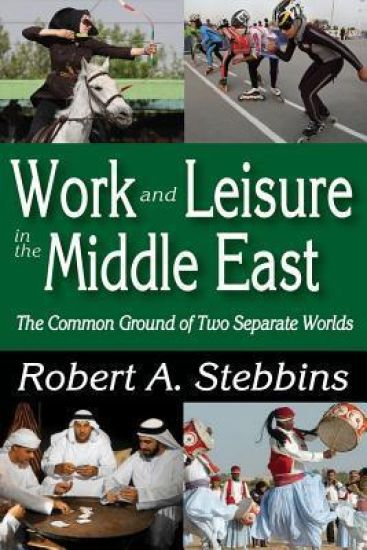
Work and Leisure in the Middle East

Work and Leisure in the Middle East

Robert A. Stebbins

AldineTransaction
2013
sidottu
Community involvement and leisure are rarely mentioned in mass media coverage of the Middle East and North Africa.Yet leisure and community involvement form a part of life in the region, and are becoming increasingly significant as modernization becomes pervasive. This work seeks to examine how the interconnection of work and leisure operates in a culture far removed from North American or European traditions.Robert A. Stebbins argues that the Middle East is a region in the throes of a developmental crisis, one of cultural underdevelopment. He indicates that while leisure and community involvement may be labeled as largely trivial activities, they in fact involve a nexus that crosses with the labor process. Discussing activities as diverse as theater and falconry, rotary clubs and brutal leisure—such as acts of terrorism and revolutionary violence—Stebbins offers a variety sufficient enough to confirm that cultural development through leisure, work, and community involvement has been possible.To provide the background for this argument, Stebbins explains what community involvement is, how it fosters cultural development, and offers a look at contemporary leisure and work in a changing economic climate. This is a unique look both at community involvement in the Middle East and how it has affected the cultural, political, and religious crisis. The book concludes by proposing that a new view of work and leisure may serve to override social divisions and traditional impediments to cultural development.
The Committed Reader

The Committed Reader

Robert A. Stebbins

Scarecrow Press
2012
nidottu
Committed utilitarian reading is either dominantly practical or more or less equally practical and fulfilling. Pleasurable reading is conceptualized as an important kind of casual leisure, experienced primarily as relaxation, active entertainment, and sexual stimulation (racy, pornographic stories). Such reading can also be a launching pad for day-dreams or lively conversation. Self-fulfilling reading is explored in a disquisition on the liberal arts hobbies. This is no place for speed reading, but instead is where we care to pause often to appreciate the artistry of the writing, creativity of the plot, profundity of the message (i.e., the information it contains), and the like. And in fulfilling reading we sometimes want to analyze the material. This book explores three main motives for reading identified as utilitarian, pleasurable, and fulfilling. Its principal object is to deepen our understanding of why some adults (and eager late adolescent readers) go in for “committed reading,” or reading that, as we strive to acquire literary knowledge and experience, necessarily consumes considerable time and requires continuous concentration. The conceptual frameworks guiding this endeavor are library and information science and the serious leisure perspective. Through their lenses the author examines the reading of books, magazines, manuals, reports, and other lengthy material as carried out in the three domains of life: work, leisure, and non-work obligation. In brief, committed reading provides its enthusiasts with knowledge and experience, which among other ways, are sought, acquired, interpreted, organized, and sometimes disseminated within the three domains. This book also examines committed reading in daily life, its ease, convenience, affordability, and enduring effects. There follows a portrait of the various reading environments, including music to read by, reading at airports and on airplanes, reading in one’s study, in a park, on public transit, in public libraries, and elsewhere. This is part of the reader’s social world, which is further comprised of book clubs, bookstores, Amazon.com, censorship, author public readings, and more.
The Idea of Leisure

The Idea of Leisure

Robert A. Stebbins

AldineTransaction
2012
sidottu
A range of thinkers in philosophy, religion, and the social sciences have argued that thanks to science, technology, and the organization of society, the human condition has improved and will continue to do so. People are becoming progressively happier and enjoying an ever-improving quality of life, they say, mostly because they are putting their skills and reason to work. The Idea of Leisure is based on the assumption that leisure also fits into the social order, and it provides a singular vector by which to measure progress, even though it is rarely mentioned in writings about the idea of progress.Robert A. Stebbins believes that leisure fosters positive development in both the individual and community. Progress through free-time activity may sometimes be hard to grasp because of the all-too-common manifestations of deviant behavior from schoolyard bullying to date rape. Despite these examples, the vast majority of leisure activities often have profound, positive consequences for participants and society. Stebbins makes a solid case for linking leisure with progress.Although leisure has huge importance for humanity, observations about the idea of leisure as part of the idea of progress have been sporadic. It is no accident that the World Leisure Organization promotes the motto: "Leisure: integral to social, cultural, and economic development." Nor is it an accident that Article 24 of the United Nations Universal Declaration of Human Rights declares that: "Everyone has the right to rest and leisure, including reasonable limitation of working hours and periodic holidays with pay." For whole nations to find satisfaction and self-fulfillment based on leisure would be a true sign of progress. Stebbins' book offers original insight into this basic human requirement.
A Dictionary of Nonprofit Terms and Concepts

A Dictionary of Nonprofit Terms and Concepts

David Horton Smith; Robert A. Stebbins; Michael A. Dover

Indiana University Press
2006
sidottu
This reference work defines more than 1,200 terms and concepts that have been found useful in past research and theory on the nonprofit sector. The entries reflect the importance of associations, citizen participation, philanthropy, voluntary action, nonprofit management, volunteer administration, leisure, and political activities of nonprofits. They also reflect a concern for the wider range of useful general concepts in theory and research that bear on the nonprofit sector and its manifestations in the United States and elsewhere. This dictionary supplies some of the necessary foundational work on the road toward a general theory of the nonprofit sector.
Between Work and Leisure

Between Work and Leisure

Robert A. Stebbins

Transaction Publishers
2004
sidottu
Occupational devotion, as defined by Robert A. Stebbins, is a strong and positive attachment to a form of self-enhancing work, where the sense of achievement is high and the core activity, or set of tasks, is endowed with such intense appeal that the line between work and leisure is virtually erased. This volume examines conditions that attract people to their work in this profound way, and the many exceptional values and intrinsic rewards they realize there.The author sets out by discussing people who are devoted to their occupations, and describes the kinds of occupations in which such people are found, the nature of their commitment to their work, and the kind of values they strive to realize through work. Stebbins frames occupational devotion in four broad social contexts--history, religion, work, and leisure--then considers the further subdivisions of gender, social class, and social character.The heart of the book uses research findings on leisure to develop a powerful critique of the "workaholic" model. Stebbins shows instead that deeply felt worker enthusiasm is devoid of addictive or coerced behavior. Stebbins also explores the role of money. How important is it? What happens when money becomes a major if not dominant value, as has happened, for example, in the realm of professional sports? Finally, he examines the social implications of the compatibility of work and serious leisure, using exploratory research to identify their shared motivational factors.Between Work and Leisure aims to debunk the prevailing myth that work and leisure are wholly separate and, often as not, mutually antagonistic spheres of life. Stebbins shows that a close relationship between leisure and work offers the opportunity for people to find joy in work just as they do in leisure. This volume will be of interest to those interested in work and occupations, as well as those interested in the quality of their own lives.
The Barbershop Singer

The Barbershop Singer

Robert A. Stebbins

University of Toronto Press
1996
pokkari
Barbershop singing is often dismissed by its critics as merely an enjoyable hobby. Though long popular with both its public and participants, it has been relatively neglected in the field of music studies. Robert A. Stebbins demonstrates that barbershop singing is an elaborate and complicated form of serious leisure that provides its participants with distinctive lifestyles. The Barbershop Singer is a unique case study of this significant musical genre, describing the social world of the barbershop singer and exploring its appeal for both male and female singers. Robert Stebbins traces the history of barbershop singing and compares and contrasts the worlds of jazz, classical music, and barbershop as serious leisure pursuits. Stebbins also reveals its costs and rewards, its complex organizational structures, the social marginality felt by its more dedicated participants, and the main problems facing the art today. Although barbershop singing is clearly a circumscribed social world, understanding how it works expands current knowledge of the variant forms of social participation available to citizens of the modern world. The Barbershop Singer will be of interest to sociologists as well as those involved in the world of barbershop.
The Franco-Calgarians

The Franco-Calgarians

Robert A. Stebbins

University of Toronto Press
1994
pokkari
Many of North America’s francophones live and work in large Anglophone cities, immersed in overwhelming English-speaking environments, yet they manage to keep their language and culture alive. In this study Robert A. Stebbins finds that francophone culture in Calgary flourishes primarily through leisure activities. Stebbins was a participant and an observer in Calgary’s French community between 1987 and 1992. In 1992 he conducted unstructured interviews in French with eighty-five adult respondents, focusing on their patterns of everyday personal and collective life. His book reveals that in large cities such as Calgary, francophone populations form communities through social and cultural organization rather than geographical association. In these circumstances, family, household, school, and leisure activities are key to maintaining French language and culture and promoting individual and community development. This is the first ethnographic study of the francophone community of a major Anglophone urban centre in Canada. Stebbins presents an objective but sympathetic analysis in a fluid and engaging style. His work provides a prototype for the analysis of francophone communities in Anglophone cities.
Amateurs, Professionals, and Serious Leisure

Amateurs, Professionals, and Serious Leisure

Robert A. Stebbins

McGill-Queen's University Press
1992
sidottu
Throughout this project Stebbins has built on the work of Barney Glaser and Anselm Strauss and their notion of "grounded theory." First, Stebbins extensively observed the routine activities of amateurs and professionals in each field studied. Then, as he became more familiar with the life-styles of the participants, he conducted lengthy, unstructured, face-to-face interviews with, in most cases, thirty amateur or professional respondents. Each field demanded special methods of observation, analysis, interviewing, probing, and reporting. As much as possible, however, Stebbins asked similar questions of all respondents in all fields so as to permit generalizations across these diverse fields. The result was a "substantive grounded theory" of each field studied. In Amateurs, Professionals, and Serious Leisure, Stebbins has developed a "formal grounded theory" of amateurs and professionals based on the research accumulated in all eight substantive fields. By transcending a variety of contexts, he argues, one can gain a more enduring appreciation of the elements that affect peoples' experiences in work and leisure pursuits. A thorough review of the findings across this wide range of activities, including his findings and ideas on hobbyists and career volunteers, enabled Stebbins to derive better definitions of the main concepts of the project, such as "amateur," "the public," and "serious leisure" -- as well as "professional," where he distinguishes between client-centred and public-centred professionals who, while sharing numerous ideal-typical attributes, vary as to the power and control they have over their work in a democratic society. He presents inductive conclusions about careers and the costs and rewards in the eight amateur-professional fields considered. He examines the external world of amateurs and professionals in the light of such issues as family ties, relations among amateurs and professionals and among amateurs and their employers, public images, critics and journalists, community contributions, and the question of marginality for amateurs who are caught between the work world of the professional and the casual leisure world of the majority of the population. He concludes with an exploration of the future role of serious leisure in relation to predictions of greater unemployment and increased leisure time and longevity.
The Laugh-Makers

The Laugh-Makers

Robert A. Stebbins

McGill-Queen's University Press
1990
sidottu
Stebbins begins with a history of stand-up comedy, giving vital background about the industry as it emerged and flourished in the United States and subsequently developed into a popular form of entertainment in Canada. He deals with the nature of comic performance in comedy rooms - cabarets designed specifically for stand-up comedy - and examines the career of the comic: how people become interested in comedy, how they progress as amateurs, how they survive on the road and how, sometimes, they become headliners and later writers for film and television. He also discusses the business of comedy: booking agents, comedy chains such as Yuk-Yuk's, room managers, and the comics themselves as entrepreneurs. As the first comprehensive study of a growing phenomenon, The Laugh-Makers will interest sociologists of humour and sociologists of occupations and will contribute to our understanding of Canadian popular culture.