
Kirjailija
Robert a Wilson
Kirjat ja teokset yhdessä paikassa: 53 kirjaa, julkaisuja vuosilta 1968-2026, suosituimpien joukossa DAYTRADING FÜR EINSTEIGER - Traden wie ein Profi. Vertaile teosten hintoja ja tarkista saatavuus suomalaisista kirjakaupoista.
Mukana myös kirjoitusasut: Robert A. Wilson
53 kirjaa
Kirjojen julkaisuhaarukka 1968-2026.



Genes and the Agents of Life undertakes to rethink the place of the individual in the biological sciences, drawing parallels with the cognitive and social sciences. Genes, organisms, and species are all agents of life but how are each of these conceptualized within genetics, developmental biology, evolutionary biology, and systematics? The book includes highly accessible discussions of genetic encoding, species and natural kinds, and pluralism above the levels of selection, drawing on work from across the biological sciences. The book is a companion to the author’s Boundaries of the Mind, also available from Cambridge, where the focus is the cognitive sciences. The book will appeal to a broad range of professionals and students in philosophy, biology, and the history of science.

Genes and the Agents of Life undertakes to rethink the place of the individual in the biological sciences, drawing parallels with the cognitive and social sciences. Genes, organisms, and species are all agents of life but how are each of these conceptualized within genetics, developmental biology, evolutionary biology, and systematics? The book includes highly accessible discussions of genetic encoding, species and natural kinds, and pluralism above the levels of selection, drawing on work from across the biological sciences. The book is a companion to the author’s Boundaries of the Mind, also available from Cambridge, where the focus is the cognitive sciences. The book will appeal to a broad range of professionals and students in philosophy, biology, and the history of science.
Where does the mind begin and end? Most philosophers and cognitive scientists take the view that the mind is bounded by the skull or skin of the individual. Robert Wilson, in this provocative and challenging 2004 book, provides the foundations for the view that the mind extends beyond the boundary of the individual. The approach adopted offers a unique blend of traditional philosophical analysis, cognitive science, and the history of psychology and the human sciences. A forthcoming companion volume Genes and the Agents of Life will explore the theme in the biological sciences. Written with verve and clarity, this ambitious book will appeal to a broad swathe of professionals and students in philosophy, psychology, cognitive science, and the history of the behavioural and human sciences.
Where does the mind begin and end? Most philosophers and cognitive scientists take the view that the mind is bounded by the skull or skin of the individual. Robert Wilson, in this provocative and challenging new book, provides the foundations for the view that the mind extends beyond the boundary of the individual. The approach adopted offers a unique blend of traditional philosophical analysis, cognitive science, and the history of psychology and the human sciences. A forthcoming companion volume Genes and the Agents of Life will explore the theme in the biological sciences. Written with verve and clarity, this ambitious book will appeal to a broad swathe of professionals and students in philosophy, psychology, cognitive science, and the history of the behavioural and human sciences.
This is an American story that reminds us of the possibilities our nation offers. It's the story of the son of a Russian immigrant, Ray Nasher, who was born in Boston, lived in a three-decker house, and graduated from that great democratizer, Boston Latin School. It's the story of his entrepreneurial success in Texas and his marriage to Patsy and their creation, over the course of more than forty years, of one of the greatest sculpture collections of the twentieth century. It's also the story of how that sculpture collection and the Nashers were courted by the most powerful art institutions and their directors-the National Gallery and its director, the late Carter Brown, the Guggenheim and its impresario, Thomas Krens, the Tate in London, and the Dallas Museum of Art. It's the story about how, in the end, Nasher did it his way, buying land next to the Dallas Museum and conceiving there an extraordinary sculpture center, designed by Renzo Piano, the Italian architect of unsurpassed insight into what the museum experience should be. Picasso. Matisse. Giacommetti. Moore. Brancusi. Arp. Gauguin. The giants of the twentieth century form the core of the Nasher Collection. And for Nasher, the pursuit is without end. For him the most important acquisition remains, as it does with all true collectors, the next one. This is a book about art and ambition. And, finally, the triumph of the Nashers' will to create a collection focused only on the best.

Graphs, Colourings and the Four-Colour Theorem
Robert A. Wilson
Oxford University Press
2002
sidottu
The four-colour theorem is one of the famous problems of mathematics, that frustrated generations of mathematicians from its birth in 1852 to its solution (using substantial assistance from electronic computers) in 1976. The theorem asks whether four colours are sufficient to colour all conceivable maps, in such a way that countries with a common border are coloured with different colours. The book discusses various attempts to solve this problem, and some of the mathematics which developed out of these attempts. Much of this mathematics has developed a life of its own, and forms a fascinating part of the subject now known as graph theory. The book is designed to be self-contained, and develops all the graph-theoretical tools needed as it goes along. It includes all the elementary graph theory that should be included in an introduction to the subject, before concentrating on specific topics relevant to the four-colour problem. Part I covers basic graph theory, Euler's polyhedral formula, and the first published false `proof' of the four-colour theorem. Part II ranges widely through related topics, including map-colouring on surfaces with holes, the famous theorems of Kuratowski, Vizing, and Brooks, the conjectures of Hadwiger and Hajos, and much more besides. In Part III we return to the four-colour theorem, and study in detail the methods which finally cracked the problem.

Graphs, Colourings and the Four-Colour Theorem
Robert A. Wilson
Oxford University Press
2002
nidottu
The four-colour theorem is one of the famous problems of mathematics, that frustrated generations of mathematicians from its birth in 1852 to its solution (using substantial assistance from electronic computers) in 1976. The theorem asks whether four colours are sufficient to colour all conceivable maps, in such a way that countries with a common border are coloured with different colours. The book discusses various attempts to solve this problem, and some of the mathematics which developed out of these attempts. Much of this mathematics has developed a life of its own, and forms a fascinating part of the subject now known as graph theory. The book is designed to be self-contained, and develops all the graph-theoretical tools needed as it goes along. It includes all the elementary graph theory that should be included in an introduction to the subject, before concentrating on specific topics relevant to the four-colour problem. Part I covers basic graph theory, Euler's polyhedral formula, and the first published false `proof' of the four-colour theorem. Part II ranges widely through related topics, including map-colouring on surfaces with holes, the famous theorems of Kuratowski, Vizing, and Brooks, the conjectures of Hadwiger and Hajos, and much more besides. In Part III we return to the four-colour theorem, and study in detail the methods which finally cracked the problem.
This American underground classic is a rollicking cosmic mystery featuring Albert Einstein and James Joyce as the ultimate space/time detectives. One fateful evening in a suitably dark, beer-soaked Swiss rathskeller, a wild and obscure Irishman named James Joyce would become the drinking partner of an unknown physics professor called Albert Einstein. And on that same momentous night, Sir John Babcock, a terror-stricken young Englishman, would rush through the tavern door bringing a mystery that only the two most brilliant minds of the century could solve . . . or perhaps bringing only a figment of his imagination born of the paranoia of our times. An outrageous, raunchy ride through the twists and turns of mind and space, Masks of the Illuminati runs amok with all our fondest conspiracy theories to show us the truth behind the laughter . . . and the laughter in the truth. Praise for Masks of the Illuminati "I was astonished and delighted . . . Robert Anton Wilson managed to reverse every mental polarity in me, as if I had been pulled through infinity."--Philip K. Dick " Wilson is] erudite, witty, and genuinely scary."--Publishers Weekly "A dazzling barker hawking tickets to the most thrilling tilt-a-whirls and daring loop-o-planes on the midway to a higher consciousness."--Tom Robbins "Wilson is one of the most profound, important, scientific philosophers of this century--scholarly, witty, hip, and hopeful."--Timothy Leary
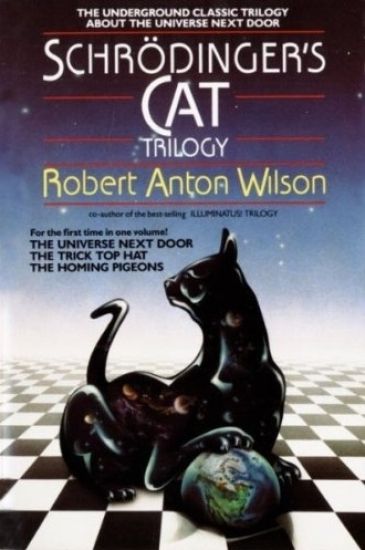
Schrodinger's Cat Trilogy: The Universe Next Door, the Trick Top Hat, & the Homing Pigeons
Robert A. Wilson
Dell
1988
nidottu
The sequel to the cult classic The Illuminatus! Trilogy, this is an epic fantasy that offers a twisted look at our modern-day world--a reality that exists in another dimension of time and space that may be closer than we think.