Kirjojen hintavertailu. Mukana 12 390 323 kirjaa ja 12 kauppaa.

Kirjailija

Robert B. Ekelund

Kirjat ja teokset yhdessä paikassa: 3 kirjaa, julkaisuja vuosilta 1997-2017, suosituimpien joukossa Sacred Trust. Vertaile teosten hintoja ja tarkista saatavuus suomalaisista kirjakaupoista.

3 kirjaa

Kirjojen julkaisuhaarukka 1997-2017.

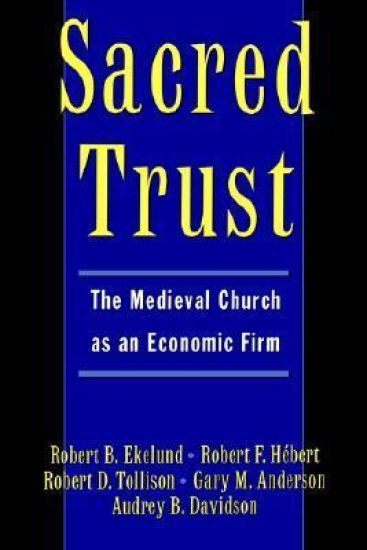
Sacred Trust

Sacred Trust

Robert B. Ekelund; Robert F. Hébert; Robert D. Tollison; Gary M. Anderson; Audrey B. Davidson

Oxford University Press Inc
1997
sidottu
The Church dominated society in the Middle Ages and functioned as a quasi-government, providing public and private goods. This book is the first to examine specific institutions in the Church in the Middle Ages in economic terms. Other books have argued generally that the Church either had a positive or negative effect on economic development. The authors of this book look more closely at the actual Church institutions and practices and describe how each functioned as a part of the larger economy of the time. They focus especially on marriage, usury, heresy, the crusades, and the monasteries. It is not their purpose to reject or impugn religious motives that may be advanced by theologians and historians. Their goal is to bring a fresh perspective to the role of institutions of the medieval Church in economic development.
The Economics of American Art

The Economics of American Art

Robert B. Ekelund; John D. Jackson; Robert D. Tollison

Oxford University Press Inc
2017
sidottu
The rapidly changing and evolving art market might appear to be chaotic to the casual observer, with new highs, potential lows, and tastes and fashions changing season to season. Economists, however, view the actions of buyers and sellers as constituting an identifiable market. They have, for some decades, studied such issues as artistic productivity and "death effects" on prices, investment returns, and on the basis of the behavior and estimated prices in auction markets. The Economics of American Art analyzes the most pervasive economic issues facing the art world, applied to the whole spectrum of American art. The book begins by looking at how a market for American art developed, how the politics of the post-war era shaped, at least in large part, the direction of American art, and how this legacy continues into contemporary art today. The book then tackles several salient, integral questions animating the American art world: Are age and "type" of artist (i.e. traditional or "innovative") related and, if so, how might they be related to productivity? Is investment in American art a remunerative endeavor compared to other investment possibilities? Do economic insights provide understanding of fakes, fraud and theft of art, particularly American art, and is it possible to prevent art crime? Is there is a boom (or a bust) in the market for contemporary American art as might be found in other markets? The ongoing evolution of American art is attended by a massive number of influences, and the economic concepts employed in this volume will complement other critical and important cultural studies of art. Both practical and accessible, The Economics of American Art will be essential for collectors, auction houses, American art experts of all kinds, museums, gallery owners and, not least, by economists with continuing scholarly interests in these matters.
Tariffs, Blockades, and Inflation

Tariffs, Blockades, and Inflation

Robert B. Ekelund; Mark Thornton

Rowman Littlefield
2004
nidottu
What role did economics play in leading the United States into the Civil War in the 1860s, and how did the war affect the economies of the North and the South? Tariffs, Blockades, and Inflation uses contemporary economic analyses such as supply and demand, modern market theory, and the economics of politics to interpret events of the Civil War. Simplifying the sometimes complex intricacies of the subject matter, Thornton and Ekelund have penned a nontechnical primer that is jargon-free and accessible. Tariffs, Blockades, and Inflation also takes a comprehensive approach to its topic. It offers a cohesive and a persuasive explanation of the how, what, and why behind the many factors at work on both sides of the contest. While most books only delve into a particular aspect of the war, this title effectively bridges the gap by offering an all-encompassing, yet relatively brief, introduction to the essential economics of the Civil War. This book starts out with a look at the reasons for the beginning of the Civil War, including explaining why the war began when it did. It then examines the economic realities in both the North and South. Also covered are the different financial strategies implemented by both the Union and the Confederacy to fund the war and the reasons behind what ultimately led to Southern defeat. Finally, the economic effect of Reconstruction is discussed, including the impact it had on the former slave population. Thornton and Ekelund have contributed an overdue examination of the Civil War that will impart to students a modern way to better comprehend the conflict. Tariffs, Blockades, and Inflation offers fresh, penetrating insights into this pivotal event in American history.